Quick Answer
Three cheeses is the right number for most charcuterie boards. One soft or fresh, one semi-firm, one aged hard. This combination covers the full range of textures, fat contents, and flavor intensities without redundancy. For 2 people, 2 cheeses works. For very large boards (12+ people), 4–5 is appropriate.
The right number of cheeses isn't only a quantity question — it's a variety question. Three cheeses chosen to cover different categories will outperform five cheeses with overlapping profiles every time. The goal is maximum variety across the fewest pieces.
The Three-Cheese Logic
The soft/semi-firm/aged structure covers three distinct dimensions simultaneously:
Texture: From spreadable (chèvre, Brie) to firm-sliceable (Manchego, Gruyère) to crumbleable or crystal-dense (Parmigiano, aged Cheddar). Guests who prefer different textures each find something.
Fat and moisture: Soft fresh cheeses have high moisture and moderate fat. Semi-firm cheeses are drier with concentrated fat. Hard aged cheeses are lowest in moisture and highest in concentrated flavor per gram. The progression across all three gives the palate variation between bites.
Flavor intensity: Soft cheeses are mild and accessible. Semi-firm cheeses have moderate complexity. Aged hard cheeses are intense, often with crystalline texture (tyrosine crystals) and concentrated umami. Moving across the progression while grazing gives each subsequent cheese something different to offer.
The Three Categories and Best Picks
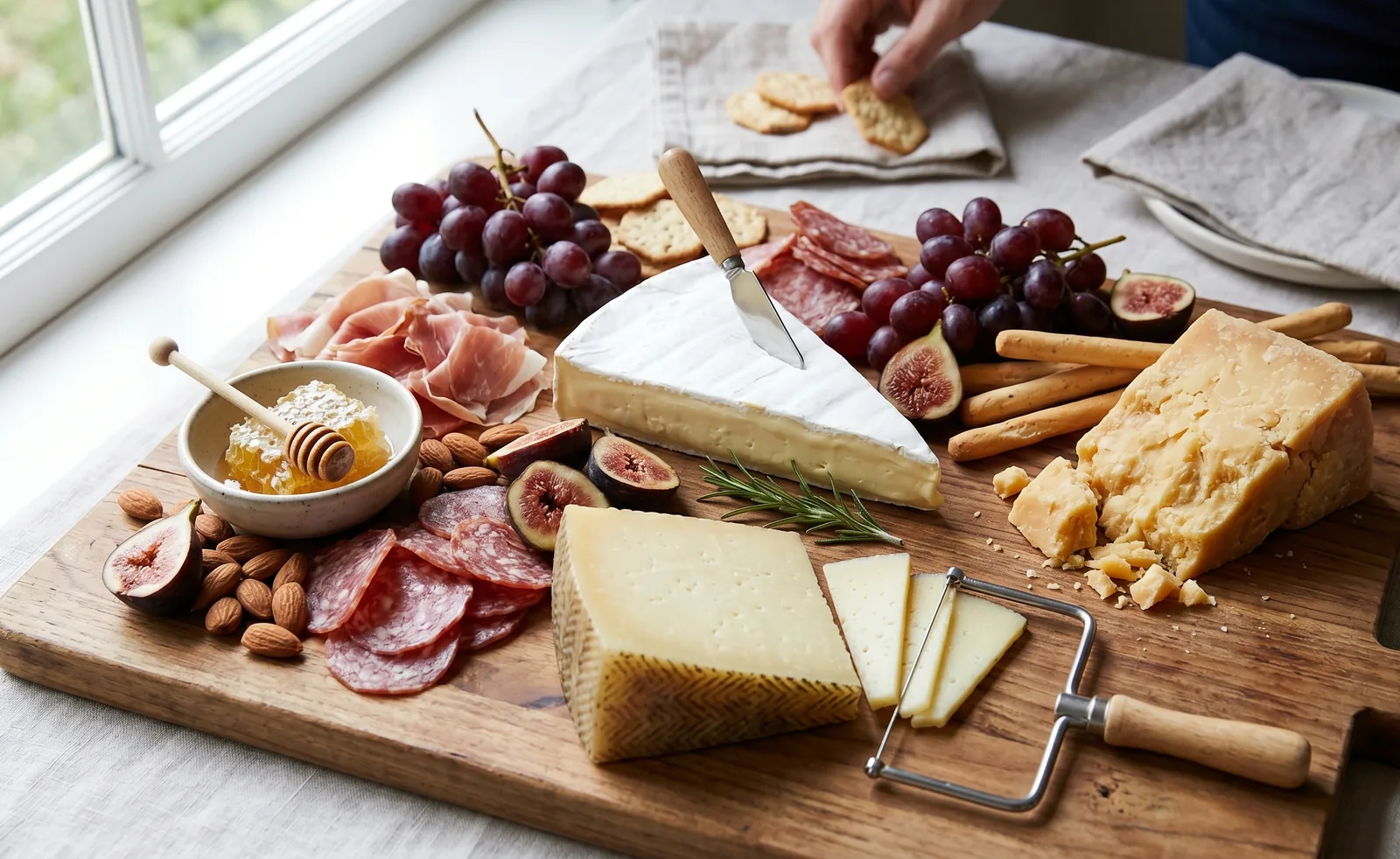
Soft/Fresh/Spreadable (1 cheese): Best picks: Brie, Camembert, fresh chèvre, burrata, ricotta, whipped cream cheese with additions. These serve as the entry point on the board — mild, approachable, works with sweet condiments.
Quantity: 3–4 oz for 4–6 people. Soft cheeses look more generous than they are because of their spreading quality — a small amount goes a long way.
Semi-Firm (1 cheese): Best picks: Gruyère, Comté (younger), Manchego (curado–semicurado), Gouda (young to medium), Fontina, Havarti. These slice cleanly, hold their shape, and represent the most universally appealing flavor range on the board.
Quantity: 3–4 oz for 4–6 people.
Aged Hard (1 cheese): Best picks: Aged Cheddar (12+ months), aged Gouda (18+ months), Parmigiano-Reggiano, Pecorino Romano, aged Manchego (viejo), Comté (18-month+). These provide the most intense flavor per bite and the most distinct visual texture (crystals, dry crumble). They're often the most memorable element for adventurous guests.
Quantity: 2–3 oz for 4–6 people. Because the flavor is concentrated, portions are naturally smaller.
When to Use 2 Cheeses
For 2 people, or for a 15-minute weeknight board where simplicity is the priority: one soft + one aged covers the essential contrast. Skip the semi-firm middle layer.
The 2-cheese board: Brie + aged Cheddar. Or chèvre + aged Comté. The contrast is still there. The variety is reduced but not missed.
When to Use 4–5 Cheeses
For 10+ people, a 4th cheese adds variety without redundancy — but only if it falls into a distinct category.
A good 4th cheese: a blue (Gorgonzola Dolce, Stilton, Roquefort) — this adds a completely new flavor category (pungent, blue-mold complexity) that none of the first three cover. Blue cheese is the logical 4th.
A 5th cheese: an unusual regional variety, or a second soft (like burrata alongside Brie, if the board is large enough to position them apart). At 5 cheeses, you're building a cheese-forward board rather than a balanced charcuterie board.
Quantity Per Cheese
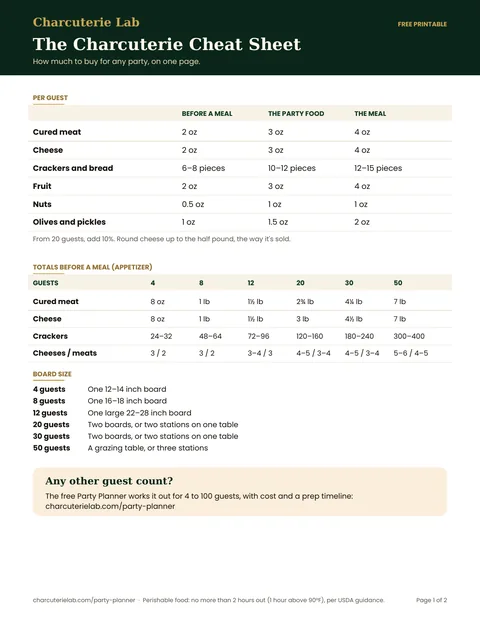
| Board size | People | Per cheese | Total cheese |
|---|---|---|---|
| Small | 2 | 2–3 oz | 4–6 oz |
| Standard | 4–6 | 3–4 oz | 9–12 oz |
| Large | 8–12 | 2–3 oz | 18–24 oz |
| Grazing | 12+ | 2–3 oz | 24–36 oz |
Note: these are per-person guidelines across all cheeses combined. Divide by the number of cheeses to get per-cheese quantities.
More board guides: charcuterielab.com Subscribe to the Charcuterie Lab Report: charcuterie-lab-report.beehiiv.com
FAQ
How many cheeses should be on a charcuterie board?
Three to four cheeses is the ideal number for most boards. This number provides sufficient variety — typically one soft, one semi-firm or aged, and one bold or distinctive — without overwhelming guests or creating competition between cheeses. Three cheeses is perfect for boards serving 4–8 people; four cheeses works well for 8–15 people or more formal gatherings.
Is two cheeses enough for a charcuterie board?
Two cheeses can work for a small board (2–4 people) or a budget-constrained board. The key is choosing cheeses with genuine contrast: one soft or mild (brie, chèvre) and one firm or bold (aged cheddar, Manchego). Two cheeses that are too similar in flavor profile will make the board feel incomplete.
Can you have too many cheeses on a charcuterie board?
Yes. More than five cheeses creates diminishing returns — guests can't engage thoughtfully with more than 4–5 options while grazing, and additional cheeses compete for attention rather than adding genuine variety. If you want to offer more cheese, run a formal cheese tasting alongside the board rather than adding more to the board itself.
What is the rule for choosing cheeses for a charcuterie board?
One cheese per register: one soft or fresh (brie, burrata, chèvre), one semi-firm or aged (cheddar, Gouda, Manchego, Gruyère), and one bold or distinctive (blue cheese, washed-rind, or extra-aged hard cheese). Each cheese should offer something the others don't. If two cheeses fill the same flavor role, replace one with something that fills a gap.
What order do you arrange cheeses on a charcuterie board?
Distribute cheeses around the board rather than clustering them together — this creates natural zones for guests to gather around and prevents crowding at one corner. Place the most visually striking cheese (a whole brie, a blue cheese with visible veining) at or near the center. Leave adequate space around each cheese for guests to cut without disturbing neighboring elements.