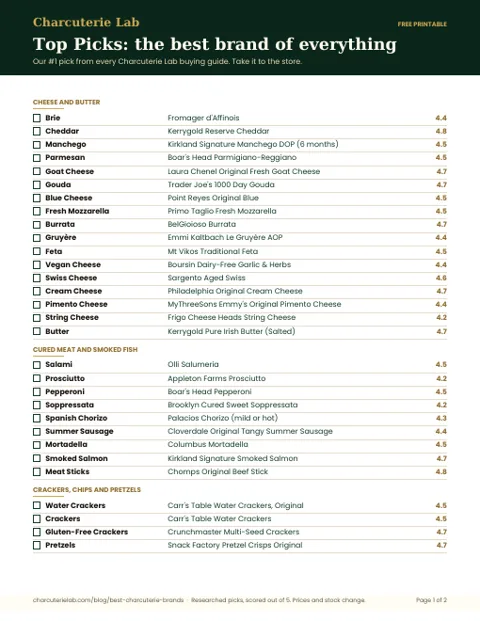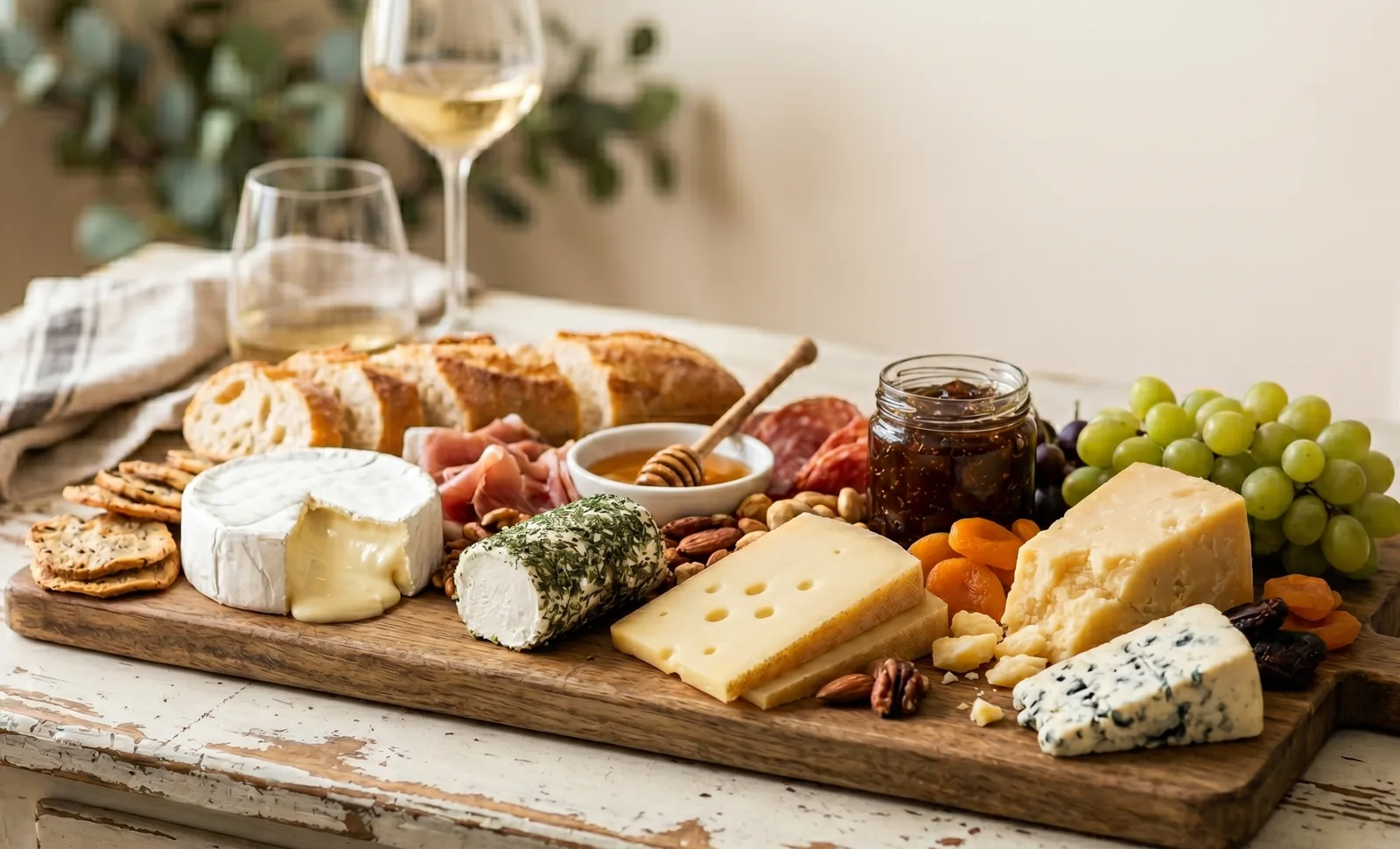
The best charcuterie board doesn't have the most expensive cheese — it has the right variety of cheese. Three or four well-chosen varieties covering different textures, flavors, and intensities gives guests options, keeps the board interesting across many bites, and provides the pairing range that makes condiments and accompaniments work.
Here's the framework and the specific cheeses worth buying for each slot.
Quick Answer: The most universally loved cheeses for charcuterie boards are aged cheddar (familiar, crowd-pleasing, widely available), brie (creamy, visually appealing, mild), and Gruyère (nutty, complex, pairs with most meats). For a complete board, pair one mild cheese with one aged or sharp cheese and one bold or distinctive cheese — the contrast between the three is what makes the board work.
The best cheeses for a charcuterie board, at a glance
| Cheese | Type | Taste | Pair it with |
|---|---|---|---|
| Brie | Soft | Buttery, mild | Fig jam, pears, walnuts |
| Camembert | Soft | Earthier than brie | Apples, baguette, cider |
| Fresh goat cheese | Soft | Bright, tangy | Honey, figs, pistachios |
| Burrata | Soft | Milky, creamy center | Prosciutto, basil, olive oil |
| Gruyère | Semi-firm | Nutty, sweet-savory | Cornichons, ham, Dijon |
| Manchego | Semi-firm | Nutty sheep's milk | Membrillo, chorizo, Marcona almonds |
| Fontina | Semi-firm | Mild, earthy, melting | Salami, mushrooms |
| Havarti | Semi-firm | Buttery, very mild | Crackers, grapes: great for kids |
| Aged cheddar | Hard | Sharp, crumbly | Apples, chutney, mustard |
| Aged Gouda | Hard | Caramel, crunchy crystals | Dark chocolate, smoked almonds |
| Parmigiano-Reggiano | Hard | Salty, savory crystals | Balsamic, pears, prosciutto |
| Comté | Hard | Brown butter, hazelnut | Walnuts, pears, saucisson |
| Pecorino Romano | Hard | Very salty, sharp | Honey, black pepper |
| Gorgonzola Dolce | Blue | Creamy, mild blue | Pears, honey, walnuts |
| Stilton | Blue | Rich, crumbly blue | Walnuts, honey, port |
| Taleggio | Washed rind | Funky rind, mild center | Speck, pears, Riesling |
Hard cheeses for charcuterie: aged cheddar, aged Gouda, Parmigiano-Reggiano, Comté, aged Manchego and Pecorino. They slice or break cleanly, hold up at room temperature for hours and pair with every cured meat.
Best Italian cheeses for charcuterie: Parmigiano-Reggiano, Gorgonzola Dolce, burrata or fresh mozzarella, Taleggio, Fontina and Pecorino. Add prosciutto, soppressata and olives, and pour a Chianti.
Not sure what goes with the cheese you bought? Look it up in the Pairing Finder.
The 4-Texture Framework
Selecting cheese by texture ensures variety in flavor, appearance, and function:
Soft Cheese (1 variety)
Soft cheese is the most approachable on the board and the first thing most guests reach for. It should be spreadable or easy to cut with a spreader, creamy, and relatively mild.
Best choices:
- Brie — the classic. A ripe brie with a creamy, flowing interior is one of the most crowd-pleasing board elements available. Look for a brie that yields to gentle finger pressure — that's ripeness.
- Camembert — similar to brie but earthier and more rustic. The rind has more pronounced mushroom notes. Good for guests who want a step beyond basic brie.
- Fresh chèvre (goat cheese) — bright, tangy, and different from the brie/camembert profile. Best for boards where you want acid contrast and a lighter fresh cheese alongside a richer soft option.
- Burrata — if you want something impressive and visual. The cream-filled interior is dramatic. Best on warm-weather or Italian-themed boards.
One tip: Don't serve cold brie. Pull it from the refrigerator 20–30 minutes before serving. Cold brie is chalky and bland; ripe brie at room temperature is flowing and extraordinary.
Semi-Firm Cheese (1 variety)
Semi-firm cheese is the most versatile slot — it slices cleanly, pairs with the widest range of meats and accompaniments, and is the least intimidating for guests who don't eat much cheese.
Best choices:
- Gruyère — fruity, nutty, slightly sweet from the propionic acid bacteria that age it. The most complex choice in this tier and the best overall.
- Young Manchego — mild, slightly buttery with a distinctive crosshatch rind. Very crowd-pleasing and visually distinctive.
- Fontina — creamy, mild, slightly nutty. Melts beautifully but also excellent at room temperature.
- Havarti — very mild and buttery; accessible for guests who are cautious about cheese. A good choice when the soft cheese slot is already occupied by a more assertive option.
Hard Cheese (1 variety)
Hard cheese is the most intensely flavored and complex option on the board. It requires the most attention from guests — it should come with context: a brief description, an adjacent condiment that pairs specifically with it, or a recommended bite combination.
Best choices:
- Aged cheddar (2+ years) — sharp, complex, tyrosine crystals throughout, pairs with everything. The most universally understood hard cheese.
- Parmigiano-Reggiano — the highest umami density of any cheese. Break it into irregular chunks that show the interior. Provide it alongside something sweet (honey, fruit) or savory (cured meat).
- Aged Gouda (1+ year) — caramel, butterscotch, nutty from Maillard reaction chemistry. Pairs beautifully with dark honey or bourbon. The most dessert-like hard cheese.
- Aged Manchego — nutty, slightly sharp, with the characteristic papery rind. The Spanish choice that pairs perfectly with quince paste.
Bold/Blue Cheese (optional, 1 variety)
Blue or otherwise bold cheese is not essential, but it provides the most flavor contrast on the board and is often the most memorable element for adventurous guests. Include it when you want a conversation piece or when guests have expressed interest in bold flavors.
Best choices:
- Gorgonzola Dolce — the most approachable blue. Creamy, mild funk, spreadable. Good entry point for guests who are skeptical of blue cheese.
- Gorgonzola Piccante — more assertive and crumbly, with pronounced blue-green veining and intense flavor. Best for experienced guests.
- Manchego + Roquefort combination — if you want Spanish regional cohesion with an assertive element.
- Stilton — the English blue with dried fruit notes; excellent next to Port wine.
Specific Combinations Worth Building
The crowd-pleasing board: Brie + young Manchego + aged cheddar. Three cheeses that cover soft/semi-firm/hard with universally accessible flavors. Foolproof.
The elevated board: Camembert + Reserve Gruyère + aged Gouda. Earthy softness, fruity nuttiness, and caramel complexity. More interesting than the crowd-pleasing version; still approachable.
The wine-board build: Fresh chèvre + Gruyère + aged Manchego. The chèvre pairs with Sauvignon Blanc, Gruyère with Pinot Noir, and Manchego with Tempranillo — three cheeses and three wine pairings built in.
The full four-tier board: Fresh chèvre + Gruyère + aged Parmigiano + Gorgonzola Dolce. Covers all four textures and ranges from fresh-tangy to umami-intense to funky. For guests who know what they like.
What to Skip
Pre-sliced deli cheese: These are processed for shelf stability, not flavor. Spend the same money on a quarter-pound cut from a cheese counter instead.
Anything labeled "cheese product" or "processed cheese": Not cheese.
Too many cheeses: Four is the practical maximum for a board that guests can engage with meaningfully. Beyond four, the board becomes overwhelming and no individual cheese gets enough attention.
Quick Cheese Selection by Board Type
| Board Type | Soft | Semi-Firm | Aged Hard | Blue |
|---|---|---|---|---|
| Classic / crowd-pleaser | Brie | Havarti or Gouda | Aged Cheddar | Skip or Gorgonzola Dolce |
| Italian-focused | Burrata | Fontina or Provolone | Parmigiano-Reggiano | Gorgonzola |
| Spanish-focused | Manchego fresco | Manchego Curado | Manchego Viejo | Skip |
| Date night (for 2) | Brie (small piece) | Comté or Manchego | — | Skip |
| Adventurous | Époisses | Aged Gruyère | Parmigiano | Roquefort |
| Budget-friendly | Camembert | Havarti | Aged Cheddar | Skip |
How Much Cheese to Buy
Per person — appetizer board (30–60 min before dinner):
- Soft cheese: about ¾ oz
- Semi-firm: about ¾ oz
- Aged hard: about ½ oz
- Blue (if using): take ¼–½ oz from the others
- Total: 2 oz per person (3 oz if the board is the party food)
Per person — meal or main event board (2+ hours, no other food):
- Total: 4 oz per person
Practical purchase guide by headcount:
| Guests | Soft cheese | Semi-firm | Aged hard |
|---|---|---|---|
| 2–4 | 3 oz | 3 oz | 2 oz |
| 6–8 | 6 oz | 6 oz | 4 oz |
| 10–12 | 9 oz | 9 oz | 6 oz |
Always buy slightly more than you need. A generous board looks better than a sparse one, and leftovers keep well wrapped in parchment (see how to store leftovers).
Temperature Rules (The Most Skipped Step)
Whatever cheeses you choose, the most important thing you can do for the flavor is pull them from the refrigerator early enough:
- Aged hard cheese: 45–60 minutes before serving
- Semi-firm cheese: 30–45 minutes
- Soft cheese (brie, camembert): 20–30 minutes
- Fresh cheese (chèvre, burrata, mozzarella): 15–20 minutes
Cold cheese mutes flavor. The aromatic compounds in Comté that make it smell like hazelnuts don't volatilize at refrigerator temperature. The silky quality of Brie requires the fat to be warm enough to flow. Temperature is the single most impactful change most people can make to their cheese experience.
Placement Logic
Place the four cheeses as anchors first — in corners or quadrants of the board. The soft cheese goes near the fruit and honey; the aged hard goes near the mustard and cornichons; the blue goes on one end with honey adjacent.
Meats, condiments, and crackers fill the space between the cheese anchors. The cheese placement determines the flow of the board.
Building more boards? The Charcuterie Lab ebook walks through 50 boards across every occasion — each one with exact quantities, a shopping list, and the science behind why it works.
FAQ
What is the best cheese for a charcuterie board?
The best charcuterie boards include three cheese types working in combination: a soft, creamy cheese (brie, camembert, or chèvre), a semi-firm or aged cheese (aged cheddar, Gruyère, or Manchego), and a bold or distinctive cheese (Gorgonzola, Stilton, or Époisses). No single cheese is "best" — the combination creates the contrast that makes a board great.
What is the most crowd-pleasing cheese for a charcuterie board?
Aged cheddar is consistently the most universally liked cheese on any board. Its familiar flavor, firm texture, and availability at all grocery stores make it the safest crowd-pleaser. Brie is the second most crowd-pleasing — mild, creamy, and visually appealing. If you're uncertain about your audience, start with these two and add one more distinctive option.
Should I serve one cheese or multiple on a charcuterie board?
Multiple cheeses — specifically three to four — create the contrast and variety that defines a charcuterie board. One cheese is a cheese plate; three or four cheeses with distinct flavor profiles (mild, aged, bold) create the complete experience. Each cheese should serve a different role on the board.
What soft cheese goes on a charcuterie board?
Brie, camembert, chèvre (fresh goat cheese), burrata, and Brillat-Savarin are all excellent soft cheese options. Each brings creaminess and a mild flavor that contrasts with sharper, harder cheeses. Serve soft cheeses at room temperature — they're bland and waxy when cold.
How much cheese do I need per person for a charcuterie board?
Plan 2 oz of cheese per person when a meal follows, 3 oz when the board is the party food, and 4 oz when it's dinner. For a board with three cheeses, divide the total evenly: if serving 6 people, buy approximately 4 oz of each cheese (12 oz total), giving each person 2 oz across three varieties.
Quick Reference
| Slot | Best Choice | Good Alternative | Skip |
|---|---|---|---|
| Soft | Brie (room temp) | Camembert, chèvre | Cold brie |
| Semi-firm | Reserve Gruyère | Young Manchego, Fontina | Generic "Swiss" |
| Hard | Aged cheddar (2yr) | Aged Gouda, Parmigiano | Pre-grated Parmesan |
| Bold (optional) | Gorgonzola Dolce | Stilton, Roquefort | Skipping this slot entirely if guests prefer mild |
Get weekly cheese science and board-building technique in the Charcuterie Lab Report newsletter.