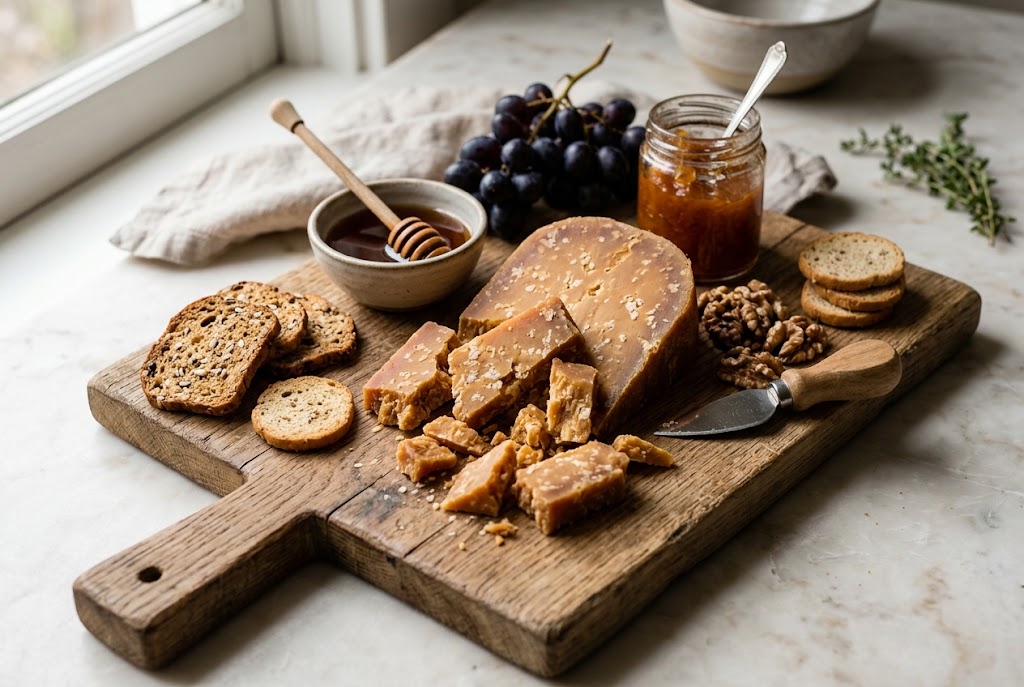
Quick Answer: Well-aged Gouda tastes of caramel and butterscotch because of slow browning reactions during aging, not added sugar. Buy the firm, amber, crystal-studded kind rather than young supermarket Gouda, break it into craggy chunks, and place it near dark honey, nuts or dried fruit, between the savory and sweet sides of the board.
Most hard cheeses develop their character through sharpness and salt. Aged Gouda does something different: it develops a genuine caramel and butterscotch sweetness, produced not by adding sugar but by specific chemical reactions that occur as the cheese ages. This makes it the most dessert-like savory cheese in the hard cheese category — and one of the most effective bridge elements between the savory and sweet sections of a charcuterie board.
If you've only ever had young or medium Gouda — the waxy orange-rind wheels common in supermarkets — you haven't had Gouda. Aged Gouda is a fundamentally different experience.
What Is Aged Gouda?
Gouda is a Dutch cow's milk cheese with origins in the city of Gouda in the Netherlands, though "Gouda" as a name is not protected globally — it describes a style of production more than a specific terroir. The defining production characteristic is washing the curd with warm water before pressing, which removes lactose (the milk sugar) from the curd. This lactose removal has major implications for how the cheese ages.
"Aged Gouda" typically refers to cheese matured for 12 months or longer, though the category extends to very old Gouda (Extra Belegen, 24+ months; Overjarig, 36+ months). Premium aged Goudas — particularly Dutch farmhouse varieties like Boeren-Leidse and brands like L'Amuse or Beemster XO — are among the finest hard cheeses in the world.
The Lab Section: Why These Pairings Work
The caramel flavor of aged Gouda is not an accident or an added ingredient — it's the result of a specific biochemical process called the Maillard reaction, operating over months and years of aging.
The lactose connection: Washing the curd during production removes most of the lactose (milk sugar) from the fresh curd. This means less lactose is available for lactic acid bacteria to ferment, which results in a less acidic, sweeter-tasting base. But it's what happens to the residual lactose that creates aged Gouda's signature character.
Maillard browning: The small amount of residual lactose reacts with free amino acids (released through proteolysis during aging) in a series of non-enzymatic browning reactions. These Maillard reactions produce a range of flavor compounds including:
- Furanones — responsible for caramel, butterscotch, and burned-sugar notes
- Pyrazines — contributing nuttiness and roasted character
- Diacetyl — buttery aroma compound (also responsible for the butter flavor in Chardonnay)
This is the same class of reactions responsible for the browning and flavor development in toasted bread, roasted coffee, and grilled meat — except in Gouda, it occurs slowly at cave temperature over months and years.
Tyrosine crystals: Like aged Parmigiano and extra-sharp cheddar, significantly aged Gouda (18 months+) develops white tyrosine crystals throughout the paste. In Gouda, these crystals tend to be larger and more densely distributed than in other cheeses, contributing a pronounced crunch. The crystals carry concentrated Maillard flavor compounds, which is why they often taste more intensely sweet and nutty than the surrounding paste.
Choosing Aged Gouda by Age
Young Gouda (4–8 weeks): Pale yellow, mild, creamy, slightly sweet. Common in supermarkets. Not a good board choice — lacks complexity and holds no structural interest. Better as a sandwich cheese.
Medium Gouda (2–6 months): Firmer, slightly more flavorful. Still fairly mild. Not ideal for a featured position on a board.
Aged Gouda (1–2 years, Belegen/Extra Belegen): This is where the character transformation happens. Deep amber color, firm to crumbly texture, crystals developing, caramel and butterscotch flavors emerging alongside nuttiness. The best all-purpose aged Gouda for a board.
Mature Gouda (2–3 years, Overjarig): Dark amber to brown interior, very firm, pronounced crystals throughout, intense caramel/toffee/butterscotch flavor with a long finish. Best as a featured element with context — a single piece eaten slowly next to dark honey or whisky is an experience.
Extra-Aged (3+ years): At this extreme, the caramel compounds develop toward something more complex and slightly savory — almost like aged soy sauce combined with butterscotch. Not for every guest, but extraordinary for those who encounter it.
Look for Dutch farmhouse versions (Boerenkaas designation) or specific quality brands (L'Amuse, Beemster, Forgotten Farms) for the best expression of these characteristics.
How to Present Aged Gouda on a Board
Breaking vs. slicing: Like Parmigiano, properly aged Gouda (2+ years) develops a crystalline structure that breaks more beautifully than it slices. A sturdy knife tip inserted and rocked produces craggy, crystalline chunks that show the amber interior and white crystals. For younger aged Gouda (1–2 years), slicing into wedges or thin pieces works well.
Color matters: The deep amber to brown color of aged Gouda is one of the most visually distinctive elements on a board. Place it where the color can be seen — adjacent to pale cheeses or light crackers for maximum contrast.
Temperature: Pull from refrigeration 30–45 minutes before serving. Aged Gouda's caramel notes are more pronounced at room temperature; cold mutes the Maillard-derived compounds.
Pairing Aged Gouda
The caramel-sweet synergy: Aged Gouda's natural caramel character creates a different dynamic with sweet pairings than most cheeses. Rather than pure salt-sweet contrast, aged Gouda + dark honey creates a caramel-on-caramel synergy — two sweet-savory elements reinforcing each other while the cheese's salt activates the honey's sweetness. It's rich, almost dessert-like.
Sweet pairings:
- Dark honey (buckwheat or chestnut) — the most intense honey matches aged Gouda's caramel depth. This is the premium pairing for very aged versions.
- Medjool dates — date's intense natural sweetness mirrors Gouda's caramel; together they create a confection-like combination.
- Dried apricots — the tartness and concentrated sweetness provide contrast to the caramel character; prevents the combination from becoming cloying.
- Apple butter or apple slices — the slight acid and freshness of apple cuts through the caramel richness and provides palate relief.
Bread and cracker pairings:
- Honey oat crackers or digestive biscuits — the mild sweetness of the cracker echoes and amplifies the Gouda's caramel character.
- Dark rye bread — the slight bitterness and earthiness of rye creates the best contrast to aged Gouda's sweetness; this is the Dutch tradition.
- Plain crackers — for a cleaner vehicle when the cheese is the focus.
Meat pairings:
- Bresaola — the lean, slightly sweet beef is a clean companion that doesn't compete with Gouda's caramel profile.
- Mild salami or Genoa — gentle savory meat that complements without dominating.
- Prosciutto — the classic delicate fat and sweetness; good but slightly redundant with Gouda's own sweetness; better with younger aged versions.
Drink pairings:
- Aged bourbon or whisky — this is the standout pairing. Bourbon and aged Gouda share nearly identical flavor compounds from their respective aging processes — caramel, butterscotch, nuttiness, vanilla. Eating aged Gouda alongside a pour of good bourbon is one of the best non-wine pairings in charcuterie.
- Pale ale or amber ale — the caramel malt notes in amber ale are harmonically compatible with Gouda's Maillard character.
- Riesling (off-dry) — the slight residual sweetness and high acidity of off-dry Riesling provides both a caramel echo and a necessary acid counterpoint.
- Tawny Port — dried fruit, caramel, and nutty notes in aged Tawny mirror aged Gouda's profile precisely.
Aged Gouda at a Glance
| Property | Description |
|---|---|
| Milk | Cow's milk (Dutch production dominant) |
| Origin | Netherlands (style, not terroir-protected globally) |
| Texture | Firm to very hard; increasingly crystalline with age |
| Flavor | Caramel, butterscotch, nutty, toffee; intensifies with age |
| Crystals | Tyrosine — large, densely distributed in older versions |
| Color | Deep amber to dark brown; darkens significantly with age |
| Best board role | Featured hard cheese; bridge between savory and sweet |
| Optimal age for boards | 1–2 years (Belegen) to 2–3 years (Overjarig) |
| Sweet pairing | Dark honey, Medjool dates, dried apricots |
| Cracker pairing | Honey oat crackers, dark rye bread |
| Meat pairing | Bresaola, mild salami |
Quick Pairing Reference
| Board Type | Aged Gouda Pairing |
|---|---|
| Dessert-forward board | 2yr+ Gouda + dark honey + Medjool dates + honey crackers |
| Whisky board | 3yr Gouda + bourbon + walnuts + dark rye |
| Classic Dutch board | Belegen Gouda + dried apricots + dark rye + mild salami |
| Wine board | Gouda + off-dry Riesling + apple slices + bresaola |
| Beer board | Gouda + amber ale + apple butter + oat crackers |
FAQ
How do I know if gouda is truly aged versus just labeled "aged"?
Look for visible tyrosine crystals — crunchy white deposits in the paste. These only form after significant aging (typically 12+ months) as amino acids precipitate out of the aging cheese. A truly aged gouda will also have a deep amber to caramel color in the paste and a hard, dry texture. "Young gouda" sold as "aged" often lacks all three of these indicators.
Can aged gouda replace parmesan on a board?
Aged gouda is a reasonable substitute for parmesan in terms of intensity, but the flavor profile differs significantly. Aged gouda is more caramel-forward and sweeter; parmesan is more umami-dense and savory. Both work as hard cheese anchors but pair differently. Aged gouda excels with sweet pairings; parmesan with acidic and umami partners.
Does aged gouda need to come to room temperature before serving?
Yes — all cheese does, but aged gouda's caramel compounds are especially temperature-sensitive. At refrigerator temperature the sweetness is muted and the texture is harder than ideal. Thirty to forty-five minutes at room temperature allows the paste to soften slightly and the full caramel and butterscotch flavor to develop.
What's the best cracker for aged gouda?
Thin, neutral crackers (water crackers, plain rice crackers) let aged gouda's complex flavor speak for itself. Seeded or whole-grain crackers complement without competing. Avoid very strongly flavored crackers (heavily herbed, spiced) that fight with the gouda's sweetness.
Putting It on the Board
Aged Gouda belongs in the hard cheese position, but positioned near the sweet section of the board rather than with the more assertive aged cheeses. Its caramel character bridges the savory and sweet zones in a way that other hard cheeses don't. Place dark honey or Medjool dates adjacent and let guests discover the synergy.
If you're doing a board with a spirits pairing, aged Gouda + bourbon is a pairing worth explicitly communicating to guests. It stops people and makes them think about what they're eating in a way that few combinations do.