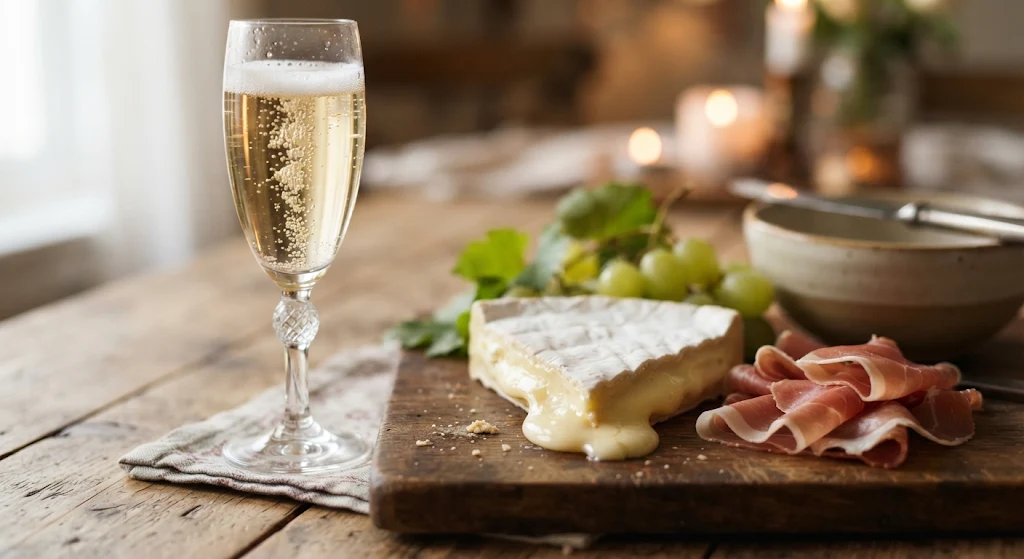
Quick Answer: Your tongue reads bubbles as acid. Carbon dioxide is turned into carbonic acid in your mouth and picked up by your sour-sensing taste cells. Add sparkling wine's high acidity and cold temperature, and every sip contrasts with the soft, coating feel of fat. That's why Champagne with brie or Prosecco with prosciutto never feels heavy.
Pairing by hand? Pairing Card Deck $5 · printable PDF
The science, in three parts
1. You taste carbonation with your sour cells
For a long time, people assumed the fizz in sparkling drinks was just bubbles popping on the tongue. In 2009, researchers at the US National Institutes of Health and UC San Diego showed it's more than that. An enzyme called carbonic anhydrase 4 sits on the surface of the sour-sensing cells in your taste buds. It turns dissolved carbon dioxide into carbonic acid, and those sour cells fire.
Carbon dioxide also triggers the nerves for touch and pain in your mouth. The prickle you feel is both signals together. The researchers noted the sensation is the same even when bubbles can't burst, so it's chemistry, not just popping.
2. Sparkling wine is one of the most acidic wines
Wines run roughly from pH 3 to 4, and the lower the number, the sharper the wine tastes. Sparkling wines are usually made in a crisp, high-acid style, and some go a bit below pH 3. Grapes for Champagne and other cool-climate sparklers are often picked early, while acidity is still high.
So a sip of sparkling wine hits your sour cells twice: once from the wine's own acid and once from the carbonation.
3. Sharp and prickly is the opposite of fat
Fat feels soft, slick and coating. Sharp, sour and astringent sensations sit on the other end of the scale. A 2012 study from the Monell Chemical Senses Center found that astringent drinks and fatty food balance each other in the mouth: with repeated sips, the drink counters the slippery feel of the fat. The researchers called them opposites, like yin and yang.
Acid also gets saliva flowing, which helps rinse your palate. The result: after a sip of sparkling wine, the next bite of triple-creme tastes as rich as the first one, not muddier.
What it isn't: bubbles don't physically scrub fat off your tongue. "Cutting through fat" describes a sensation of contrast and reset, not cleaning.
10 pairings that use it
| Rich bite | Bubbles | Why it works |
|---|---|---|
| Brie or Camembert | Brut Champagne or Cremant | Acid and fizz lift buttery, mushroomy cream |
| Triple-creme | Blanc de blancs | The richest cheese meets the sharpest wine |
| Prosciutto | Prosecco | Fruit softens salt; bubbles reset the fat |
| Parmigiano-Reggiano | Lambrusco or Prosecco | The Emilia-Romagna match: salty crystals and fizz |
| Aged Gouda | Vintage Champagne | Toasty, nutty notes on both sides |
| Comte | Cremant du Jura | Same region, same nutty depth |
| Smoked salmon and cream cheese | Brut or sparkling rose | Acid cuts oily fish and cream |
| Kettle chips or cheese crisps | Any dry sparkler | Salt and fried crunch love acid |
| Genoa salami | Cava | Dry, crisp and budget-friendly with fatty meat |
| Nduja or soppressata | Extra Dry Prosecco | A touch of sugar tames the heat |
No alcohol? Sparkling water and dry sparkling cider use the same carbonation. See our non-alcoholic pairings.
How to use it on a board
- Put bubbles beside the richest things. Brie, triple-creme, burrata and fatty salami benefit most. Lean, sharp cheeses need it least.
- Serve it cold, around 45°F. Cold makes acid taste sharper and keeps bubbles in the glass longer. A warm sparkler tastes flat and sweet.
- Match sweetness to salt and spice. Brut is dry. Extra Dry is a little sweeter, which works better with spicy salami and very salty ham.
- Watch the strongest cheeses. Very funky washed rinds and strong blues can bury a light sparkler. Give them port or a beer instead.
- One bottle serves about 2 guests at a party where it's the main drink. Plan more if it's the only drink.
Try it in two minutes
Take a bite of brie and notice how your mouth feels coated afterward. Now take a sip of something sparkling, even plain seltzer, and take a second bite. Most people find the second bite tastes cleaner and richer at the same time. That's the reset.
Sources
- NIH: Scientists discover protein receptor for carbonation taste (2009)
- Chandrashekar et al., "The Taste of Carbonation," Science (2009), Caltech record
- ScienceDaily: Why wine and tea pair so well with a meal: it's all in the mouthfeel (2012)
- WineMaker Magazine: Acidity in wine
FAQ
Why does Champagne go so well with cheese?
Sparkling wine is very acidic, and your tongue also reads carbonation through its sour-sensing cells. That sharp, prickly signal is the opposite of the soft, coating feel of fat, so each sip resets your palate and the next bite of rich cheese tastes fresh again.
Do bubbles really cut through fat?
Not by scrubbing it off your tongue. Bubbles work through sensation: carbon dioxide is turned into carbonic acid in the mouth and is felt as a sour, tingling prickle. Together with the wine's acidity and cold temperature, that contrast keeps rich food from feeling heavy.
What cheese goes best with sparkling wine?
Rich, creamy and salty cheeses: brie, Camembert, triple-cremes like Saint Andre, Parmigiano-Reggiano, aged Gouda and Comte. Very funky washed-rind or strong blue cheeses can overpower a delicate sparkling wine.
Is Prosecco or Champagne better with charcuterie?
Both work. Champagne is usually drier and more acidic, which suits rich cheese. Prosecco is fruitier and often a touch sweeter, which suits salty prosciutto and spicy salami. For a sweeter style with spicy food, look for Extra Dry rather than Brut.
Does beer work the same way?
Partly. Beer brings the same carbonation, and hops add a bitter edge that also contrasts with fat. A crisp lager or saison with cheddar or salami works on the same principle.