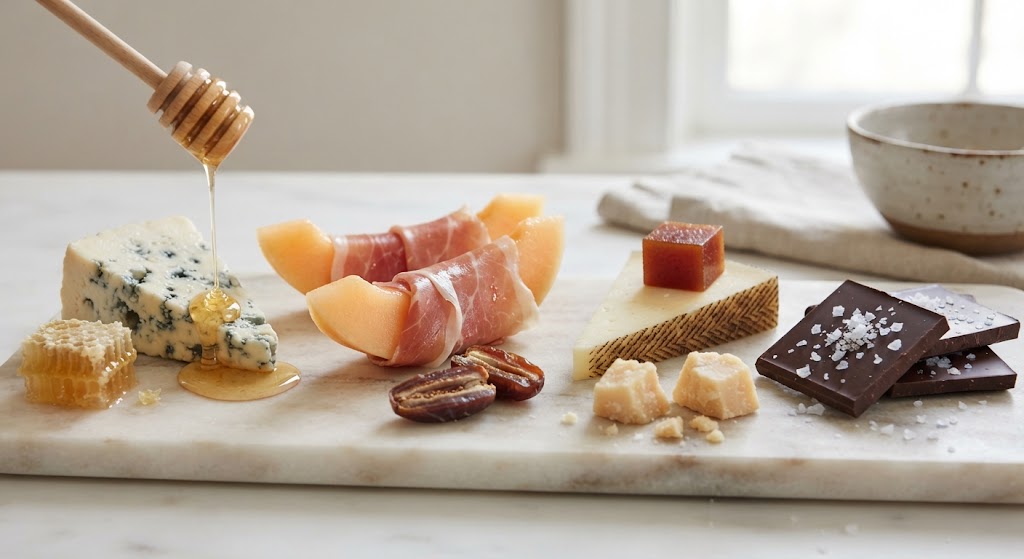
Quick Answer: A little salt blocks bitterness, so sweetness comes through brighter. Sodium may also help the tongue's sweet sensors react to sugar. Sweetness, in return, softens salt. That's why honey on blue cheese, melon with prosciutto and salt on chocolate all taste better than either half alone.
The science, in three parts
1. Salt blocks bitterness
Many foods have a faint bitter edge: dark chocolate, cheese rinds, some fruit, cured meat. In a well-known 1997 study in Nature, Paul Breslin and Gary Beauchamp showed that salt suppresses bitterness, and that when bitterness drops, the sweetness of the same food comes forward. Salt doesn't add sweetness so much as uncover it.
That's why a pinch of salt on watermelon, grapefruit or dark chocolate makes them taste sweeter.
2. Sodium may boost the sweet signal itself
The main sweet sensor on your tongue is a receptor called T1R2/T1R3. But in 2011, researchers at the Monell Chemical Senses Center found something else in the sweet-sensing cells of mice: SGLT1, a sugar transporter that only works when sodium is present. Their suggestion: a little salt may help these cells take in sugar and respond to it more strongly. It's a proposed explanation, not settled science, but it fits what cooks have known for centuries.
3. Sweet softens salt
It works the other way, too. Sweetness turns down how salty a food tastes. A slice of prosciutto on its own is very salty; wrapped around melon it tastes rich and rounded instead. The two tastes calm each other's extremes, and the bite tastes balanced instead of sharp.
Plus: contrast keeps your palate awake
Eat salty bite after salty bite and your tongue adapts: each one tastes flatter. Switching between salty and sweet resets that, so both stay vivid for the whole party. That's the core idea behind pairing by contrast.
10 classic salty-sweet pairings
| Salty | Sweet | Why it works |
|---|---|---|
| Gorgonzola, Stilton or Roquefort | Honey or honeycomb | Honey tames the sharp, salty bite of blue; blue makes honey taste floral |
| Prosciutto | Melon | Juicy fruit softens the salt; salt makes the melon sweeter |
| Manchego | Quince paste (membrillo) | Spain's classic: firm, salty sheep's cheese with dense fruit paste |
| Parmigiano-Reggiano | Medjool dates or balsamic glaze | Caramel sweetness against salty, crunchy crystals |
| Aged cheddar | Apples | Sweet-tart fruit rounds out sharp, salty cheese |
| Genoa salami | Fig jam | Jammy fruit against fatty, salty meat |
| Pepperoni or soppressata | Hot honey | Sweet, salty and spicy all at once |
| Brie | Cranberry sauce | Tart-sweet fruit lifts mild, buttery cheese |
| Dark chocolate | Flaky sea salt | Salt cuts chocolate's bitterness, so it tastes sweeter |
| Aged Gouda | Candied pecans | Butterscotch notes on both sides, with crunch |
How to use it on a board
- Put the sweet next to the saltiest thing. Honey goes beside the blue cheese, fig jam beside the salami, melon beside the prosciutto. If it's right there, guests pair them without being told.
- Match the strength. Strong salty food needs a strong sweet: blue cheese wants honey or honeycomb, not grapes. Mild cheese wants something gentle, like fresh fruit or a light jam.
- Keep the ratio around 1 sweet to 2 or 3 salty. One small dish of honey or jam and one or two fruits is plenty for a board for 6 to 8. More than that and it drifts into dessert.
- Add a little acid too. Sweet and salty is the first pairing guests notice, but cornichons, mustard or tart apple keep a rich board from feeling heavy. See the acid rule.
- Salt your fruit. A few flakes of sea salt on melon, pineapple or chocolate pieces makes them pop.
Try it in two minutes
Taste a square of dark chocolate. Then sprinkle a few flakes of sea salt on the next square and taste again. Most people find the salted square tastes less bitter and sweeter, even though you only added salt. That's the principle in one bite.
Sources
- Breslin & Beauchamp, "Salt enhances flavour by suppressing bitterness," Nature (1997)
- Yee et al., "Glucose transporters and ATP-gated K+ (KATP) metabolic sensors are present in type 1 taste receptor 3 (T1r3)-expressing taste cells," PNAS (2011)
- FoodNavigator: Study suggests why salt can boost sweet taste perception
FAQ
Why do salty and sweet taste so good together?
A little salt suppresses bitterness, so sweet and other flavors come through more clearly. Research also suggests sodium may help sweet-sensing cells in the tongue respond to sugar. In return, sweetness softens how salty something tastes. Each makes the other taste better balanced and more vivid.
Does salt make things taste sweeter?
Often, yes, in small amounts. Salt blocks bitterness, which unmasks sweetness, and a 2011 Monell Center study found a sodium-dependent sugar sensor (SGLT1) in sweet taste cells of mice, a possible reason salt can boost sweetness. Too much salt just tastes salty.
What are the best salty-sweet pairings on a charcuterie board?
Blue cheese and honey, prosciutto and melon, Manchego and quince paste, Parmigiano-Reggiano and dates or balsamic, aged cheddar and apple, salami and fig jam, pepperoni and hot honey, Brie and cranberry, and dark chocolate with flaky salt.
How much sweet should go on a charcuterie board?
About one sweet element for every two or three salty ones. A small dish of honey or jam and one or two fruits is plenty. Too much sweetness and the board starts to feel like dessert.
Why do people put salt on watermelon?
The same principle. A pinch of salt suppresses any bitterness and makes the fruit taste sweeter and juicier. It works on melon, cantaloupe, pineapple and grapefruit too.