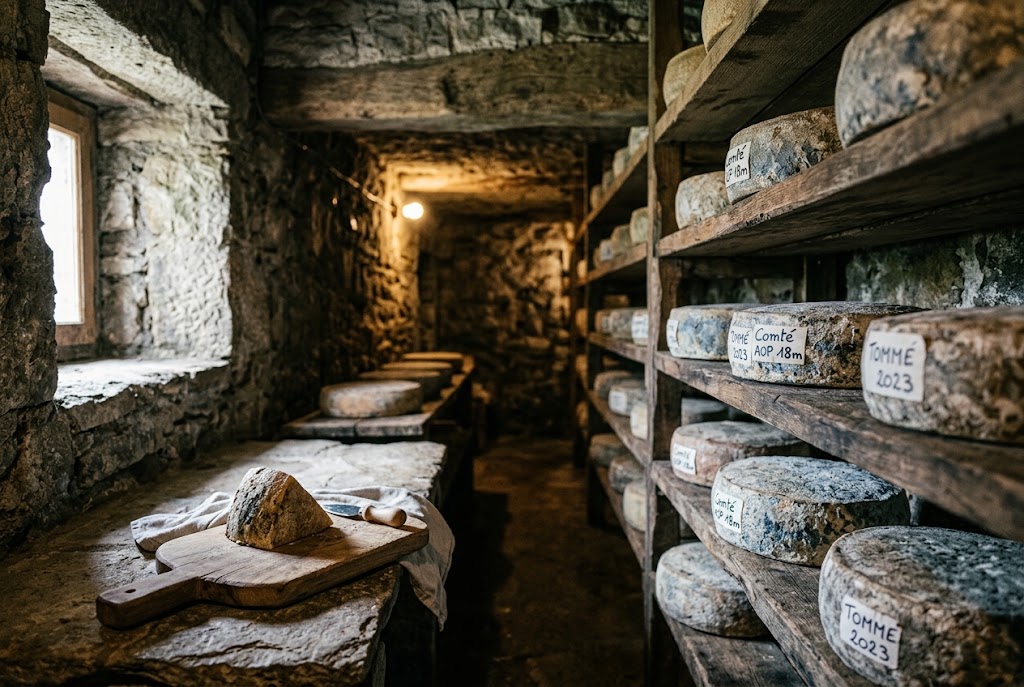
The phrase "cave-aged" on a cheese label is sometimes marketing shorthand for "aged somewhere cool and dark." But genuine cave aging is a specific technical choice with measurable flavor consequences — and understanding what caves actually do explains why the same recipe produces different cheese in different caves, and why some of the world's most distinctive cheeses are geographically irreplaceable.
Quick Answer: Cheese aging caves provide the controlled environment — stable temperature (10–14°C), high humidity (80–95%), and airflow — necessary for the complex biochemical processes of aging to proceed at the correct rate. Without cave conditions, aging accelerates unevenly (warm temperatures), rind formation fails (low humidity), or unwanted molds proliferate (poor airflow). The cave is not a passive storage space but an active tool in the cheesemaker's craft.
What a Cave Provides That a Refrigerator Doesn't
A modern controlled-environment aging room can match the temperature and humidity of a natural cave with precision. What it cannot replicate is the cave's microbial ecology — the specific community of bacteria, yeasts, molds, and fungi that have evolved in a given cave environment over decades or centuries and continuously inoculate every cheese that enters.
The four key variables in cave aging:
Temperature Stability
Natural caves maintain remarkably consistent temperatures year-round — typically 8–14°C (46–57°F) depending on depth and geography. This stability is more important than the specific temperature. Fluctuations cause differential expansion and contraction in the cheese body, opening micro-cracks in the rind that allow uncontrolled microbial entry and disrupt even aging.
Why caves are stable: The thermal mass of rock, especially below the frost line, buffers external temperature swings. A cave at 10m depth can remain within ±1°C year-round in climates with 40°C seasonal swings.
Why this matters for flavor: Enzymatic activity in cheese is temperature-dependent. Constant cool temperature produces slow, even enzymatic breakdown — predictable proteolysis and lipolysis that builds complexity without generating off-flavors.
Humidity
Most cheese requires high relative humidity (85–98% RH) during aging to prevent the surface from drying out faster than the interior. Natural caves often maintain appropriate humidity naturally through evaporation from rock walls, water seepage, and limited airflow.
The moisture gradient: The exterior of an aging cheese continuously loses moisture to the environment. The moisture gradient (higher moisture interior, drier exterior) drives the formation and hardening of the rind. Too low humidity = rind forms too fast, trapping moisture inside and preventing even aging. Too high humidity = no effective rind formation, uncontrolled surface mold.
Regional humidity differences: This is why certain cheeses come from certain regions — Comté's caves in the Jura maintain specific humidity levels that differ from Gruyère's caves in Switzerland, producing different rind development and different aging outcomes even from similar starting recipes.
Airflow
Cheese requires oxygen — particularly blue cheeses where P. roqueforti is aerobic and requires oxygen to grow. Natural caves often have airflow through geological features (fissures, connected chambers) that provide passive, consistent air exchange.
The Roquefort fleurines: The most dramatic example — the natural wind channels in the Combalou plateau create consistent airflow through the aging cellars without mechanical ventilation. P. roqueforti was discovered in these caves precisely because the airflow maintained conditions for its growth.
Why natural airflow differs from mechanical: Natural airflow carries the cave's microbial community with it — each air movement deposits bacteria, yeasts, and spores onto the cheese surface. Mechanical ventilation moves filtered air; natural cave airflow moves bioactive air.
The Microbial Community
The cave's resident microbial ecosystem is the most complex and least replicable aspect of cave aging. This community includes:
Surface molds: Species of Penicillium, Mucor, Geotrichum, and others that colonize the rind and contribute to the exterior flavor and protective function. The specific mold species in a given cave are determined by the cave's geology, the cheeses that have been aged there, and decades of selection pressure favoring strains that thrive in that environment.
Yeasts: Various Debaryomyces, Yarrowia, Kluyveromyces species that produce esters and alcohols contributing to the cheese's aromatic complexity. Yeasts in cave-aged cheeses are significantly more diverse than in controlled-environment aging facilities.
Bacteria: Surface-colonizing bacteria including Brevibacterium linens (the organism responsible for washed-rind orange color and aroma) and many others. The bacterial community of a cave's walls, floors, and airstream inoculates every cheese that ages there.
Case Studies: Caves That Define Specific Cheeses
Combalou Caves → Roquefort
The Combalou caves of Roquefort-sur-Soulzon are carved through a collapsed limestone plateau that creates the fleurines — natural fissures that channel outside air through the cave system at constant temperature and humidity. The indigenous Penicillium roqueforti population that inhabits these caves was originally isolated here and is specifically adapted to this environment.
Seven licensed Roquefort producers all use the same cave system. The AOC specifically prohibits production outside this single geological formation. This isn't tradition for tradition's sake — it's recognition that the cave's microbial community and airflow are part of the recipe.
Jura Caves → Comté
Comté is aged in caves across the Jura plateau region of eastern France. The Jura's limestone cave systems maintain temperatures of 12–16°C and very high humidity that allow Comté's rind to develop slowly, evenly, and with the distinctive surface mold communities that contribute to Comté's earthy, nutty character.
Different Comté caves produce perceptibly different cheeses from the same starting material — the affineur (ager) using caves from one valley produces Comté with a slightly different flavor profile than an affineur in an adjacent valley. This is not variation; it's terroir expression.
Stilton Caves → Stilton
English Stilton is aged in caves and cellars in the Vale of Belvoir and surrounding areas of Nottinghamshire, Derbyshire, and Leicestershire. The cave environments support P. roqueforti populations and associated bacteria that have developed in that specific limestone geology over centuries.
Only six dairies are licensed to produce Stilton PDO. The geographic restriction exists partly because the caves where Stilton has historically been aged have developed specific microbial communities that influence flavor.
How the Cave Microbiome Influences Flavor
The surface microbial community does more than protect the cheese from uncontrolled contamination — it actively produces flavor-generating compounds:
Esters from yeasts: Many cave yeasts are prolific ester producers. Ethyl butyrate (fruity, pineapple), ethyl hexanoate (apple-like), and isoamyl acetate (banana) are commonly produced. These contribute the subtle fruity notes that distinguish naturally cave-aged cheeses from controlled-environment versions.
Secondary metabolites from molds: Surface Penicillium species produce secondary metabolites including geosmin (earthy) and various terpenoids that contribute to the "cave" or "cellar" character of aged cheeses. These compounds are present in trace amounts but are detectable at very low concentrations.
Proteolytic activity from surface bacteria: Surface bacteria produce proteases that begin breaking down the rind exterior. This contributes to the formation of soft, slightly ammoniac rind layers in natural-rind cheeses and enhances the paste immediately beneath the rind.
What This Means for Cheese Selection
"Cave-aged" on a label is meaningful when: The cheese is made by an affinage house with established caves, the label specifies the cave or region, or the cheese is an AOC/DOP product where the cave environment is part of the protected specification.
"Cave-aged" is potentially marketing when: The "cave" is a generic temperature-controlled basement or industrial cold room. Some commercial producers use "cave-aged" loosely for any cool-storage aging environment.
How to tell: AOC and PDO designations require specific geographic aging locations. For unmarked claims, ask where the cheese was aged — "our affinage facility in Vermont" is different from "the Combalou caves" in a way that the label may obscure.
Building a Cave-Aged Board
A board celebrating cave-aged cheeses makes an interesting educational through-line for guests who enjoy learning about what they're eating:
- Comté (12+ months): Jura limestone caves, distinctly earthy
- Roquefort: Combalou caves — the cave defines the cheese
- Stilton: Vale of Belvoir limestone cellars
- Cave-aged Gruyère: Swiss mountain caves, alpine hay and mold notes
- Maytag Blue (American): Caves in Newton, Iowa — the American cave-aging tradition
Label each with a brief note on the cave. Pair with accompaniments that echo cave/earthy notes: walnut, mushroom-seasoned crackers, earthy honey.
The Takeaway
A cave is not storage. It's an ecosystem with a specific microbial community, temperature stability, humidity, and airflow that participate in flavor development as actively as the cheesemaker's recipe. The irreplaceable quality of geographically protected cheeses (Roquefort, Comté, Stilton) is partly in the recipe and partly in the caves — the former can be taught; the latter cannot be moved.
Subscribe to The Charcuterie Lab Report for weekly science deep dives.
FAQ
Why do caves create ideal aging conditions for cheese and charcuterie? Natural caves maintain stable, cool temperatures (typically 50–60°F/10–15°C) and high humidity (85–95%) year-round — conditions nearly impossible to replicate consistently in modern climate-controlled environments. The stable temperature prevents the dramatic swings that accelerate undesirable mold growth and fat oxidation. High humidity prevents the surface from drying too quickly, allowing the interior to age evenly. Which cheeses and cured meats are cave-aged? Roquefort (Combalou caves, France), Mimolette (cave-aged by mites), Comté (mountain caves, Jura), and many traditional alpine cheeses require cave aging. Among cured meats, culatello (Po Valley fog cellars) and traditional Spanish Ibérico are aged in environments that mimic natural cave conditions — cool, humid, with specific airflow. Can modern refrigeration replicate cave aging? Partially — modern cheese caves (specialized humidity and temperature-controlled rooms) can approximate cave conditions and are used by artisan producers globally. But true cave-aged cheeses gain complexity from the specific microbial ecosystems present in particular caves, which vary by geography. This is why Roquefort can only be made in the Combalou caves — the specific Penicillium roqueforti strain naturally present there produces flavors that cannot be replicated elsewhere. Does cave aging affect flavor in a way you can taste on a board? Yes — cave-aged cheeses and cured meats have more complex, layered flavors than those aged in standard facilities. The diversity of microbial activity in cave environments produces a wider range of flavor compounds (esters, aldehydes, ketones) that create depth and nuance. Pairing cave-aged products on a board almost always produces a richer, more complex flavor experience than commodity-produced alternatives.