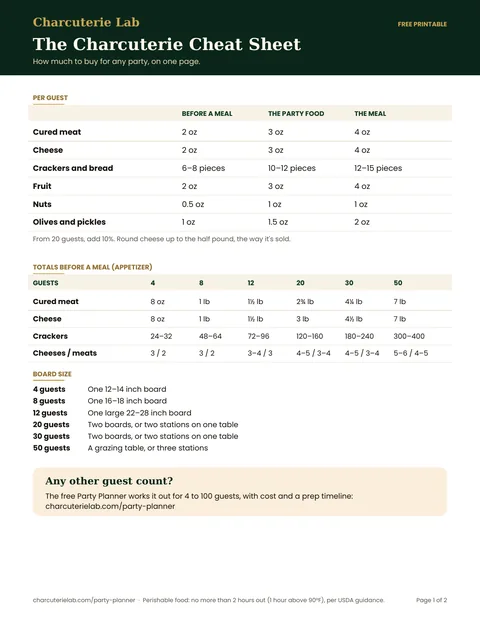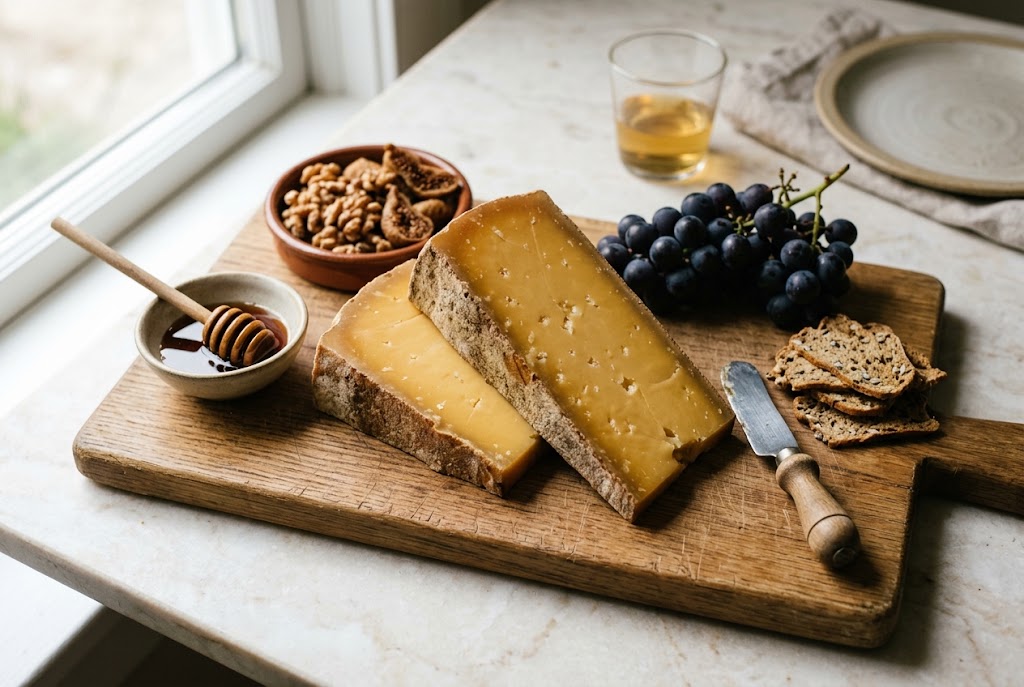
Quick Answer: Comté is a nutty, fruity French alpine cheese. For a board, buy it aged 12 to 18 months. Pair it with French ham or saucisson, cornichons and Dijon.
No two wheels taste the same: one bite can taste of fruit, nuts and brown butter at once.
What Makes Comté's Milk Different
Comté is produced exclusively in the Franche-Comté region of eastern France, primarily from milk produced by Montbéliarde and French Simmental cows grazed in the Jura mountains. The cows must be pasture-grazed in summer and fed exclusively on hay (no silage) in winter — the feed prohibition exists because silage fermentation produces compounds that interfere with Comté's flavor development.
The mountains are in the milk: alpine pastures hold dozens of grasses, wildflowers and herbs. Their aromas are fat-soluble, so they pass into the milk and survive into the finished cheese.
That's where Comté's herbal, floral and hay notes come from. When people say alpine cheese tastes of its place, they mean it literally.
Seasonal variation: Summer-milk Comté (from June-September pasture grazing) consistently develops more complex fruity and floral notes. Winter-milk Comté (from hay feeding) tends toward nutty, toasted, and more restrained flavor profiles. Both are high-quality; they taste different because the milk is genuinely different.
The Copper Vat: Why the Metal Matters
Comté is made in copper vats — large open-top vessels lined with copper, used exclusively in traditional Swiss and French alpine cheesemaking. The copper is not incidental to the process. It plays an active chemical role.
Copper as a catalyst: Copper ions released from the vat surface catalyze oxidation reactions in the milk during cooking. These reactions accelerate the development of certain flavor precursors and also suppress the growth of unwanted bacteria by disrupting their enzymatic processes. Copper's antimicrobial properties mean that the bacterial populations in a copper vat are naturally more controlled than in stainless steel — favoring the lactic acid bacteria and Propionibacterium that contribute to Comté's characteristic flavor.
Propionibacterium and the eyes: Some Comté wheels develop small interior holes — eyes — from Propionibacterium shermanii, which produces CO2 as a metabolic byproduct. The same organism is responsible for the eyes in Swiss Emmental. More importantly, Propionibacterium also produces propionic acid and acetic acid during its metabolism — both contribute flavor compounds that build Comté's complexity.
The Maillard dimension: The high-temperature cooking step (the curd is heated to 54°C / 130°F during Comté production) initiates early Maillard reactions between milk proteins and lactose. These reactions, combined with extended aging, produce the butterscotch and caramelized-nut notes that appear in aged Comté.
Aging: What Time Does to Comté
Comté is aged for a minimum of 4 months, but most serious Comté available in specialty retail is aged 12–18 months, and some exceptional wheels reach 24–36 months.
Age categories and flavor profiles:
- 4–8 months: Mild, slightly sweet, milky. Board-functional but not particularly distinctive.
- 8–12 months: Fruity notes emerging (green apple, apricot), texture firming, light nuttiness.
- 12–18 months: The sweet spot for most applications. Full fruity-nutty complexity, tyrosine crystals beginning to appear, caramelized notes developing. This is the age range most specialty retailers carry.
- 18–36 months: Intensely complex, pronounced caramel and toasted hazelnut, crystalline texture, assertive finish. For guests who appreciate aged hard cheese.
The Lab Section: Why These Pairings Work
Comté gets its depth from 4 to 24 months of aging in caves. The copper vats it's made in help produce its nutty, fruity flavor, and the rich milk of Montbéliarde cows keeps it creamy as it ages.
To pair it:
- Something sweet (honey, fig jam) brings out the nuttiness.
- Something sour (dry white wine, pickled fruit) resets your palate between rich bites.
- Tannic red wine also cuts through its fat.
How to Use Comté on a Board
As the primary French cheese: Comté is the anchor for any French-themed board. It pairs naturally with jambon de Bayonne (French air-cured ham), saucisson sec (French dry salami), cornichons, and Dijon mustard. A Brie or Camembert alongside Comté covers both the soft-ripened and hard-aged categories for a complete French board.
As the complex hard cheese in a mixed board: Comté functions as the "nuanced, complex" aged cheese slot on a mixed board — more interesting than a plain Cheddar, more accessible to most guests than an aggressively aged Manchego or a blue. It's the safe sophisticated choice.
Pairing with cured meats: Comté pairs well across the spectrum of mild to moderately flavorful meats. Prosciutto (mild, sweet-salty), coppa (slightly more assertive), and saucisson sec (peppery French salami) all complement Comté's fruity-nutty complexity without overpowering it. Avoid very aggressively spiced meats (heavily seasoned hot salami, nduja) — the spice overrides Comté's subtlety.
Condiment pairing:
- Marcona almonds (roasted hazelnut notes echo)
- Fresh grapes or thinly sliced pear (fruit acid cuts the fat; pear's subtle floral notes echo Comté's)
- Honey (mild wildflower, not assertive buckwheat)
- Cornichons for acidity balance
Wine pairing: Comté's home region produces Jura wines — Savagnin-based whites (including Vin Jaune) with oxidative, nutty character that directly echoes Comté's flavor. Outside Jura: a white Burgundy (Chardonnay), a crisp Alsatian Pinot Gris, or an aged Viognier. The fruity complexity of Comté also works with light reds (Pinot Noir, light Gamay) where the wine's fruit doesn't compete with the cheese's complexity.
Comté vs. Gruyère
Comté and Gruyère are often confused — both are alpine cooked-curd cheeses with similar production methods (copper vats, high-temperature curd cooking, extended aging). The differences:
- Geography: Comté is French (Jura); Gruyère is Swiss (Fribourg, Vaud)
- Milk: Both use mountain cow milk; regional pasture differences create flavor distinctions
- Flavor: Comté tends more fruity and complex; Gruyère tends more consistently nutty and slightly sweet with a meatier, brothy dimension
- Texture: Both develop tyrosine crystals at age; Comté tends slightly more granular; Gruyère slightly more pliable
- Eyes: Gruyère traditionally has no eyes (smooth interior); Comté may have small eyes from Propionibacterium
Both are excellent board cheeses; on a board with space for one, Comté's broader flavor range is a slight edge over Gruyère for educated guests.
Sources
FAQ
What's the difference between Comté and Gruyère?
Both are alpine-style cow's milk cheeses aged in mountain caves, but Comté (French) and Gruyère (Swiss) differ in milk source, aging climate, and flavor. Comté typically has a slightly sweeter, more floral and fruity character; Gruyère tends toward nuttier and earthier notes. Comté is aged longer on average (minimum 4 months, often 12–24 months) and produced in larger wheels.
Should I buy young or aged Comté for a charcuterie board?
For a board, 12–18 month Comté is the sweet spot. Young Comté (4–8 months) is mild and subtle — it works but lacks the complexity to hold its own against assertive meats and condiments. Very aged Comté (24+ months) is intensely complex and better as a featured cheese.
Can you eat the rind on Comté?
Comté's natural rind is edible but has a different, more intense and earthy flavor than the interior. Most people prefer the interior. The rind near the edge often has a slightly different flavor gradient — worth exploring if you enjoy the complexity of cave-aged rinds.
What wines pair best with Comté?
Comté's home is the Jura region of France, and the traditional pairing is Jura white wines — particularly Vin Jaune (oxidative, sherry-like) which matches Comté's nuttiness perfectly. More accessible pairings: white Burgundy (Chardonnay), dry Alsatian whites, or a medium-bodied Pinot Noir for red wine lovers.