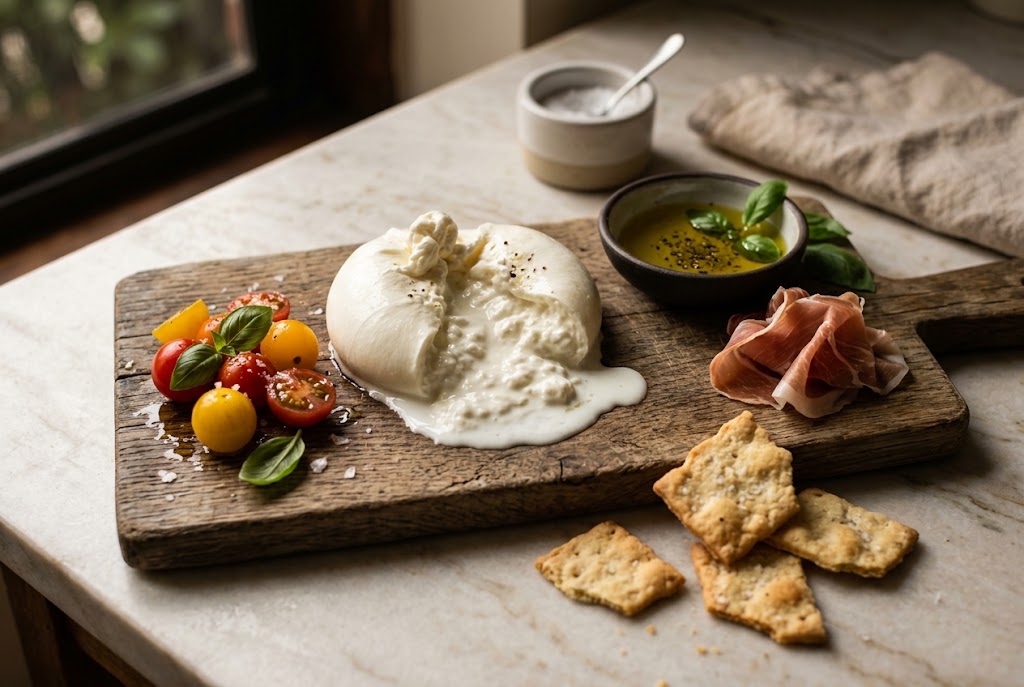
Quick Answer: Burrata is a thin shell of mozzarella wrapped around stracciatella, shreds of curd soaked in cream. Put it on the board whole and cut it open at the table, never ahead. Pair it with bright, fresh contrast: ripe tomatoes, basil, good olive oil and crusty bread to scoop up the center.
Burrata is frequently described as "a type of fresh mozzarella." This is technically accurate but practically misleading — like calling a soufflé a type of egg dish. Burrata and mozzarella share an outer shell of pulled pasta filata curd, but everything inside the shell is different, the structural behavior is completely different, and the rules for serving it on a board are different as a result.
Understanding what burrata actually is makes it easier to use it correctly, and using it correctly makes it one of the most visually impressive and texturally distinctive elements on any cheese board.
What Burrata Actually Is
Burrata is a fresh Italian cheese from Puglia (the heel of Italy's boot) consisting of two distinct components:
The shell: A thin, tightly pulled envelope of pasta filata curd — the same stretched, pulled fresh cheese that forms fresh mozzarella. This shell gives burrata its round shape and contains the filling.
The filling: A mixture of stracciatella (soft, shredded mozzarella curd pulled into irregular cream-soaked strands) and fresh heavy cream. This filling — called stracciatella e panna in Italian production — has a loose, semi-fluid consistency. It does not hold its shape; it flows when the shell is cut.
The result is a product with two distinct textures in a single bite: the slight resistance of the pasta filata shell, then the immediate release of the soft, cream-rich interior. The shell is mild and slightly chewy. The interior is rich, fatty, and intensely milky.
Stracciatella specifically: The word comes from stracciare — to shred or tear — which describes the production method. Mozzarella curd is pulled and then shredded or torn into irregular strands while being soaked in cream. The strands remain distinct rather than fully homogenizing into the cream, which is why burrata's interior has both fluid richness and textural irregularity. Stracciatella is also sold separately as a cheese on its own — same filling, no shell.
The Lab Section: Why These Pairings Work
Pasta filata production (the shared foundation):
Both burrata's shell and fresh mozzarella are produced by the same basic method: fresh mozzarella curd is heated in hot water or whey until it becomes plastic and stretchable, then pulled, stretched, and worked until it reaches the right consistency. This process — pasta filata, or "stretched curd" — aligns the casein protein chains in a specific way that produces the characteristic smooth, glossy surface and slightly chewy texture.
In mozzarella, the entire cheese is pasta filata curd. In burrata, only the thin outer shell is pasta filata — the majority of the product by volume is the stracciatella-and-cream filling.
Why burrata is so rich:
Burrata is richer than fresh mozzarella because of the cream worked into its stracciatella filling. This higher fat content is why burrata is richer, more luxurious in mouthfeel, and faster to overwhelm the palate than regular mozzarella. It's also why pairings that provide acidity and freshness are particularly effective: the acid cuts the fat richness in the same way it cuts any high-fat dairy.
The structural implication: The pasta filata shell maintains shape when intact but is thin and weak relative to the volume of the filling. This means:
- Burrata cannot be pre-sliced like other cheeses — once cut, the filling flows out immediately
- It must be served whole, with guests cutting into it at the table
- It cannot be placed directly on a board without a container or backdrop (the bottom of the burrata will gradually seep as it reaches room temperature)
Burrata vs. Fresh Mozzarella: The Practical Differences
| Burrata | Fresh Mozzarella | |
|---|---|---|
| Structure | Pasta filata shell + stracciatella cream filling | Solid pasta filata throughout |
| Richness | Higher (cream-filled center) | Lower |
| Flavor | Rich, milky, cream-forward | Mild, fresh, slightly tangy |
| Texture | Two-part: slight chew then cream release | Uniform: slight chew throughout |
| Board behavior | Must be served whole; filling releases on cut | Can be sliced, cubed, or torn |
| Pairing role | Centerpiece visual; cream element | Background texture element |
How to Serve Burrata on a Board
Never pre-cut. Burrata should arrive at the table whole. The moment the shell is punctured, the filling flows. If you cut it in the kitchen and bring it to the board, you'll have a spreading pool of cream and shredded curd. Cut it at the table, ideally in front of guests — the reveal is part of the experience.
Use a vessel or backdrop. Burrata placed directly on a wood board will sit and seep slightly at the base as the cheese warms. Better options:
- A small plate, slate tile, or shallow bowl placed on the board to catch any seeping
- A bed of arugula or fresh basil leaves underneath — the greens absorb any seepage and are part of the pairing anyway
- A small piece of parchment paper underneath if using a bare wood board
Temperature: Burrata should be removed from refrigeration 20–30 minutes before serving. Cold burrata is firmer and the cream filling is thicker. Room-temperature burrata has a looser, silkier filling. The ideal serving temperature is cool-but-not-cold: the filling should flow when cut, but not be so warm that the cream becomes greasy.
Quantity: Burrata is very rich. A standard individual burrata (100–125g) serves 3–4 people on a board. One burrata for 6 people is sufficient if it's accompanied by other cheeses. Don't over-serve burrata — its richness means it goes further than it appears.
Timing: Fresh burrata has a short shelf life — typically 3–5 days from production. Check the freshness date, and plan to serve burrata within 1–2 days of purchase. It degrades quickly.
Pairing Burrata
Burrata's flavor profile — rich cream, mild fresh dairy, slight milky tang — calls for pairings that provide contrast without adding more richness.
The classic Italian combination: Burrata with ripe heirloom tomatoes, fresh basil, and a drizzle of good extra-virgin olive oil is the definitive burrata pairing. On a board, a few cherry tomato halves or a slice of heirloom tomato placed adjacent to the burrata with a few basil leaves and an olive oil drizzle recreates this combination in board format.
Fruit pairings:
- Ripe peaches or nectarines — the sweetness and acidity of stone fruit against cream richness is classic summer
- Figs — fresh figs provide both sweetness and slight tannin from the seeds; sliced figs arranged around burrata are visually striking
- Roasted grapes — concentrated sweetness and slight jammy depth; more complex than fresh grapes with burrata
Acidic elements (essential for balance):
- Balsamic vinegar or aged balsamic — a drizzle over the burrata at serving; the concentrated acidity cuts the cream richness cleanly
- Cornichons or pickled elements — bright brine acid provides palate reset between rich bites
- Fresh lemon zest — a small amount of zest grated over burrata right before serving brightens the entire dish
Bread and cracker pairings:
- Grilled or toasted crostini — the slight char and crunch contrasts with the soft cream interior
- Focaccia — absorbs the cream and oil combination; the Italian classic vehicle
- Plain crackers — neutral vehicle that doesn't compete with burrata's flavor
Wine pairings:
- Vermentino or Falanghina — light Italian whites with mineral freshness and clean acidity; the regional pairing (Puglia produces both Primitivo and Negroamaro, but for burrata specifically, whites serve better)
- Pinot Grigio — acid-forward, clean; cuts cream richness without competing
- Light Prosecco — bubbles and acid against cream fat; the aperitivo combination
- Avoid full red wines — heavy tannin against high-fat fresh dairy produces a harsh, unpleasant interaction; burrata is a white wine and light sparkling cheese
Burrata at a Glance
| Property | Description |
|---|---|
| Structure | Pasta filata shell + stracciatella-and-cream filling |
| Origin | Puglia, Italy |
| Richness | Richer than mozzarella (cream-filled center) |
| Texture | Shell: slight chew. Interior: cream + shredded curd, flows on cut |
| Flavor | Rich, milky, cream-forward; mild fresh dairy tang |
| Board role | Centerpiece visual element; opened at the table |
| Classic pairing | Heirloom tomato, basil, olive oil; ripe figs; aged balsamic |
| Drink pairing | Vermentino, Pinot Grigio, Prosecco |
FAQ
What is inside burrata — is it raw?
The interior of burrata is a mixture of stracciatella (torn fresh mozzarella) and cream. It is not raw in the typical sense — it's fresh unaged cheese made from pasteurized milk. The interior is soft and liquid-like because of its high cream content, not because it's uncooked.
How long does burrata last?
Burrata is extremely perishable — it should be consumed within 24–48 hours of purchase. It's typically sold in its packaging liquid (whey or water) to preserve moisture. Once removed from the liquid, it should be served immediately. It does not store well once opened.
Can burrata be added to a board in advance?
No — burrata weeps liquid quickly once placed on a board and can make surrounding items soggy within 30–45 minutes. Add burrata to the board no more than 15–20 minutes before serving. Alternatively, serve it separately in its packaging liquid and let guests take what they want.
What's the difference between burrata and fresh mozzarella?
Fresh mozzarella is a solid ball of pulled curd cheese with a consistent elastic texture throughout. Burrata has a fresh mozzarella exterior shell but a creamy, liquid-like interior of stracciatella and cream. Burrata is richer and more indulgent; mozzarella is firmer and cleaner in flavor.