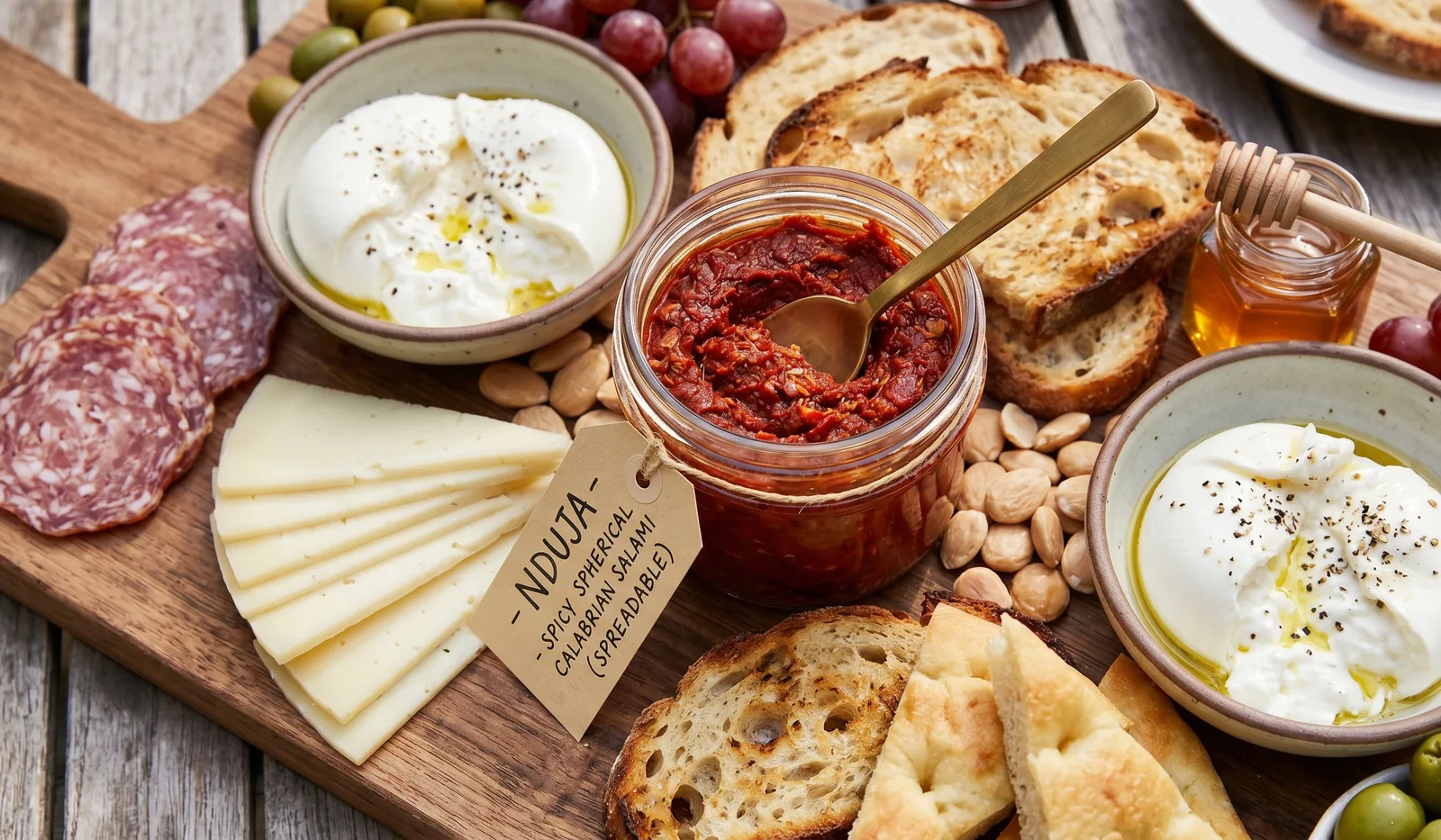
Quick Answer: Nduja (en-DOO-ya) is a spicy, spreadable pork salami from Calabria. Serve it at room temperature in a small jar with a spreader, labeled so guests know it's hot. Pair it with fresh mozzarella or burrata to calm the heat, honey for contrast, and crusty sourdough.
Nduja (pronounced en-DOO-ya) is the most interesting thing you can add to a charcuterie board that most people have never encountered. It's a spreadable, fiery Calabrian salami that functions less like a sliced meat and more like an extremely good condiment — and its pairing logic is nothing like anything else on the board.
What Is Nduja?
Nduja originates from Calabria, the toe of Italy's boot, where Calabrian chile peppers are grown and used with intensity that distinguishes the region's food culture from the rest of Italy.
The meat is made from pork fat, pork shoulder, and Calabrian chiles — fermented, cured, and stuffed into natural casing, then aged just long enough to develop complex fermentation notes. The fat content is exceptionally high, which is what gives nduja its smooth, spreadable consistency at room temperature. The chile content is what gives it its fire.
The flavor profile: intensely porky, smoky, spicy, with an underlying fermentation complexity that reveals itself after the initial heat fades. It's not simply spicy salami. The fat carries the chile's capsaicin differently than a dry sausage would — more slowly, longer on the palate, and with more of the chile's underlying fruity notes intact.
Traditional Calabrian nduja is protected under Italian law. What's sold in the US is typically excellent — look for it at Italian delis, specialty food stores, or online.
Best Use on a Charcuterie Board
Nduja does not slice. Serve it in a small jar, ramekin, or bowl with a spreader. It should be at room temperature — cold nduja is stiff and the fat doesn't flow properly, which mutes the flavor and makes it difficult to spread.
On the board, nduja functions as a component rather than a central element. It's part of a micro-combination: nduja + mild cheese + crusty bread is a three-part bite. Design the board so these three elements are adjacent to each other.
Amount: 2–3 oz for a board serving 4–6 guests. A small amount goes a long way — nduja is rich and spicy, and guests self-limit quickly. The jar itself is visually interesting; it doesn't need to be overflowing.
Label it clearly. Guests who don't know what nduja is may take a generous amount and be overwhelmed by the heat. A small label or mention when you present the board prevents that.
What to Pair It With
Fresh mozzarella or burrata is the strongest pairing. The mild dairy fat suppresses capsaicin's heat receptor activation and provides a neutral, creamy base that lets nduja's fermented pork complexity come forward without the burn dominating.
Honey is the second essential pairing. Sweet elements disrupt capsaicin binding and reduce perceived heat while honey's floral notes create an unexpected harmony with the chile's fruity undertones. Acacia honey works well; wildflower is also excellent.
Crusty sourdough or focaccia provides the structural base. The bread absorbs the fat, moderates the spice, and adds fermentation complexity that resonates with nduja's own fermented notes. Thin crackers will crack under nduja's weight; crusty bread holds it.
Young Pecorino Romano or stracchino work as alternative cheese pairings — mild, approachable, with enough fat to moderate the heat.
Avoid: aged, pungent, or strongly flavored cheeses. Aged gouda or Gorgonzola next to nduja creates a flavor collision rather than a pairing.
The Lab Section: Why These Pairings Work
Nduja's heat comes from capsaicin — the active compound in Calabrian chiles. Capsaicin binds to TRPV1 receptors in the mouth and throat, triggering the same neurological response as physical heat. This is why capsaicin is perceived as burning rather than bitter or sour.
Dairy fat is the most effective capsaicin moderator available. Fat is lipophilic — it dissolves capsaicin and carries it away from receptor sites before it can fully bind. This is why milk extinguishes chile heat more effectively than water. Fresh mozzarella and burrata, with their high water and fat content, do exactly this: they reduce the capsaicin concentration at the receptor level, making nduja's heat more sustained and pleasant rather than overwhelming and sharp.
Honey's sugar compounds work through a different pathway — they activate sweet receptor responses that compete with and suppress the bitter, hot signals from capsaicin. The sweet signal doesn't eliminate the heat; it moderates its urgency and allows more of capsaicin's flavor complexity to emerge alongside it.
Sourdough's fermentation acids (lactic and acetic) resonate with nduja's own fermentation compounds, creating flavor harmony between the bread and the meat that simple crackers can't produce.
Common Mistakes
Serving nduja cold. Cold nduja is stiff, waxy, and muted. Allow at least 45 minutes at room temperature before serving. The fat needs to be fluid for the flavor to open up.
Not labeling it. Guests who encounter nduja without warning take too much and are overwhelmed. Label it, or mention it when presenting the board.
Pairing with bold cheese. Nduja's intensity requires a mild dairy counterpart. Bold cheese competes — the board ends up with two aggressive flavors and nothing to anchor them.
No bread nearby. Nduja spread on a thin cracker is an unpleasant experience — the cracker shatters, the spice lands without moderation. Crusty bread is not optional for nduja.
Over-serving. Two to three ounces is enough for a full board. More than that, and guests who don't like heat have nowhere to go.
Building more boards? The Charcuterie Lab ebook walks through 50 boards across every occasion — each one with exact quantities, a shopping list, and the science behind why it works.
The Charcuterie Lab Takeaway
Nduja earns its place on a board as the most distinctive element in the spread — the one thing guests will ask about and remember. Serve it at room temperature in a small jar, paired with fresh mozzarella, honey, and crusty sourdough. Label it. Keep the rest of the board's flavors mild enough that nduja's intensity has somewhere to contrast against. Used correctly, it transforms a familiar board into something guests haven't experienced before.
FAQ
What is nduja and how do you use it on a charcuterie board?
Nduja is a soft, spreadable Calabrian salami made from pork fat, pork shoulder, and Calabrian chiles. It's intensely spicy, rich, and spreadable at room temperature. On a board, serve it in a small bowl or jar with a spoon, alongside mild cheese and crusty bread. It functions more like a condiment than a sliced meat.
What cheese pairs best with nduja on a charcuterie board?
Mild, creamy cheeses work best — fresh mozzarella, burrata, stracchino, or young Pecorino. The dairy fat suppresses capsaicin's heat and provides a neutral canvas for nduja's spice and smokiness. Avoid aged or pungent cheeses; they compete rather than complement.
Is nduja too spicy for a charcuterie board?
Nduja is very spicy — more than most guests expect from a charcuterie element. Label it clearly. Place it alongside honey and mild cheese so guests who want to moderate the heat can do so. The combination of nduja + honey + fresh mozzarella is how the heat becomes an asset rather than a barrier.
Where do you put nduja on a charcuterie board?
Serve nduja in a small jar, ramekin, or bowl with a spreader. Do not slice it — nduja is too soft to hold a slice. Place it near the mildest cheese on the board and adjacent to honey. Keep it separated from more delicate flavors it would overwhelm.
What crackers or bread go with nduja?
Crusty sourdough or focaccia absorbs nduja's fat without disintegrating, making them the strongest pairing. Thicker crackers work; thin water crackers break under nduja's spreadable texture. Flatbread is a good middle ground. Avoid delicate crackers — nduja will dominate them.