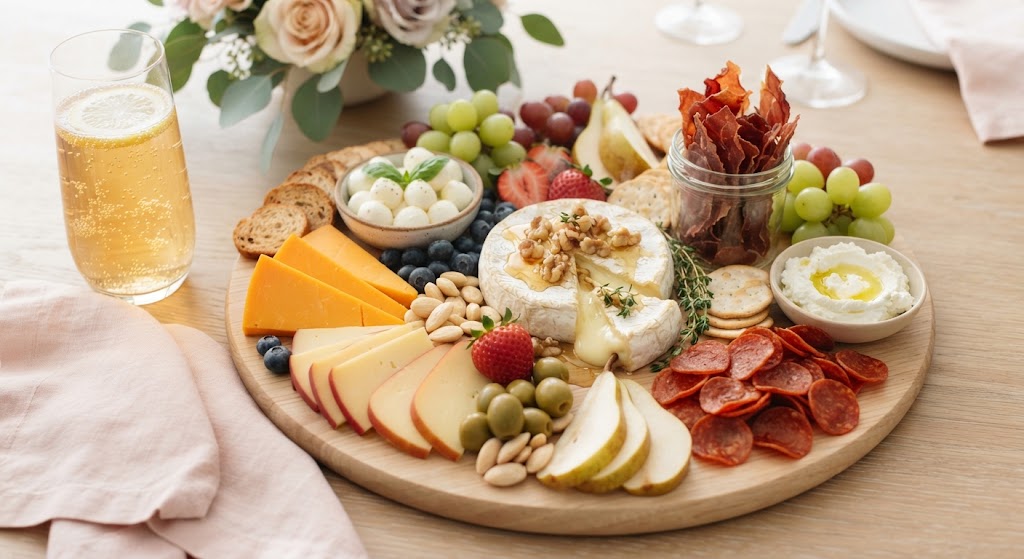
Quick Answer: Not the way it's usually served. US and UK health agencies both say pregnant people should not eat cold cured meats like salami, prosciutto and pepperoni unless they're heated until steaming hot (165°F), and should avoid cheese made with raw milk, refrigerated pâté and refrigerated smoked salmon. A pregnancy-safe board swaps in prosciutto crisps, pepperoni chips and baked brie, uses pasteurized cheddar, gouda, mozzarella and feta, and keeps everything else (fruit, crackers, nuts, honey, olives) as it is.
Charcuterie is one of the foods pregnant guests most often have to skip at a party, and it's usually the one they miss the most. The good news is that most of a board is already fine, and the parts that aren't have easy swaps that still taste like charcuterie. This guide covers what the CDC (US) and the NHS (UK) actually say, where they disagree, and how to build a board a pregnant guest can eat all of.
This is general food-safety information, not medical advice. Guidance differs by country and changes over time, so check with your own doctor or midwife.
Why charcuterie is on the pregnancy list
There are two concerns, and both are about bacteria or parasites in food that isn't cooked:
- Listeria. It can grow at fridge temperature and is found in ready-to-eat foods such as deli meats, refrigerated pâté, refrigerated smoked fish and some soft cheeses. Pregnant people are much more likely to get sick from it, and it can cause miscarriage or stillbirth. This is the main reason behind the CDC's guidance.
- Toxoplasmosis. The NHS also notes that cold cured meats carry a small risk of toxoplasmosis, a parasite that can harm a baby.
Heat kills both. That's why the rule for meat is "steaming hot," not "never."
What's safe and what to swap
| Food | US (CDC) | UK (NHS) | Pregnancy-safe swap |
|---|---|---|---|
| Salami, pepperoni, chorizo and other dry sausages | Avoid unless heated to 165°F or steaming hot | Cook until steaming hot | Pepperoni chips, pan-crisped salami or chorizo |
| Prosciutto, coppa, ham and other cured or deli meats | Avoid unless heated to 165°F or steaming hot | Cook until steaming hot | Prosciutto crisps |
| Refrigerated pâté or meat spreads | Avoid; shelf-stable cans and jars are fine | Listed as a be-careful food | Shelf-stable pâté, or skip it |
| Refrigerated smoked salmon | Avoid unless cooked; shelf-stable is fine | Cook until steaming hot | Shelf-stable smoked fish, or a hot smoked-salmon dip |
| Hard cheeses (cheddar, gouda, parmesan) | Fine if pasteurized; avoid raw-milk cheese | Fine, pasteurized or not | Pasteurized cheddar and gouda |
| Brie, camembert and white-rind goat cheese | Not named; avoid if made with raw milk | Cook thoroughly | Baked brie, served hot |
| Soft blue cheese (gorgonzola, Roquefort) | Avoid if made with raw milk | Cook thoroughly | Skip it, or bake it into something hot |
| Queso fresco, panela and similar fresh cheeses | Avoid unless heated, even if pasteurized | Fine if pasteurized | Skip on a cold board |
| Mozzarella, feta, cream cheese, cottage cheese | Fine if pasteurized | Fine if pasteurized | Fresh mozzarella, whipped feta, Boursin |
Where the two disagree, the safest board follows whichever rule is stricter. That means pasteurized cheese, cooked meat, and soft white-rind or blue cheese only when it's baked.
Check the label: raw-milk cheeses
US guidance says to avoid any cheese made with raw (unpasteurized) milk, and a few of the most popular board cheeses are made that way by tradition. Look for "made with pasteurized milk" on the label.
- Parmigiano-Reggiano is always made with raw milk. Grana Padano is also raw-milk; a pasteurized American parmesan is the swap.
- Comté and traditional Gruyère are made with raw milk.
- Manchego comes both ways, so read the label.
- Roquefort is made with raw sheep's milk.
Most supermarket cheddar, gouda, mozzarella, feta, cream cheese and Boursin in the US are pasteurized, but checking takes two seconds.
The swaps that make it still feel like charcuterie
Prosciutto crisps
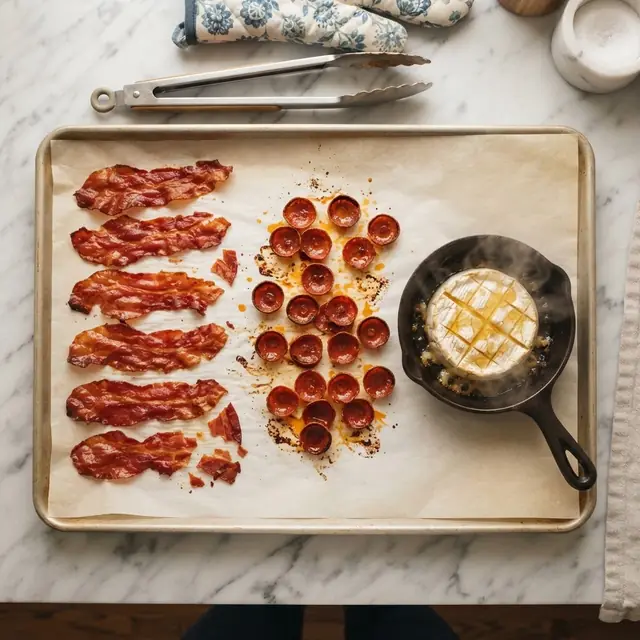
Lay prosciutto slices flat on a parchment-lined baking sheet and bake at 400°F for 10 to 12 minutes, until they shrink and turn deep red and crisp. They firm up more as they cool. Break them into shards and stand them in a small glass or crumble them over whipped feta.
Pepperoni chips
Spread pepperoni slices on a parchment-lined sheet and bake at 400°F for 6 to 8 minutes, or microwave them between paper towels for 45 to 60 seconds, until they're sizzling and crisp. Blot off the fat. They eat like a salty chip and go fast.
Pan-crisped salami or chorizo
Cook thin slices of Genoa salami or sliced chorizo in a dry pan over medium heat for a minute or two per side until they sizzle and curl. Serve them warm.
Baked brie
Score the top of a small pasteurized brie, bake it at 350°F for 10 to 15 minutes until the center is soft and steaming, and top it with honey or fig jam and walnuts. Put it on the board hot. It's the centerpiece most guests go for first.
A note on cooked meat: once it's cooked, treat it like any other board food. Make it the same day and keep it out no more than 2 hours, or 1 hour above 90°F.
A pregnancy-safe board for 8
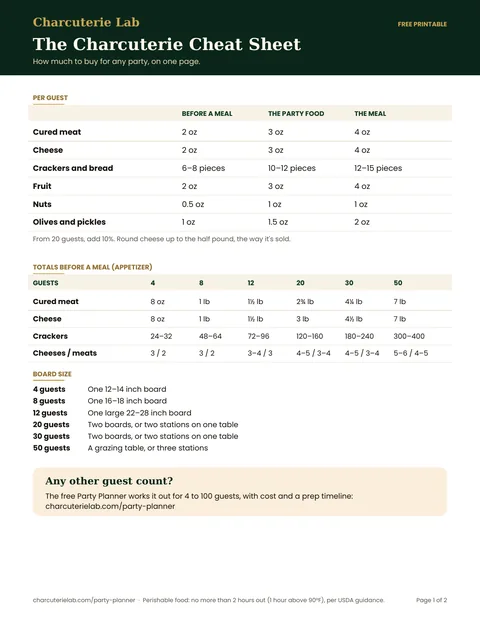
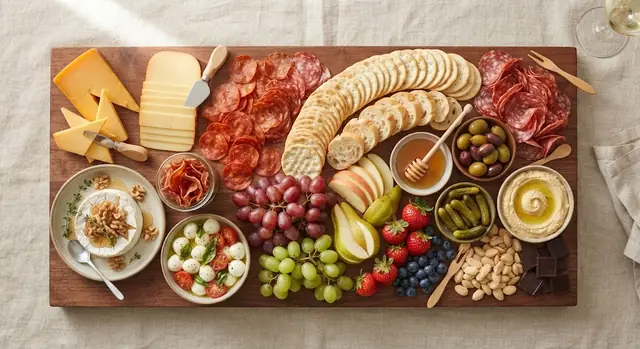
This is a starter board before a meal, using the Lab standard of about 2 oz of cheese and 2 oz of meat per guest.
| Group | What to buy | Amount |
|---|---|---|
| Cheese | Pasteurized aged cheddar | 6 oz |
| Pasteurized aged gouda | 4 oz | |
| Small pasteurized brie, baked | 1 wheel (8 oz) | |
| Fresh mozzarella pearls or whipped feta | 4 oz | |
| Cooked meat | Prosciutto, baked into crisps | 4 oz |
| Pepperoni, baked into chips | 6 oz | |
| Salami, pan-crisped | 4 oz | |
| Crunch | Crackers and a sliced baguette | 50 to 60 pieces |
| Fruit | Grapes, apple and pear slices, berries, washed | 2 lb |
| Extras | Marcona almonds, honey, olives, cornichons, hummus, dark chocolate | Small bowls of each |
Wash all fruit well, including grapes and berries, before it goes on the board.
Hosting a pregnant guest
- Make a separate small plate if the main board has cold cured meat on it. Shared knives and meat touching cheese can carry bacteria from one food to another.
- Label the board. A small card that says "all cheeses pasteurized, all meat cooked" saves the guest from having to ask.
- Skip the wine pairing for her. Sparkling apple cider, black iced tea and kombucha follow the same pairing rules. See zero-proof pairings.
- Planning a whole shower? The baby shower charcuterie board has a full menu and amounts for a crowd.
Sources
FAQ
Can you eat salami while pregnant? Not cold. The CDC advises pregnant people to avoid unheated deli meats and fermented or dry sausages such as salami and pepperoni, and to eat them only reheated to 165°F or until steaming hot. Baked pepperoni chips and pan-crisped salami are easy ways to keep them on the board.
Is prosciutto safe to eat when pregnant? Cold prosciutto is a cured, ready-to-eat meat, so US and UK guidance both say to heat it until steaming hot first. Baking slices into prosciutto crisps at 400°F for 10 to 12 minutes is the simplest way to serve it.
Can pregnant women eat brie? Guidance differs. The CDC focuses on avoiding cheese made with raw milk and queso fresco-type cheeses, and pasteurized brie is widely sold in the US. The NHS says brie, camembert and other white-rind cheeses should be cooked thoroughly. Baked brie served steaming hot meets both, and it is worth asking your own doctor or midwife.
What cheeses are safe during pregnancy? Pasteurized hard and semi-firm cheeses such as cheddar and gouda, and pasteurized cream cheese, mozzarella, feta, string cheese and cottage cheese. Check the label for made with pasteurized milk, because Parmigiano-Reggiano, Comté, traditional Gruyère and some Manchego are made with raw milk.
What can a pregnant person eat on a charcuterie board? Pasteurized cheddar, gouda, mozzarella and whipped feta, prosciutto crisps and pepperoni chips cooked until hot, baked brie, washed fruit, crackers, nuts, honey, olives, pickles, hummus and dark chocolate. Keep any cold cured meat on a separate plate with its own utensils.
Get one board idea a week, plus the free charcuterie cheat sheet, when you join the Charcuterie Lab newsletter.