Quick Answer: Manchego and pecorino are both firm cheeses made from sheep's milk, but they come from different countries and taste very different. Manchego is Spanish, nutty, buttery and mellow. "Pecorino" just means sheep's-milk cheese in Italian, and the famous one, Pecorino Romano, is hard and very salty, made mostly for grating. The Italian cheese that's closest to Manchego is Pecorino Toscano: mild, buttery and great on a board.
First: "pecorino" is a family, not one cheese
Pecora is Italian for sheep, so pecorino means sheep's-milk cheese. Italy makes several protected versions, and the two you'll see most in the US are nothing alike:
- Pecorino Romano DOP: hard, dry and intensely salty. It's the grating cheese for cacio e pepe and carbonara.
- Pecorino Toscano DOP: softer, buttery and mild. It's a table cheese, made to eat in slices.
So the honest comparison is three cheeses, not two.
Manchego vs. pecorino at a glance
| Manchego | Pecorino Romano | Pecorino Toscano | |
|---|---|---|---|
| Country | Spain (La Mancha) | Italy (mostly Sardinia, also Lazio) | Italy (Tuscany) |
| Milk | Manchega sheep | Sheep | Sheep |
| Aging | 60 days to 2 years (30 days for small wheels) | At least 5 months | 20 days to several months |
| Salt | Moderate | Very high | Low to moderate |
| Texture | Firm, slightly crumbly | Hard, dry, granular | Semi-firm to firm, buttery |
| Taste | Nutty, buttery, faintly tangy | Salty, sharp, tangy | Mild, sweet, milky |
| Rind | Zigzag basket pattern | Smooth, often black or dark | Pale yellow to reddish |
| Best use | Board star | Grating, cooking | Board cheese |
Why they taste so different
Salt is the main reason. Pecorino Romano is dry-salted over and over for weeks, so it ends up much saltier than even Parmigiano-Reggiano. Manchego and Pecorino Toscano are salted far more lightly.
Aging is the second. Manchego changes a lot with age:
- Semicurado (about 3 months): soft, mild, milky.
- Curado (3 to 6 months): firm and nutty. The everyday board choice.
- Viejo (1 to 2 years): dry, sharp and crystalline.
Sheep's milk gives all three a little tang and a richer feel than cow's-milk cheeses, because it has more fat and protein.
Which goes on a charcuterie board?
Manchego or Pecorino Toscano. Use Romano for cooking.
Manchego is the classic Spanish board cheese. Serve it in thin triangles with:
- Membrillo (quince paste), the traditional Spanish pairing.
- Jamón serrano and Spanish chorizo. See chorizo and Manchego.
- Marcona almonds and green olives.
- Drinks: Tempranillo, Rioja or a dry sherry.
Pecorino Toscano goes with honey, pears, walnuts and fresh fava beans in spring, plus a Chianti.
Pecorino Romano on a board needs something sweet beside it: honey, fig jam or fresh pears. Shave it thin and put out only a little. Most guests find a whole wedge too salty.
Take Manchego and Toscano out of the fridge 30 to 45 minutes before serving; Romano and aged viejo Manchego can go 45 to 60.
Substitutions
- Cooking with Romano but only have Manchego? Use aged Manchego, grate a bit more and add a pinch of salt.
- Want a Manchego swap for an Italian board? Pecorino Toscano stagionato (the aged one).
- Grating cheese without the salt punch? Parmigiano-Reggiano. See Parmesan vs. Parmigiano-Reggiano.
How much to buy
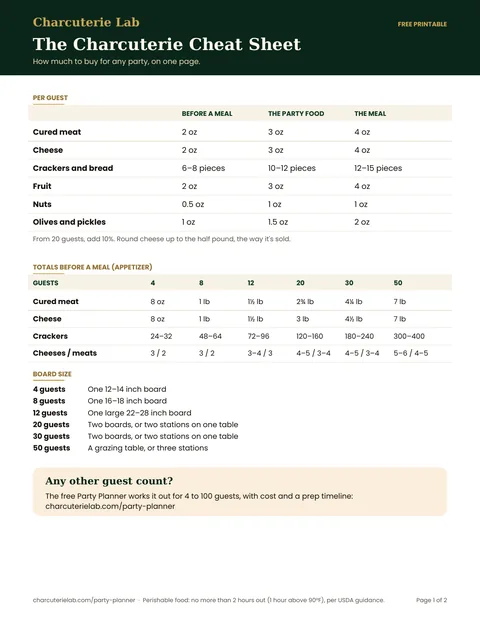
Plan on 2 oz of cheese per guest before a meal, 3 oz when the board is the party food and 4 oz when it's dinner, split across two or three cheeses. If Romano is on the board, count it as a garnish, about half an ounce per guest.
Which should you buy?
- For a Spanish or tapas board: Manchego curado, about 6 months.
- For a cheese-focused board: Manchego viejo, 12 months or more.
- For an Italian board: Pecorino Toscano.
- For pasta: Pecorino Romano.
Look for Queso Manchego DOP on the label. Our ranking of the best Manchego brands covers the ones worth buying, including the Costco wedge.