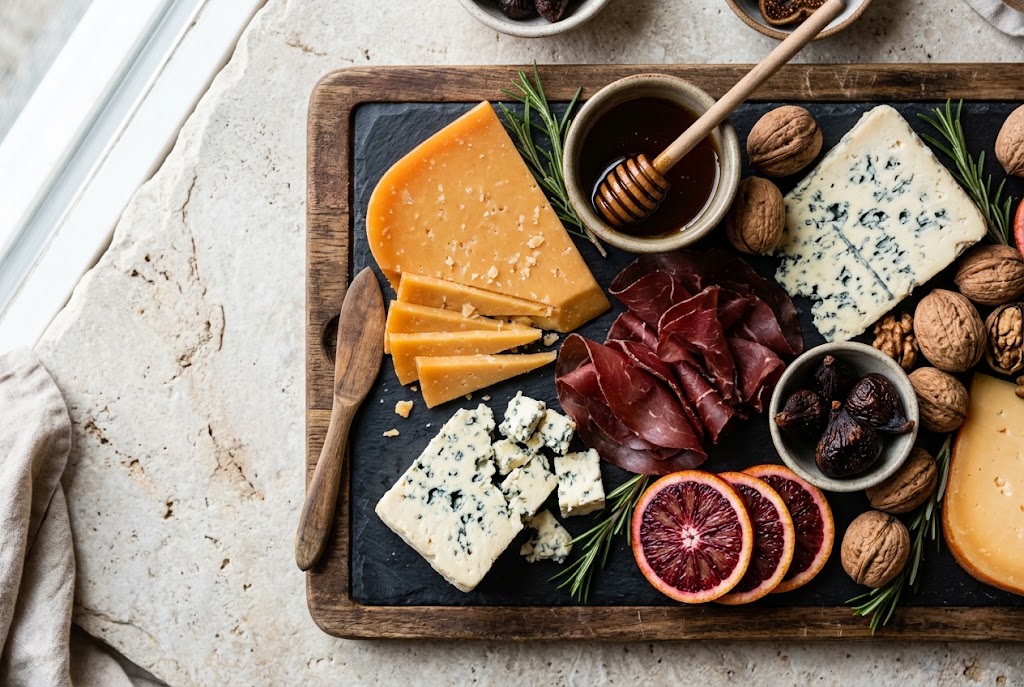
Winter is the right season for bold boards. Cold weather creates appetite for aged, rich, and intensely flavored food — which maps exactly onto what the best charcuterie elements offer: sharp Stilton, caramel-forward aged gouda, fat-rich prosciutto, and deep winter accompaniments like dark honey, dried cranberries, and spiced walnuts.
This is not a board dressed up in seasonal packaging. These are the cheeses and flavors that actually peak in winter.
Quick Answer: A winter charcuterie board centers on bold aged cheeses (Stilton, aged gouda, comté, aged cheddar), rich cured meats (prosciutto, coppa, salami), and seasonal accompaniments — dark honey, dried cranberries, spiced walnuts, fig jam, and rosemary. The winter flavor profile is deep, rich, and complex. Let the ingredients carry the season; the visual palette follows naturally.
Hosting for the holidays? Our Christmas charcuterie board ideas cover the festive versions. This board is built for the cold months after.
The Cheese Selection
Winter boards call for aged, assertive cheeses. The season's cold amplifies appetite for intensity, and the accompanying elements — dark honey, dried fruit, spiced nuts — are built to complement rather than compete with bold flavor.
Stilton is the essential winter blue. Crumbly and dense with notes of walnut, earth, and a sharpness that softens slightly at room temperature. It pairs with dark honey, dried cranberries, and port — all natural winter companions. If any cheese defines the season, it's Stilton.
Aged gouda (belegen or older) brings caramel sweetness from the Maillard reaction — the same browning process that caramelizes sugars in cooking. The older the gouda, the more pronounced the caramel and butterscotch notes. Aged gouda pairs with spiced walnuts and dried apricots in a way that feels distinctly winter.
Comté aged 18+ months is one of France's great winter cheeses. Its long aging produces complex notes of toasted bread, hazelnut, and mountain herbs. It works with Dijon mustard, cornichons, and a plain cracker.
Aged cheddar is the reliable anchor for guests who prefer familiar territory. Sharp, slightly crystalline, and versatile enough to pair with everything else on the board.
Triple-crème brie rounds out the selection as the creamy contrast — soft, rich, and mild against the assertiveness of the blues and aged hard cheeses.
The Meat Selection
Winter calls for rich, flavorful cured meats:
Prosciutto di Parma or San Daniele — the elegant, fat-forward foundation. Drape rather than roll.
Coppa — pork neck cured with red wine and spices. Its depth of flavor and slightly spiced edge are well-suited to winter boards.
Aged salami or finocchiona — fennel salami's winter spice notes make it more seasonally appropriate than a generic salami.
Bresaola (optional) — the lean beef alternative that provides contrast against the fat-forward pork meats.
The Winter Accompaniments
These are what make the board feel seasonal:
Dark honey or honeycomb — chestnut honey or buckwheat honey, both with complex bitter-sweet profiles that pair with Stilton and aged gouda.
Dried cranberries — tart, red, deeply seasonal.
Spiced walnuts or pecans — toasted with rosemary, cinnamon, or cayenne. The tannins in walnuts interact with aged cheese fat in a way that softens the cheese's edge.
Fig jam — the default bridge condiment for aged cheeses across the board.
Quince paste (membrillo) — dense, sweet-tart, and traditional with manchego; works with any aged hard cheese.
Cornichons and whole-grain mustard — essential for cutting through the richness and providing acidity between bites.
Rosemary sprigs — both garnish and edible herb. Arrange in small clusters as visual anchors. The piney, slightly resinous aroma of fresh rosemary complements aged gouda and prosciutto.
The Visual Palette
Winter's palette is deep: dark reds, forest greens, warm amber, and gold.
Deep red: Dried cranberries, pomegranate seeds, fig jam, coppa's deep-red slices Green: Rosemary sprigs, green grapes, green olives, fresh herbs Gold/amber: Aged gouda's interior, honeycomb, dried apricots, water crackers Deep brown: Spiced walnuts, dark honey, aged cheddar's rind
Every decorative element should be edible. If it's on the board, guests should be able to eat it.
Assembly Sequence
1. Cheese first — place the four cheeses as anchors in corners or quadrants of the board. 2. Fill condiment bowls (honey, fig jam, mustard, cornichons) and place adjacent to their paired cheeses. 3. Add meats — drape prosciutto near the brie, fold coppa near the aged cheddar, arrange salami in a separate cluster. 4. Fill gaps with dried cranberries, walnuts, and dried fruit. 5. Add rosemary sprigs and fresh garnish. 6. Add crackers and sliced bread last — immediately before serving.
Common Mistakes
Over-decorating. The board's visual character should come from the food, not from non-edible props. Rosemary, cranberries, and honeycomb do all the seasonal work without adding clutter.
Skipping the acidic element. Winter boards lean rich and heavy. Cornichons and mustard are non-negotiable — without acid, the board becomes monotonous after the first few bites.
Cold cheese. Allow 45–60 minutes at room temperature. Stilton is particularly dramatic in this regard: cold Stilton is dense and closed; at room temperature it opens up into its full walnut-and-earth profile.
Building more boards? The Charcuterie Lab ebook walks through 50 boards across every occasion — each one with exact quantities, a shopping list, and the science behind why it works.
The Charcuterie Lab Takeaway
Winter charcuterie is about giving the season's best ingredients room to do what they do naturally. Stilton with dark honey. Aged gouda with spiced walnuts. Coppa with cornichons. Rosemary sprigs and dried cranberries as the garnish that earns its place because it can be eaten. Build from the cheese outward, use acid to cut the richness, and let the aged, complex flavors carry the board.
FAQ
What goes on a winter charcuterie board?
Bold aged cheeses (Stilton, aged gouda, aged cheddar, comté), rich cured meats (prosciutto, coppa, salami), and seasonal accompaniments: dark honey or honeycomb, dried cranberries, spiced walnuts, fig jam, quince paste, cornichons, and rosemary sprigs. Winter boards lean into aged, rich, and intensely flavored elements because the season supports them.
What cheeses are best for a winter charcuterie board?
Stilton, aged gouda, aged cheddar, and comté are the strongest winter choices. Stilton's walnut-and-earth notes are distinctly seasonal. Aged gouda's caramel Maillard notes pair naturally with winter accompaniments. Comté (aged 18+ months) brings depth and complexity. One triple-crème brie as the creamy contrast rounds out the selection.
How do you make a winter charcuterie board look seasonal?
Use rosemary sprigs as visual garnish (they resemble miniature fir branches), dried cranberries and pomegranate seeds for deep red, honeycomb for gold texture, and green grapes or green olives for contrast. Every visual element should be edible. Dark honey, deep-red fig jam, and warm amber aged gouda provide the winter color palette naturally.
What wine pairs with a winter charcuterie board?
Bold reds — Cabernet Sauvignon, Syrah, Barolo — work with the aged cheese and rich cured meats on a winter board. Port pairs exceptionally with Stilton. If serving Champagne or sparkling wine, anchor one section of the board with triple-crème brie and prosciutto for a lighter pairing.
How is a winter charcuterie board different from a Christmas board?
A Christmas board is specifically themed for the holiday — decorative, festive, often with explicitly holiday elements. A winter board is seasonal in flavor without the holiday framing: it's appropriate for any winter gathering, dinner party, or casual evening. The ingredient logic is similar, but a winter board doesn't require the decorative intentionality of a Christmas spread.