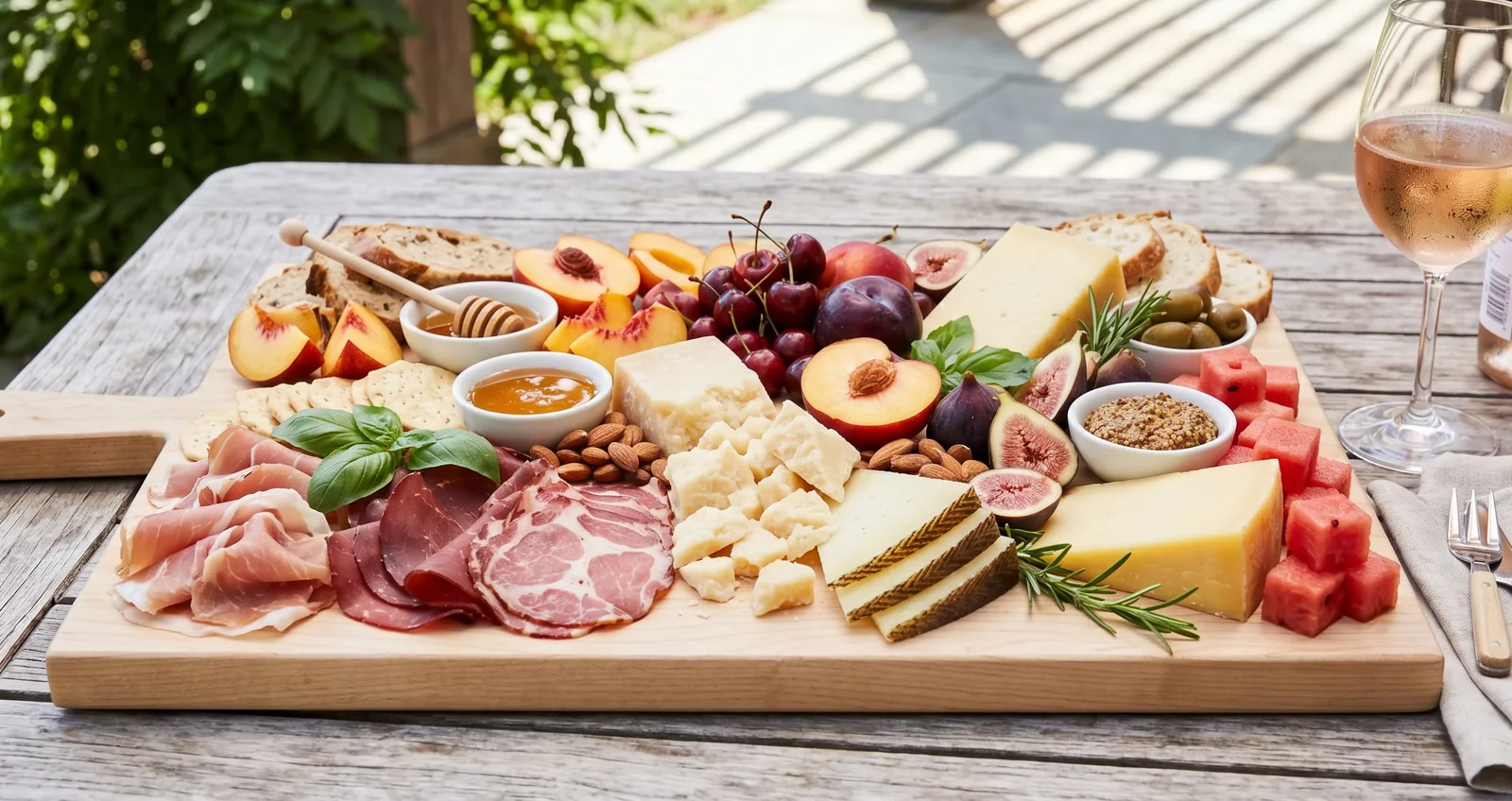
Quick Answer: A summer charcuterie board emphasizes fresh stone fruit, lighter cured meats (bresaola, prosciutto), and aged hard cheeses that hold up in heat. Swap brie and other soft cheeses for Parmigiano-Reggiano and aged manchego outdoors. Use rosé or Albariño. Plan for shorter food safety windows — soft items need rotation every 90 minutes in summer temperatures.
Why Summer Changes the Board
Season changes a charcuterie board in two ways: ingredient availability and temperature management.
Summer brings the year's best stone fruits — peaches, nectarines, plums, fresh figs in late August — which are the most naturally complementary to cured meats and aged cheese of any fruit category. The acidity in ripe stone fruit cuts fat precisely, and the floral aromatics bridge the gap between the board's savory and sweet elements.
Temperature management is the less glamorous consideration but arguably the more important one. Soft cheeses (brie, camembert, fresh chèvre) become unsafe at warm outdoor temperatures faster than the standard two-hour rule accounts for. Above 75°F (24°C), reduce the limit for soft items to 90 minutes. In direct summer sun, 60 minutes is the safe ceiling.
The practical solution is selecting cheeses that don't carry this risk — aged hard cheeses with low moisture content that hold their texture even in summer heat. The food-safety limit is still 1 hour above 90°F.
Cheese That Works in Summer
Aged hard cheeses are summer's workhorses. Low moisture, high protein structure, excellent heat stability. The best summer choices:
Parmigiano-Reggiano: hard, granular, crystalline, and completely stable at room temperature. Break into irregular shards rather than slicing — the texture is part of the experience. Its umami intensity works well against the fresh, bright flavors of summer stone fruit.
Aged manchego (curado to viejo): the extra aging reduces moisture content further. The caramel-nutty flavor complements stone fruit better than most cheeses. Slice thin and fan.
Aged cheddar (24+ months): sharp, crystalline, and firm enough to hold up in heat. Its saltiness makes stone fruit taste more vivid. Choose a quality sharp cheddar, not a mass-produced block.
Aged Gruyère: the cave-aged version (Premier Cru) has enough density to hold well outdoors. Its caramel-walnut character pairs exceptionally with summer fruit.
If the party is indoors with air conditioning, brie and soft cheese are back on the table — the standard food safety rules apply.
Summer Meats
Bresaola (air-dried cured beef from the Valtellina valley) is summer's ideal cured meat: lean, delicate, with a subtle herbal-peppery quality that doesn't overwhelm fresh fruit. It's lighter than most cured pork products and holds up better at room temperature because of its low fat content.
Prosciutto remains excellent in summer when served at the right temperature. Its delicate fat complements stone fruit beautifully — the prosciutto-peach combination is the summer equivalent of the winter prosciutto-fig pairing.
Thinly sliced coppa works well, but avoid heavily spiced varieties in heat — the spice becomes more assertive as the meat warms.
Avoid in summer outdoor conditions: heavily smoked sausages (they become greasy as they warm), pepperoni and highly spiced salamis (heat intensifies spice in ways that fight fruit pairings), and any sliced sausage with a high fat content that will pool visibly in the heat.
Summer Fruit Pairings
Stone fruits are summer's defining charcuterie contribution and the reason a summer board looks and tastes different from every other season.
Peaches: Slice ripe peaches into wedges immediately before serving (they brown quickly). The floral-sweet character works with prosciutto, bresaola, and aged hard cheese. The acidity of a ripe peach cuts cured meat fat as effectively as apple.
Nectarines: Similar pairing logic to peaches, slightly firmer texture, no browning issue after cutting. Red or yellow varieties both work.
Plums (red, black, or Italian): Higher tannin and acidity than peaches. The slight tartness of a plum creates a contrast pairing with salty aged cheese that works particularly well. Italian prune plums (small, dark, late summer) are the most flavor-dense option.
Cherries: Serve whole with stems on. The bittersweet quality of fresh dark cherries pairs well with aged hard cheese — the slight bitterness contrasts the fat in the same mechanism as walnuts.
Fresh figs (late July–September): The best pairing on the entire summer board. Fresh figs, unlike dried figs, have enough acidity and moisture to work as a fresh fruit element. Their tannin content from the skin creates the same fat-binding mechanism as fig jam. Halve them and place cut-side up.
Watermelon: Cut into small triangles or cubes. The high water content makes it the most palate-cleansing fruit on a summer board. Keep it in a small cluster — it weeps and can make the board soggy if it spreads.
Summer Board Assembly and Safety
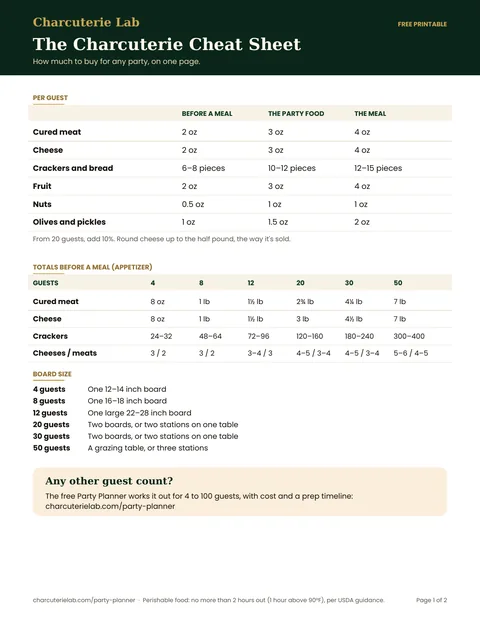
Quantities for summer: Plan the same per-person ratios as any board (2–3 oz meat, 2–3 oz cheese), but skew toward more fruit. Summer guests expect lighter eating, and stone fruit is generous — more volume, lower caloric density than dried fruit.
Stagger the soft elements. If the party runs 3+ hours, plan for the board in two waves. Set out aged hard cheese and whole cured meats at the start. Add soft cheese (if using) and pre-cut stone fruit at the 30–45 minute mark, and plan to refresh or remove them at 90 minutes.
Shade matters. Direct summer sun warms a board far faster than ambient temperature alone. If possible, position the board in shade or under a covered area. White marble boards retain less heat than wood or slate.
Building more boards? The Charcuterie Lab ebook includes seasonal board variations with exact quantities and shopping lists for every occasion.
The Charcuterie Lab Takeaway
Summer charcuterie is about two things: leaning into stone fruit at its peak and choosing cheeses that don't collapse in the heat. Bresaola and prosciutto over spiced sausages. Aged manchego and Parmigiano-Reggiano over brie outdoors. Rosé in the glass. Fresh figs when they're in season — they are the best pairing on the board.
Sources
FAQ
What cheese holds up best on a summer charcuterie board?
Aged hard cheeses hold up best in summer heat: Parmigiano-Reggiano, aged manchego, aged cheddar, and Gruyère all have low enough moisture content to hold their texture in the heat, while the 1-hour rule above 90°F still applies to the board. Avoid brie, camembert, and other soft-ripened cheeses outdoors in summer — they become runny and can reach unsafe temperatures within 90 minutes.
What meat goes on a summer charcuterie board?
Lighter, delicate cured meats are better in summer: bresaola (air-dried beef), prosciutto, and thinly sliced coppa. Avoid heavily spiced or smoked sausages in hot weather — they become greasy and the spice can overwhelm the lighter seasonal fruit elements on a summer board.
How long can a summer charcuterie board sit out?
In summer heat (above 75°F / 24°C), soft cheeses and cut fruit should not sit out longer than 90 minutes. If the party is outdoors in direct sun, reduce that to 60 minutes. Aged hard cheeses and whole cured meats hold for 2–3 hours even in summer conditions.
What fruit goes on a summer charcuterie board?
Stone fruits are summer's best contribution to a charcuterie board: sliced peaches, nectarines, and plums all pair well with aged cheese and cured meats. Fresh figs (when in season late summer), cherries, and watermelon chunks in small pieces also work well. The acidity in stone fruit cuts cured meat fat effectively.
What wine pairs with a summer charcuterie board?
Rosé is the natural summer pairing — it has enough acidity to cut fat, enough fruit to match summer stone fruits, and it serves well chilled. Albariño and dry Riesling are strong white wine alternatives. Avoid full-bodied tannic reds in summer heat — they taste heavier than they should.