Quick Answer: A Christmas charcuterie board for 15–25 holiday guests needs 3 oz each of cheese and meat per person for 2–3 hours of grazing, plus 10% from 20 guests up. Build the red-green-white holiday palette from ingredients: prosciutto and pomegranate for red, Castelvetrano olives and rosemary for green, brie and white crackers for white. Four cheeses, three meats, generous produce and condiments.
Want themes instead? See our Christmas charcuterie board ideas: the wreath, the tree and a hot cocoa board. For January and February, try a winter board.
The Christmas board serves a different function than most event boards. It's a two-to-three hour grazing platform, not a pre-dinner appetizer. That changes the quantity formula, the variety logic, and the visual requirements.
Quantity Formula for 15–25 Guests
For 2–3 hours of continuous grazing at a holiday party:
Cheese: 3 oz per person, plus 10%. For 20 guests: about 4½ lb total across 4–5 types. Meat: 3 oz per person, plus 10%. For 20 guests: about 4¼ lb total across 3–4 types. Crackers/bread: Two to three boxes of crackers plus a sliced baguette. Fruit: Two clusters of grapes, two apples, one pear, plus dried fruit and berries.
Total build cost for 20 guests: $90–120 depending on sourcing and region.
For very large events (30+), build two boards rather than one oversized board. This prevents the board from looking depleted, and it's easier to replenish a second board than to rebuild one.
The Holiday Cheese Selection
Aged cheddar: The reliable anchor. Red wax cheddar adds visual seasonality. White cheddar is sharper and more versatile. Pre-slice into wedges or serve as a block with a knife.
Brie or triple cream: The creamy centerpiece. Place on a small board within the board or as the visual anchor. Score the top in a crosshatch pattern and drape with honeycomb for a presentation moment.
Manchego: Firm, nutty, universally loved. Slices cleanly and fans out well. Pairs with everything on the board. The safe bet for guests who aren't adventurous cheese eaters.
Gorgonzola dolce or mild blue: The bold note. Gorgonzola dolce is creamy and mild rather than aggressive — the entry point for guests who think they don't like blue cheese. Pair it with honeycomb and walnuts and it converts people.
Optional fifth: a fresh goat cheese log rolled in herbs or dried cranberry and pistachio. It's festive, requires no slicing, and photographs beautifully.
The Holiday Meat Selection
Prosciutto: The visual star. Fold into roses or drape in loose waves. Deep pink-red color contributes directly to the holiday palette.
Soppressata or Calabrese: Red salami rounds add color, visual variety, and spice contrast. Stack in rosettes.
Coppa or bresaola: A second whole-muscle option with a different texture and color profile from prosciutto. Bresaola (beef) is darker and leaner.
Optional: A hard salami like Genoa or Milano for something more neutral and universally appealing.
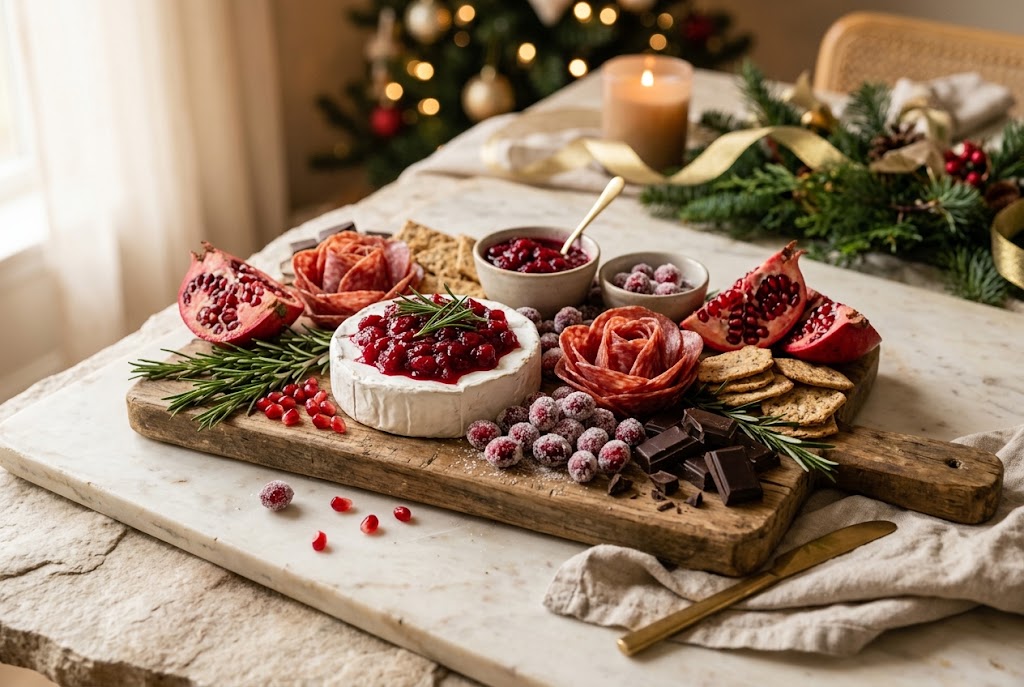
The Red-Green-White Palette
The Christmas board's visual power comes entirely from ingredient selection, not decoration.
Red: Prosciutto, Calabrese salami, dried cranberry, pomegranate arils, red grapes, fresh strawberries, cherry tomatoes (halved).
Green: Castelvetrano olives, green grapes, cucumber rounds, pistachio, fresh rosemary sprigs, fresh thyme, green apple slices.
White/cream: Brie rind, manchego slices, water crackers, white cheddar, fresh chèvre, honeycomb.
Rosemary sprigs are the single most effective holiday garnish — they smell like Christmas, look like greenery, and fill visual gaps without affecting flavor.
Condiments and Accents
Honeycomb: The luxury item. Place a full comb section on the board — it photographs better than drizzled honey and tastes the same. Pairs with cheddar, brie, and blue cheese.
Fig jam: In a small jar or bowl. Pairs with manchego, brie, and prosciutto.
Whole grain dijon: The savory contrast. Pairs with cheddar, salami, and coppa.
Cornichons: Acid relief for the palate between rich bites. Non-negotiable on a board this size.
Candied walnuts or pecans: The sweet-savory bridge. Scatter throughout the board.
Dark chocolate: Broken pieces of 70%+ dark chocolate add a festive note and pair genuinely well with aged cheddar and blue cheese.
Build Sequence
- Place cheese anchors first at three to four points on the board, evenly spaced.
- Add meat folds between each cheese anchor.
- Place condiment bowls (fig jam, mustard) at corners or tucked beside cheeses.
- Arrange fruit in clusters — grapes in two corners, apple/pear slices grouped with relevant cheeses.
- Fill gaps with olives, dried cranberry, nuts, and cornichons.
- Insert rosemary sprigs into remaining gaps — they occupy visual space without taking up plate room.
- Add crackers in a fanned cluster along one or two edges.
Make-Ahead Timeline
Day before: Purchase everything. Slice and portion hard cheeses into serving pieces. Refrigerate wrapped.
2 hours before: Assemble full board, cover tightly with plastic wrap, refrigerate.
45 minutes before: Remove from refrigerator. Unwrap. Cheese comes to temperature.
5 minutes before: Add crackers and any sliced fresh fruit.
The Charcuterie Lab Takeaway
The Christmas board is a grazing platform, not an appetizer — plan 3 oz each of cheese and meat per person for 2–3 hours. Build the red-green-white palette from ingredients: prosciutto and pomegranate for red, Castelvetrano olives and rosemary for green, brie and water crackers for white. Four cheeses and three meats gives the range needed for a crowd with varied tastes. Build 2 hours ahead, pull from refrigerator 45 minutes before, add crackers last.
Building more boards? The Charcuterie Lab ebook covers 50 boards with exact quantities, shopping lists, and the pairing science behind every combination — including the full holiday season.
FAQ
How much food do you need for a Christmas charcuterie board?
For a holiday party of 15–25 guests grazing over 2–3 hours, plan 3 oz each of cheese and meat per person, plus 10% from 20 guests up — this is a longer grazing event than a pre-dinner board. For 20 guests: about 4½ lb of cheese and 4¼ lb of meat across 4–5 types each. Add generous produce, crackers, and condiments to fill the board visually.
What cheeses work best on a Christmas charcuterie board?
Aged cheddar (red wax or white, both festive), brie (the creamy centerpiece), manchego (firm, nutty, universally loved), and a blue or gorgonzola for contrast. For a four-cheese board, this combination covers every flavor and texture register. Avoid overly niche selections for a large holiday crowd — approachability matters when serving guests with varied palates.
What's the best red and green color palette for a Christmas board?
Red: prosciutto, salami, dried cranberry, pomegranate arils, red grapes, strawberries, cherry tomatoes. Green: Castelvetrano olives, green grapes, fresh rosemary, pistachio, cucumber, kiwi. White/cream: brie, manchego, white crackers, white cheddar. This palette works without any artificial decoration — the ingredients themselves create the visual.
What wines pair with a Christmas charcuterie board?
Sparkling wine (Champagne, Prosecco, Cava) works with everything on the board — acidity and bubbles cut through fat and cleanse the palate. For red, choose a Pinot Noir or lighter Gamay — big tannic reds overpower soft cheeses. Gewürztraminer and off-dry Riesling complement fruit elements and spiced meats. Mulled wine can be offered separately.
How far in advance can you build a Christmas charcuterie board?
Build up to 2 hours before guests arrive and refrigerate covered with plastic wrap. Pull out 45 minutes before serving for cheese to reach room temperature. Add crackers and bread immediately before serving — never in advance. For large events with multiple boards, stagger preparation so fresh boards replace empty ones rather than a single large board sitting out for hours.