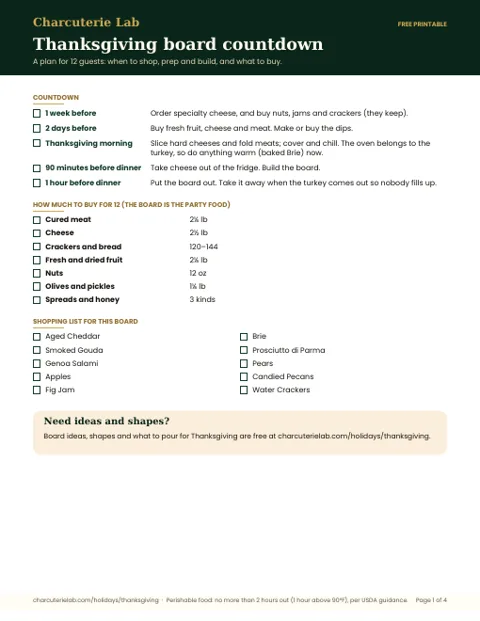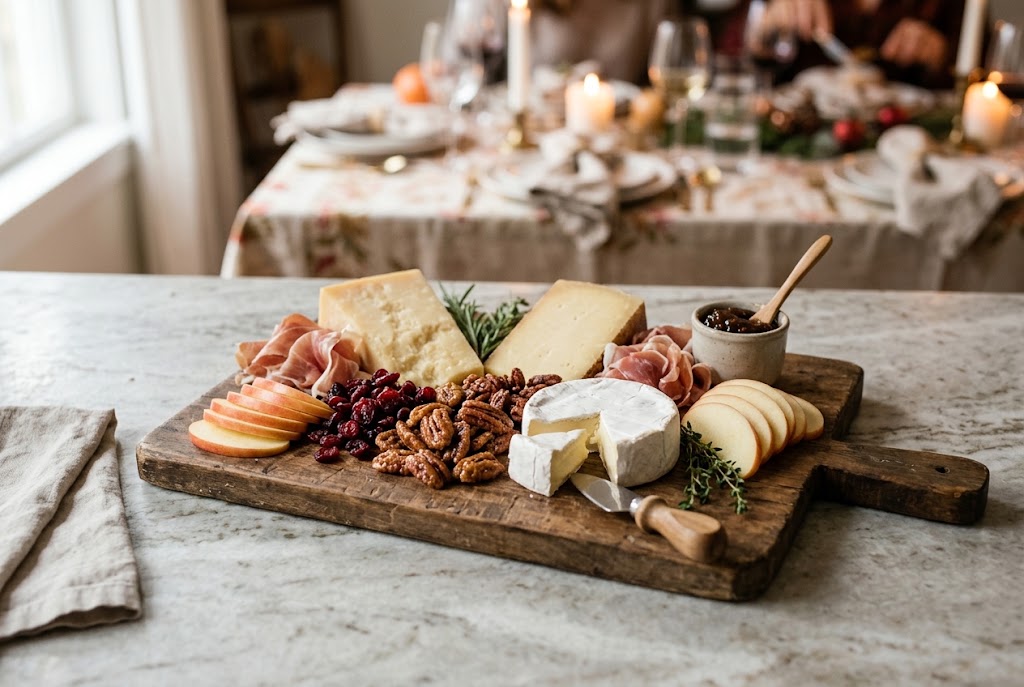
Quick Answer: A Thanksgiving charcuterie board works as a pre-dinner appetizer for 12–20 people using 2 oz each of cheese and meat per person (smaller portions than a standalone board since dinner follows). Choose cheeses with fall affinity — aged cheddar, brie, aged gouda — and pair with apple, pear, dried cranberry, and honeycomb. Skip heavily smoked meats that compete with turkey.
Want themes instead? See our Thanksgiving charcuterie board ideas: the turkey board, a Thanksgiving pie board and a Friendsgiving board.
The Thanksgiving board has a specific job: sustain guests during the gap between arrival and dinner without spoiling appetite. That means portioning down from a standalone board, choosing flavors that harmonize with the meal ahead, and building a palette that reads as intentionally autumnal.
The Quantity Formula for 12–20 Guests
Pre-dinner board math differs from a standalone board. When dinner follows within 90 minutes, guests eat more conservatively.
Cheese: 2 oz per person. For 15 guests: about 2 lb total across 3 types. Meat: 2 oz per person. For 15 guests: about 2 lb total across 2–3 types. Crackers: 6–8 per person (two boxes minimum for 15 guests). Fruit: One cluster of grapes + sliced apple + sliced pear covers 15 guests adequately.
Total build cost for 15 guests: $55–75 depending on cheese selection.
Fall Cheese Selection
The Thanksgiving board calls for cheeses with autumnal flavor profiles — warm, nutty, and complex without being polarizing.
Aged cheddar: The reliable anchor. Sharp, familiar, crowd-pleasing, and directly enhanced by apple and honey pairings. Use white cheddar for a cleaner visual. A Vermont or English clothbound cheddar elevates the selection.
Brie or triple cream: The textural contrast. Creamy, mild, and approachable. Its buttery richness doesn't compete with the meal ahead the way a stinky washed rind would. Fan-slice to show the paste.
Aged gouda: The distinctive choice. At 18+ months, Dutch gouda develops caramel, butterscotch, and toffee notes from the Maillard reaction in the curd. These flavors are genuinely seasonal — they pair with apple, pear, and dried fruit in a way that reads as inherently autumnal.
Optional fourth: Gorgonzola dolce. The sweeter, creamier Italian blue. Pairs with pear, honeycomb, and walnut. Use if your guest group tolerates blue cheese — if uncertain, skip it.
Fall Meat Selection
Thanksgiving's flavor profile trends toward herbs, warm spice, and richness. Smoked meats fight those flavors. Lighter cured meats complement them.
Prosciutto: The default elegant meat. Drape loosely rather than folding — thin sheets look more generous and take up more board real estate.
Coppa or capicola: Slightly more robust than prosciutto, with a mild spice note that pairs well with the apple and pear elements.
Dry salami or Calabrese: Adds visual pop (the deep red rounds against orange and brown autumn colors) and spice contrast to the mild cheeses.
Avoid heavily smoked meats: smoked gouda as an additional cheese is fine, but smoked kielbasa, smoked brisket, and similar products carry flavors that fight Thanksgiving wines and sides.
The Fall Produce Palette
Fruit: Sliced honeycrisp or pink lady apple, sliced ripe pear, red and black grapes, dried cranberries, dried apricot, medjool dates. Fresh figs if available. Pomegranate arils scattered as color accents.
Nuts: Candied walnuts or pecans are the most seasonally appropriate choice. The caramelized sugar and nut combination mirrors the gouda's caramel notes.
Vegetables: Roasted butternut squash cubes (if doing a more substantial board), cornichons for acid relief, whole grain mustard.
Condiments: Honeycomb or liquid honey (pairs with cheddar and brie), fig jam, whole grain dijon.
Color Palette and Visual Strategy
Thanksgiving's autumnal palette: amber, deep red, burnt orange, and green accents.
Amber: honeycomb, aged gouda, dried apricot Deep red: Calabrese salami rounds, dried cranberry, pomegranate arils Burnt orange/warm brown: water crackers, crostini, candied walnuts, dates Green: grapes, fresh rosemary sprigs, cornichons
Rosemary and thyme sprigs as garnish are both functional (they smell like Thanksgiving) and visual. Place them in gaps rather than grouped together.
Build Sequence
Start with the largest elements: brie wedge, block of cheddar, aged gouda cut into triangles. Place these at three anchor points on the board.
Add meat folds between the cheese anchors. Prosciutto draped in loose waves, salami in rosettes or stacked rounds.
Fill in produce: grape cluster in one corner, apple and pear slices in another, dates and dried cranberry scattered through gaps.
Add condiments in small bowls or dropped directly onto the board: honeycomb in the center, fig jam in a corner ramekin.
Final layer: crackers clustered along one edge, rosemary sprigs in remaining gaps.
Make-Ahead Timeline
2 hours before guests arrive: Build the full board (minus crackers and cut apple/pear). Cover tightly with plastic wrap. Refrigerate.
30–45 minutes before: Pull from refrigerator, remove wrap. Cheese needs to warm to room temperature.
10 minutes before: Add crackers and sliced apple/pear (cut apple won't brown in 10 minutes if the pieces are thick).
The Charcuterie Lab Takeaway
The Thanksgiving board succeeds when it's calibrated to its role: pre-dinner sustenance, not the meal itself. Portion down from standalone quantities, lean into autumnal flavors (aged gouda, apple, pear, honeycomb, candied walnut), and skip smoked meats that compete with the turkey and Thanksgiving wines. Build 2 hours ahead, pull from the refrigerator 45 minutes before serving, and add crackers and cut fruit last.
Building more boards? The Charcuterie Lab ebook covers 50 boards across every occasion — including the holiday season — with exact quantities, shopping lists, and the science behind every pairing.
FAQ
How much food do you need for a Thanksgiving charcuterie board?
For a pre-dinner appetizer board serving 12–20 guests, plan 2 oz each of cheese and meat per person, less than a standalone board because Thanksgiving dinner follows. Total for 15 guests: roughly 25oz cheese and 20oz meat across 3–4 types each. Scale up if the board serves as dinner rather than a starter.
What cheeses work best on a Thanksgiving charcuterie board?
Aged cheddar (sharp, familiar, crowd-pleasing), a creamy brie or triple cream (contrasts the rich meal ahead), and an aged gouda with caramel notes (amplified by apple and pear accents). A mild blue like Gorgonzola dolce works well if your crowd tolerates it. Avoid intensely funky choices — the board competes with strong Thanksgiving flavors.
What meats pair with Thanksgiving flavors on a charcuterie board?
Prosciutto, coppa, and dry salami work well — they're lighter than heavy smoked meats and don't compete with turkey. A spiced salami like Calabrese adds warmth that echoes fall spices. Skip heavily smoked meats; the smoke flavor conflicts with traditional Thanksgiving side dishes and wines.
What fall fruits belong on a Thanksgiving board?
Sliced apple (honeycrisp or pink lady), sliced pear, red and green grapes, dried cranberry, dried apricot, and pomegranate arils for color. Fresh figs if in season. These fruits pair with both the cheeses and the wines typically served at Thanksgiving — Pinot Noir, Riesling, and Gewürztraminer all work with apple and pear.
Can you build a Thanksgiving charcuterie board ahead of time?
Yes — build up to 2 hours in advance and cover with plastic wrap. Keep refrigerated and pull out 30–45 minutes before serving so cheese reaches room temperature. Add crackers, bread, and any cut fruit (apple, pear) just before serving to prevent sogginess and browning. Dried fruits, nuts, and condiments can be placed during initial build.