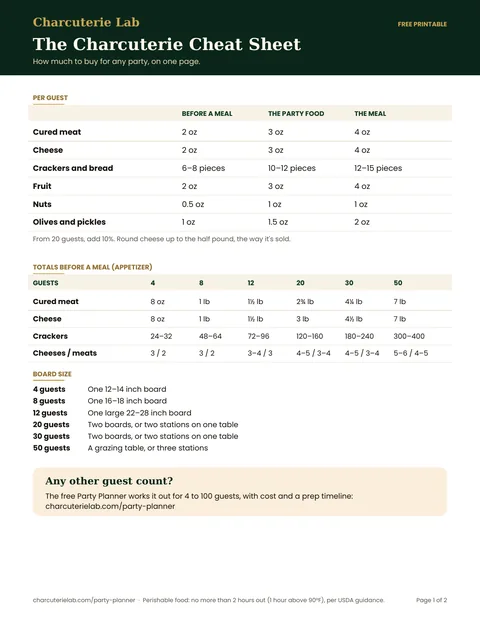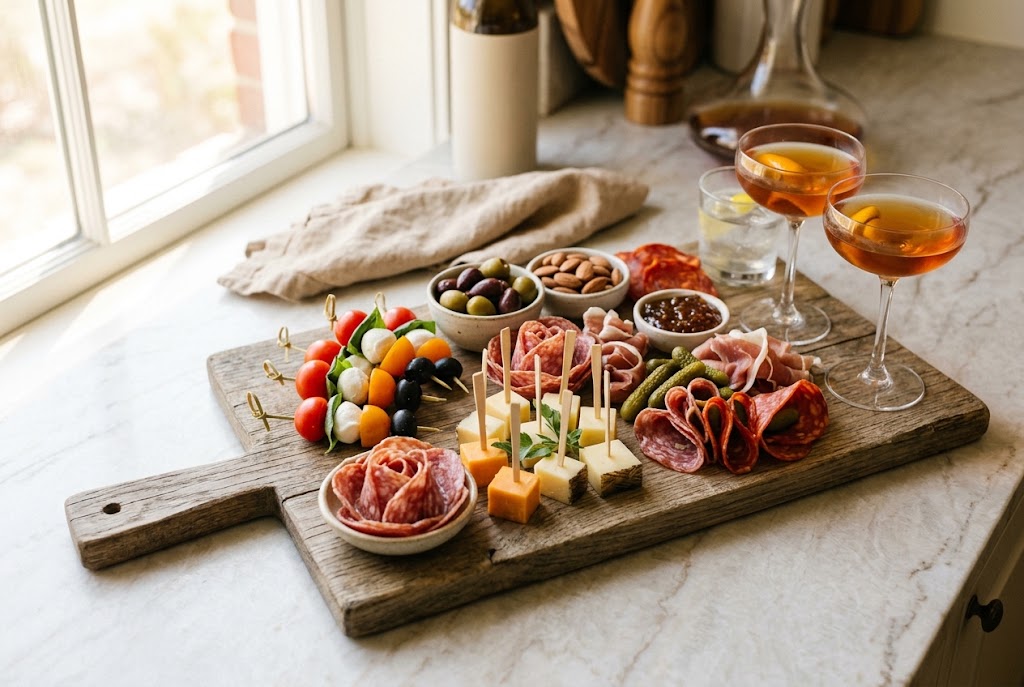
Quick Answer: Guests are standing with a drink in one hand, so everything must be eaten one-handed: firm cheese cut into ¾-inch cubes, meats pre-folded, bites on picks, nothing that needs a knife. Set the board at counter height and keep a second board ready to swap in once the first looks picked over.
What Makes a Cocktail Party Board Different
A cocktail party board has one constraint that a standard entertaining board doesn't: guests are standing, holding a drink in one hand, and have limited coordination for assembly. They can't pick up a knife, spread cheese on a cracker, fold a piece of prosciutto, and manage a glass simultaneously. Everything that requires two hands, a plate, or a seated position fails in a cocktail context.
This changes the design rules. A cocktail party board is built for one-handed eating — smaller pieces, pre-assembled combinations where possible, and positioning that doesn't require the guest to lean over or reach awkwardly. The visual aesthetic shifts too: instead of the abundant, overflowing style of a grazing table, a cocktail board should be refined, ordered, and easy to navigate at a glance.
The payoff is worth the additional thought: a well-built cocktail board drives guest interaction and conversation in a way that a bowl of chips doesn't. When guests pick up a pre-skewered combination — manchego, prosciutto, cornichon on a pick — and discover that it tastes like a designed experience, the board becomes a talking point.
The Cocktail Board Ingredient Framework
Cheese: Select firm, pickable cheeses that can be pre-cubed to 3/4-inch pieces — aged cheddar, manchego, aged Gouda, Gruyère, provolone. Cut them into cubes before assembling the board. Avoid cheeses that require a knife and spreader (chèvre, burrata) — they're impossible to eat standing. Exception: a whole small brie, pre-cut into wedges, which guests can pick up by the rind without needing additional tools.
Meat: Thin-sliced, pre-folded or rolled. Prosciutto folded into small rectangles or quarters. Salami in half-moon folds or small rolls. Speck or coppa in loose ruffles. Everything should be one-bite size or easily torn to size without tools.
Accompaniments: Small, grabbable elements only. Castelvetrano or Cerignola olives (large enough to hold with fingers, pitted for ease). Cornichons in a small bowl. Grape clusters broken into 2–3 fruit sections. Marcona almonds in a small dish. Mini crackers, rounds, or small crostini rather than large crackers that require breaking.
Pre-assembled bites: This is the differentiator of a cocktail board. Prepare 12–15 skewered combinations per 8–10 guests:
- Manchego cube + prosciutto fold + 1 cornichon on a pick
- Grape + aged cheddar cube + 1 Marcona almond on a pick
- Small brie wedge + 1/2 dried fig + 1 walnut on a pick
- Prosciutto-wrapped Marcona almond (no pick needed, self-contained)
Thread these onto 4-inch appetizer picks and arrange in clusters across the board. They telegraph the pairings, solve the one-handed coordination problem, and photograph dramatically.
Quantities for a Cocktail Party
Scale differs from a seated board:
When board is one appetizer among several:
- Cheese: 2 oz per person
- Meat: 2 oz per person
- Accompaniments: proportional
When board is the primary food:
- Cheese: 3 oz per person
- Meat: 3 oz per person
- Accompaniments: scale up significantly
For a 20-person cocktail party where the board is one of several appetizers: approximately 1.5 lbs cheese, 1.25 lbs meat, and proportional accompaniments. Build slightly more than this calculation suggests — cocktail guests graze in waves, and running out early is worse than having leftovers.
Board Positioning and Setup
Height matters at a cocktail party. A board placed on a standard dining table (30 inches) works for seated guests but requires standing guests to bend awkwardly. Position boards on a kitchen island, bar cart, console table, or use risers on a standard table to bring the board to counter height (36 inches). This makes grazing natural and comfortable.
Multiple smaller boards outperform one large board. Rather than one 20-inch board for 20 people, use two 12-inch boards positioned at different locations in the party space. This distributes the crowd, prevents bottlenecks, and allows guests on both sides of a room to graze without navigating around each other.
Leave space around the board. Unlike a dinner table board where guests sit around the edges, a cocktail board needs clear approaching space for guests to step up, select something, and step away. Leave 18–24 inches of unobstructed space in front of the board.
The Two-Board System
Cocktail party boards face an appearance problem that dinner boards don't: by 90 minutes in, a single board looks depleted and picked-over, which signals to arriving guests that they've missed the food. This is both visually unappealing and socially discouraging.
The two-board system solves this. Assemble two identical boards before the party. Set the first board out when guests arrive. Keep the second covered in the refrigerator. At the 90-minute mark, swap them — bring the fresh board out, clear the depleted one, and refill it from any remaining ingredients for a third rotation if needed.
Guests who arrive at the 90-minute mark get the same experience as guests who arrived at the beginning. The board stays visually fresh throughout the event. The total setup investment is approximately 15 minutes more than building one board.
Common Mistakes
Using a full-size board format. A standard entertaining board with large cracker fans, whole cheese wedges, and spread-on condiments is a different format entirely — it works for seated or semi-seated guests but fails for a cocktail party standing crowd. Adapt the format, not the ingredient list.
Condiments in wide, flat bowls. A wide, flat bowl of fig jam at a cocktail party gets knocked over, gets fingers in it, and is impossible to use without a spreading surface. Use small, deep ramekins with a spoon, positioned toward the edge of the board where they're accessible without guests reaching over everything else.
Forgetting napkins. A cocktail board without napkins creates immediate discomfort. Position a stack of cocktail napkins at each board end. Guests should never have to set their drink down to eat from the board.
No pre-assembled options. A cocktail board with no pre-built bites puts all the assembly work on the guest, who then has to set their drink down, navigate three separate elements, and build a combination on a cracker — with one hand. Pre-assembled picks solve this and dramatically increase engagement.
The Charcuterie Lab Takeaway
The cocktail party board rewards the 15 minutes of additional thought it takes over a standard board. Build for one-handed eating: small pieces, firm cheeses, pre-folded meat, pickable accompaniments, and pre-assembled bites on picks. Position at counter height, use two boards for longer events, and leave space for guests to approach and retreat easily. The format serves the occasion — and the occasion is served by the format.
Building more boards? The Charcuterie Lab ebook walks through 50 boards across every occasion — each one with exact quantities, a shopping list, and the science behind why it works.
FAQ
What is a cocktail party charcuterie board?
A cocktail party board is built for standing guests who are eating one-handed while holding a drink. The ingredients are smaller, the presentation more bite-sized, and the board positioned at standing height. Skewer-able elements, small cracker rounds, and pre-built one-bite combinations make the board functional for guests who can't sit down with a plate.
How much food do you need for a cocktail party charcuterie board?
For a cocktail party where the board is one of several appetizers: 2 oz each of cheese and meat per person. For a cocktail party where the board is the primary food: 3 oz each of cheese and meat per person. Cocktail guests typically eat less per hour than seated dinner guests but over a longer period — plan for 2–3 hours of continuous grazing.
What cheeses work best for a cocktail party board?
Firm cheeses that can be pre-cubed or sliced into bite-sized pieces work best — aged cheddar, manchego, Gruyère, aged Gouda. Avoid runny soft cheeses that require a spreader and a moment of focus. Brie works if pre-cut into wedges; leave it in the rind so guests can pick it up cleanly without a knife.
Should I pre-build bites on a cocktail party board?
Yes — pre-assembled one-bite combinations dramatically increase guest engagement. Thread a small cube of manchego, a folded piece of prosciutto, and a cornichon onto a short pick. Wrap a Marcona almond in a half-slice of prosciutto. Skewer a grape, a piece of aged cheddar, and a date. Pre-built bites remove the coordination challenge for standing guests and signal intentional pairing.
How do you keep a cocktail party board fresh over 2-3 hours?
Use a two-board system: set out one board at the start and keep a second assembled board in the refrigerator. Swap boards at the 90-minute mark — the fresh board goes out, the depleted one gets cleared. This prevents the tired, picked-over look of a single board at the end of an event and ensures the last guests get the same experience as the first.