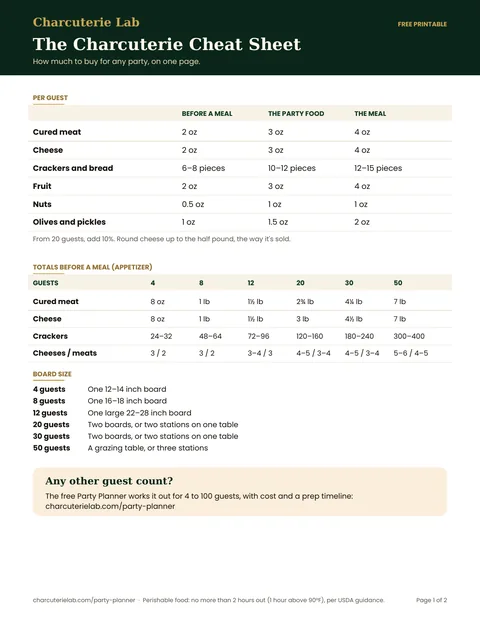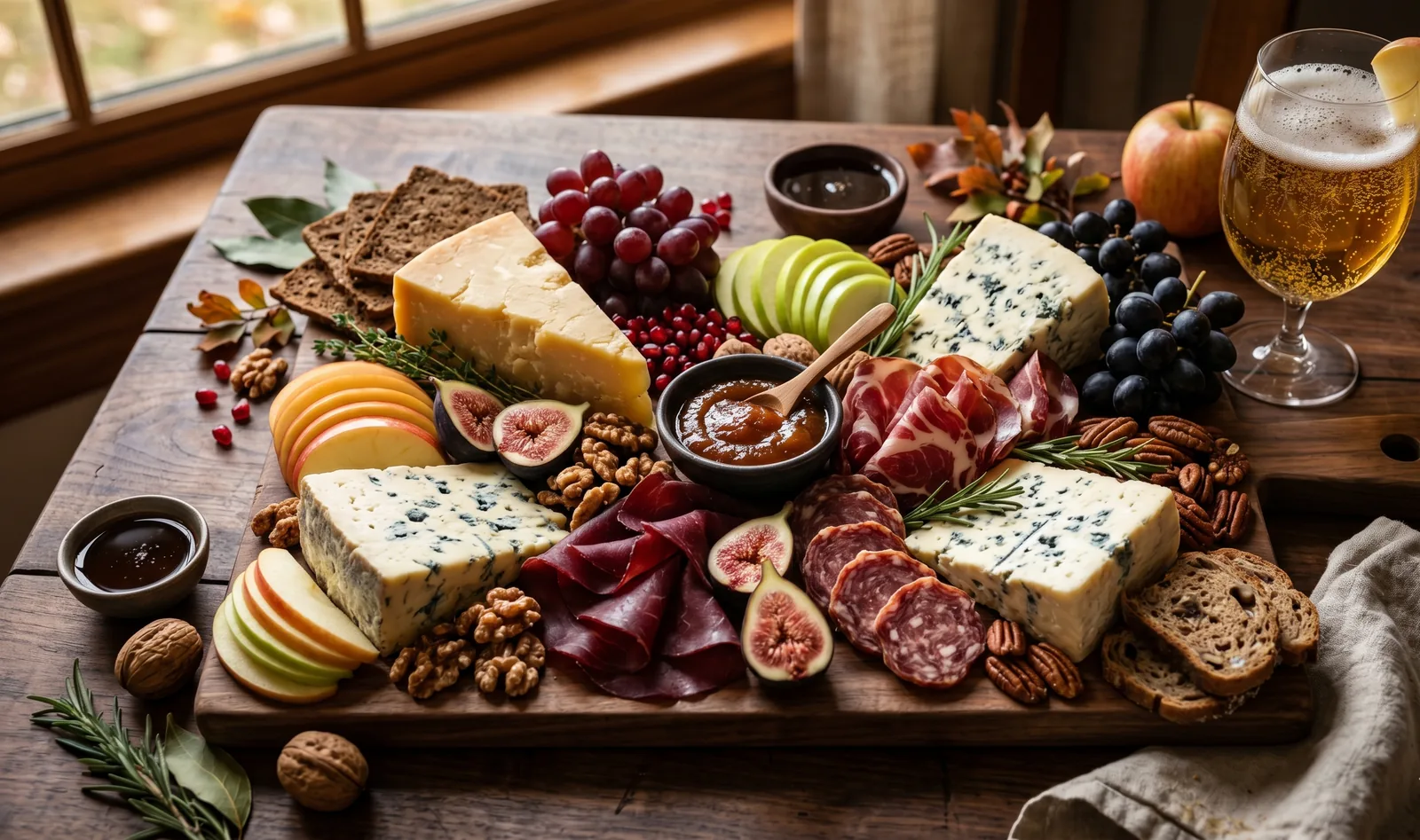
A fall charcuterie board is not a regular board with leaves and pinecones placed around it. The best autumn boards are built around the specific flavor properties of seasonal fall ingredients — the tannin and richness of walnuts, the sharp acidity of fresh apple, the caramel notes of aged Gouda that echo the flavor of apple cider, the dried-fruit complexity of Stilton that mirrors the season's ripe-and-dried fruit repertoire.
Building a fall board well means understanding why these ingredients belong together beyond just "it's the right season."
Quick Answer: A fall charcuterie board uses autumn's best produce and harvest flavors: aged cheddar, Gruyère, and Gorgonzola for cheese; prosciutto or soppressata for meat; sliced pears, figs, pomegranate arils, and dried cranberries for fruit; candied walnuts; fig jam or quince paste. The color palette — amber, burgundy, rust, and cream — defines the season visually.
The Fall Flavor Register
Fall's dominant flavor register differs from other seasons:
Spring and summer: Fresh, bright, acid-forward. Fresh berries, stone fruit, young herbs. Lighter wines and sparkling drinks.
Fall: Rich, complex, earth-forward. Dried fruit, nuts, aged cheese, warm spice. Fuller wines and fortified drinks.
This seasonal shift in flavor register is why the same cheese selection that works in summer doesn't work as well in fall. A board with burrata, prosciutto, and fresh peaches reads as summer and feels slightly wrong in October. A board with aged Gouda, Stilton, bresaola, walnuts, and dried fig reads as precisely right.
The fall flavor framework has four pillars: aged complexity, dried fruit sweetness, nut tannin, and apple acidity. Build a fall board to cover these four pillars and it will taste like the season.
The Core Fall Ingredients
Cheeses:
Aged Gouda (12–24 month) — the anchor cheese for a fall board. The Maillard reaction caramel and butterscotch notes in aged Gouda echo the flavor of hard apple cider, apple butter, and concentrated autumn fruit. This is not coincidence — the Maillard compounds produced during Gouda's extended aging are chemically similar to those produced in apple caramelization. One compound echo runs through the entire board.
Stilton or Gorgonzola Piccante — the bold cheese. Blue cheese's complex dried-fruit and peppery character suits fall's richer flavor register better than it suits summer. Stilton's caramel and dried-fig notes align directly with the season's fruit repertoire.
Gruyère or Comté — the semi-firm workhorse. Both have the nutty, hazelnut-adjacent flavor notes that echo the nut elements on the board (walnut, chestnut). Comté in particular has an autumnal depth — hay, dried fruit, long finish — that reads perfectly in October.
Optional: Camembert or aged Brie — soft and earthy, with mushroom and truffle notes that are seasonally resonant. Earth-forward soft cheese is more appropriate in fall than in summer.
Cured Meats:
Bresaola — the lean, burgundy-colored air-cured beef. Its earthy, slightly mineral flavor and deep color are visually and gastronomically autumnal. Bresaola with walnuts and Parmigiano is a classic Italian autumn antipasto combination.
Soppressata or spicy salami — the bold, spiced salami element. The slightly elevated spice level in soppressata works with fall's richer flavor base in a way it sometimes doesn't in lighter summer contexts.
Coppa — the richly marbled neck/shoulder cut. Its depth and fat richness suit the season's higher richness register.
Fruits:
Fresh apple slices — Granny Smith for maximum acid contrast; Honeycrisp or Fuji for sweetness and crunch. Apple provides the fresh acid element that prevents fall's richer register from becoming heavy. Apple + aged Gouda is a classic compound echo pairing (shared Maillard-adjacent caramel compounds).
Fresh or dried figs — fresh Black Mission or Brown Turkey figs in early fall; dried figs as the season progresses. Figs' jammy sweetness and seed tannin work with every fall cheese.
Dried cranberries or dried cherries — concentrated tartness provides acid interest without requiring fresh fruit; holds well on a board without wilting.
Pear — fresh pear near the Stilton; the pear-Stilton pairing is one of the classic English combinations (the sweetness and delicate texture complement the bold blue).
Grapes — red or black grapes in fall; the deeper color is seasonally appropriate and the tannin in the skins works with the board's richer elements.
Nuts:
Walnuts — the essential fall nut on a charcuterie board. Walnut tannin provides structural complexity that lighter nuts (macadamia, cashew) don't. The slight bitterness in walnuts contrasts with Stilton and Gouda richness. Additionally, walnut tannin echoes the tannin in fall red wines, creating compound resonance with Bordeaux-style pairings.
Candied pecans — for a sweeter, more festive element. The caramel coating echoes aged Gouda's caramel notes.
Chestnuts (roasted) — fresh roasted chestnuts in fall are a seasonal specialty. Their starchy, sweet, earthy flavor has no direct equivalent in other seasons and works beautifully with Gruyère, Comté, and coppa.
Condiments:
Apple butter — the definitive fall condiment. Its concentrated, spiced apple sweetness amplifies the compound echo with aged Gouda and hard cider. Spread on a cracker with aged Gouda.
Whole grain or Dijon mustard — pairs with cured meats; the sharpness cuts through coppa's fat richness.
Dark honey (buckwheat) — assertive enough to hold against Stilton and aged cheeses; the earthy, slightly molasses-adjacent flavor registers as autumnal.
Chestnut honey — if available, its distinctively complex, slightly bitter sweetness is one of the great autumn pairings with Parmigiano or aged Comté.
Crackers and bread:
Dark rye crispbread — earthy, slightly bitter; the definitive fall cracker. Aged Gouda on dark rye is the Dutch tradition; Stilton on dark rye is equally classic.
Walnut bread or seeded loaf — more elaborate option; the nut content in the bread echoes the walnut element and pairs with every cheese on the board.
The Fall Compound Echo: Apple + Aged Gouda + Hard Cider
The most scientifically coherent theme running through a fall board is the compound echo between aged Gouda, fresh apple, and hard cider (or an aged Calvados if you want to take it further).
Aged Gouda's caramel and butterscotch notes come from Maillard reactions during extended aging. Hard apple cider and Calvados develop caramel, apple-brandy, and toasted notes through fermentation and in Calvados's case barrel aging. Fresh apple contributes malic acid and fructose-based sweetness.
All three share the same basic aromatic register: caramel, fruit sweetness, and a clean acidity that provides structure. When these elements appear together on a board, each one reinforces the others. This is a triple compound echo — one of the most complete flavor harmonies possible.
To build this trio: aged Gouda wedge, a small pile of Honeycrisp or Fuji apple slices, a glass of dry hard cider or Calvados alongside. Apple butter in a small bowl as the connector condiment.
The Fall Board Assembly
Anchor cheeses: Place aged Gouda at one position, Stilton at another. These are the two flavor anchors for the board.
Color distribution for fall:
- Amber zone: aged Gouda, dried apricots, honey, apple butter
- Dark zone: bresaola, soppressata, dried figs, dark grapes, dark rye
- Ivory zone: Gruyère or Comté, water crackers, pear slices
- Green accent: green apple slices, fresh thyme sprigs (seasonal garnish)
The fall board's amber and dark zones should be dominant — more warm and deep tones than the lighter tones that dominate spring and summer boards.
The visual autumn accent: Small sprigs of fresh thyme, a few rosemary branches, or dried bay leaves used as visual dividers are autumnal and edible. Avoid purely decorative elements that guests can't eat.
Timing: Same rules as any board. Cheese out 30–45 minutes before serving. Crackers last. Apple slices should be cut close to serving to prevent browning — a brief toss in lemon juice prevents oxidation if preparing more than 15 minutes ahead.
Fall Board Reference
| Element | Recommended Options |
|---|---|
| Aged anchor cheese | Aged Gouda (12–24 month), aged Manchego |
| Bold cheese | Stilton, Gorgonzola Piccante |
| Semi-firm workhorse | Gruyère, Comté |
| Soft cheese (optional) | Camembert, aged Brie |
| Whole-muscle meat | Bresaola, coppa |
| Sliced cured meat | Soppressata, finocchiona |
| Fresh fruit | Apple (Granny Smith or Honeycrisp), pear |
| Dried/preserved fruit | Dried figs, dried cranberries, black grapes |
| Nuts | Walnuts, candied pecans, roasted chestnuts |
| Condiment | Apple butter, dark honey, whole grain mustard |
| Cracker/bread | Dark rye crispbread, walnut bread |
| Drink | Hard cider, Calvados, Burgundy, Barolo, Tawny Port |
Get weekly board science in the Charcuterie Lab Report newsletter.
FAQ
What goes on a fall charcuterie board?
Fall boards build around autumn produce and harvest flavors: aged cheddar, Gruyère, Gorgonzola, and a cranberry-studded goat cheese; prosciutto, salami, or soppressata; sliced pears and apples, figs, pomegranate arils, dried cranberries and apricots; candied walnuts or pecans; fig jam, quince paste, or honey; and rosemary or thyme sprigs as garnish. The color palette — amber, burgundy, rust, and cream — signals the season immediately.
What seasonal fruits are best for fall charcuterie?
Peak fall fruit for charcuterie: Bartlett and Anjou pears (exceptional with aged cheese), honeycrisp apple slices (pairs with cheddar and Manchego), fresh and dried figs (pairs with blue cheese and prosciutto), pomegranate arils (visual impact, tart-sweet contrast), grapes (muscatel varieties if available), persimmon slices, and dried cranberries for color and sweetness.
What cheese pairs best with fall flavors?
Aged cheddar is the definitive fall cheese — its caramel, nutty intensity mirrors the flavors of the season. Gruyère echoes the same register. Gorgonzola dolce with honey and pear is a classic fall pairing. Manchego with quince paste is the Spanish fall pairing equivalent. For maximum seasonal alignment, choose cheeses with caramel, nut, or earth undertones.
What wine goes with a fall charcuterie board?
Fall calls for fuller-bodied wines: aged Chardonnay, Viognier, Pinot Noir, Grenache, or Malbec. Cider — particularly dry, farmhouse-style cider — is an exceptionally seasonal pairing for fall charcuterie. The apple-forward acidity of cider cuts through fat while reinforcing the apple and pear notes already on the board.
How do you make a fall board look visually autumnal?
Color placement is everything: cluster pomegranate arils and red grapes in one zone, amber and brown nuts in another, and use a deep burgundy jam as a visual anchor. Add dried orange slices or cinnamon sticks as garnishes (they're inedible as garnish but visually evocative). Use a dark slate or walnut board to reinforce the warm, rich color palette.