Quick Answer: A charcuterie board is assembly, not cooking: shop, cut, arrange. Use three cheeses (soft, semi-firm, aged) and two meats, add a jam or honey, crackers, fruit and something briny, and ask the cheese counter to help you choose. There's nothing to burn and no timing to get wrong.
Charcuterie boards look impressive in photographs. The careful arrangements, the variety of textures and colors, the professional-looking fan-sliced cheeses and precise prosciutto folds — it reads as skilled work. That visual complexity makes people assume building a board requires expertise they don't have.
This is the wrong inference. The difficulty of building a charcuterie board is almost entirely imaginary. It requires no cooking skill, no technique (until you want to add technique), no timing, and no equipment beyond a board and a knife. The things that make boards look impressive in photographs — variety, color contrast, abundance — are selection and shopping decisions, not skill decisions.
What Building a Board Actually Requires
Shopping: Finding 2-3 cheeses, 2 cured meats, and 3-4 condiment/filling elements at a grocery store with a decent cheese section. This is 80% of the work for a standard board.
Cutting: Slicing cheese into serving portions and opening packaging. No special knife required beyond a standard kitchen knife. Most cured meats come pre-sliced.
Assembly: Placing elements on the board in a sequence that distributes variety and creates visual balance. The main guidance: put bowls down first as anchors, then place large cheese pieces, then fill in the spaces with meat and condiments, then add crackers last.
That's it. There's no timing pressure, nothing that burns, nothing that fails. The worst outcome for a beginner board is "less visually polished" — not "inedible."
The Three-Cheese, Two-Meat Framework
If you're building your first board (or your fiftieth and want a reliable foundation), this framework works:
Three cheeses covering three texture categories:
- One soft/creamy (Brie, Camembert, chèvre, burrata)
- One semi-firm (Gruyère, Manchego, Gouda, Havarti, aged Cheddar)
- One aged/hard or pungent (Parmigiano-Reggiano, extra-aged Cheddar, Stilton, Gorgonzola)
This ensures textural variety and a flavor range from mild to assertive. Any combination of one from each category produces a functional board.
Two cured meats covering two categories:
- One whole-muscle (prosciutto, coppa, bresaola, speck, jambon de Bayonne)
- One fermented sausage (Genoa salami, soppressata, finocchiona, chorizo)
Two meats covering two production types gives variety without requiring that you know anything about any specific product beyond whether it's a sliced ham or a sliced sausage.
Fill in with three condiment/element types:
- Something sweet (honey, fig jam, quince paste)
- Something acidic/briny (cornichons, olives, pickled peppers)
- Something crunchy (crackers, grissini, Marcona almonds)
Done. A board following this framework will satisfy any group of guests.
The Three Fears, Addressed
"I don't know anything about cheese." You don't need to. Ask at the cheese counter: "I need one soft, one semi-firm, and one aged cheese for a board for six people." Most specialty grocers and Whole Foods-style stores have staff who will do the selection for you. Alternatively, buy by description: if it says "soft-ripened" on the label, that's your soft cheese.
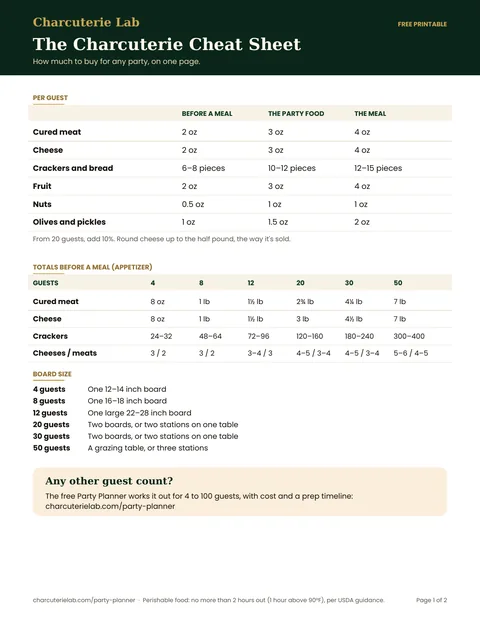
"The quantities and portions seem complicated." They're not. Plan 3 oz each of cheese and cured meat per person when the board is the party food, or 2 oz each if a meal follows. For six people as the party food: about 1¼ lb of meat and 1½ lb of cheese. One round of Brie (8 oz), a small Manchego wedge (6 oz), and a piece of Parmigiano (4-5 oz) covers the cheese for six. Two packages of pre-sliced prosciutto and one package of salami covers the meat.
"It won't look as nice as boards I've seen on social media." Board photography heavily favors abundance, perfect light, and post-processing. A real board at a real table doesn't need to look like that. Guests care about taste and generosity, not magazine-perfect arrangement. And presentation improves immediately and automatically with practice — you'll build a better board the second time just from having done it once.
What Actually Improves with Experience
This isn't to say there's nothing to learn. There is. But it's incremental, optional, and adds polish rather than rescuing disasters.
- Knowing specific product names means you can shop without asking for help
- Fan-slicing cheese takes 60 extra seconds and looks significantly more polished
- Understanding flavor pairing allows you to select condiments that specifically complement the cheeses you chose
- Knowing about temperature (cheese at room temperature smells and tastes better than cold cheese) improves the experience noticeably
- Visual balance — color contrast, height variation, avoiding uniformity — makes boards photograph better
None of these are required. They're improvements to an already-functioning system.
The Minimum Viable Charcuterie Board
For a party of 6, a functional board from a single grocery trip:
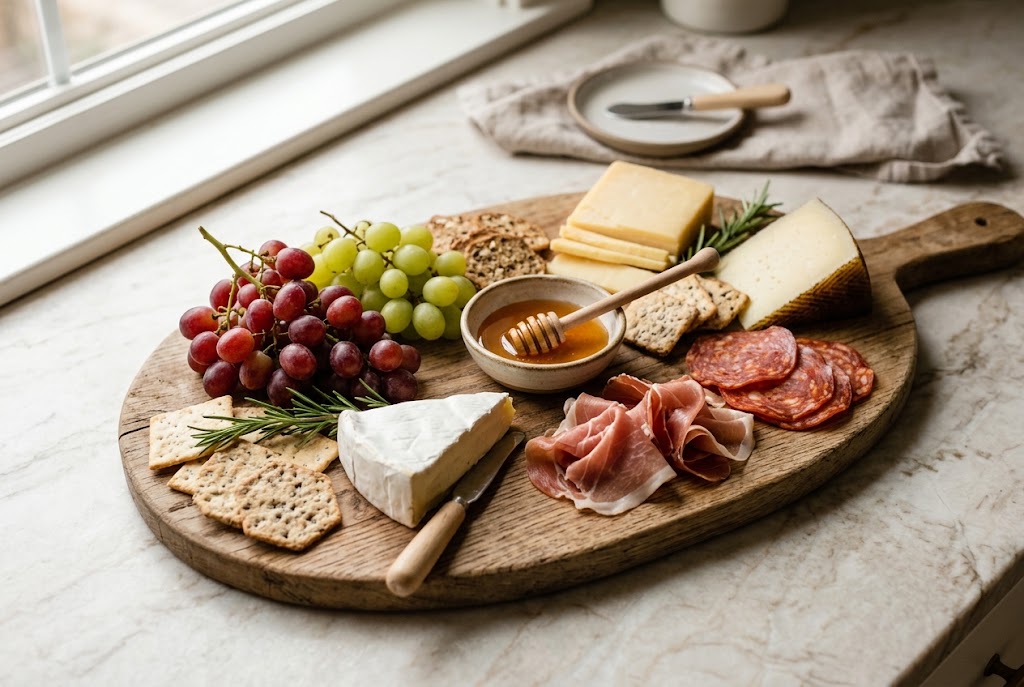
- 1 wheel of Brie (8 oz)
- 1 wedge of aged Cheddar or Manchego (~6 oz)
- 1 package Genoa salami or prosciutto (pre-sliced)
- 1 small jar of fig jam or honey
- 1 box of water crackers
- 1 small container of cornichons or olives
Total cost: $30-45 at most grocery stores. Total prep time: 15 minutes. Total skill required: opening packages and placing things on a board.
Everything beyond this is genuine improvement. But it starts here.
FAQ
Is building a charcuterie board actually difficult?
No — a basic board for 2–4 people can be assembled in 10–15 minutes from grocery store ingredients. The perception of difficulty comes from social media boards that have been styled for photographs, not from the actual skill involved. The core technique is simple: place anchors (cheese, bowls), add meat, fill gaps. The rest is refinement.
What is the minimum skill required to build a good charcuterie board?
None. You need the ability to slice cheese, fold meat, and place items on a surface. No cooking is involved, no heat, no timing precision. A beginner's board with grocery-store cheddar, salami, crackers, and grapes is immediately enjoyable. Technique, variety, and presentation improve with experience, but the floor is very accessible.
What are the most common mistakes beginners make on charcuterie boards?
Overcrowding (cramming too many elements onto too small a board), serving cheese cold, choosing too many bold or pungent elements without mild anchors, and neglecting visual variety. All of these are easy to avoid once you know to look for them. None require advanced skill — they require awareness.
How do I get better at building charcuterie boards without formal training?
Practice is the only path. Build boards regularly, photograph them, and study what worked visually and flavor-wise. Pay attention to guest reactions — what gets eaten first, what gets skipped. Read about pairing science (fat + acid, salt + sweet) to understand why combinations work. The learning curve is short and enjoyable.
Can I build a good charcuterie board at a grocery store without a specialty shop?
Absolutely. Most grocery stores carry sufficient variety: at least 3–4 cheese options, pre-sliced prosciutto and salami, seasonal fruit, and crackers. The quality gap between grocery store and specialty store is real but not disqualifying for a home board. Start with what's available and expand your sourcing as your interest grows.