Quick Answer: A holiday board feeds more people for longer, often 10–16 guests grazing for two hours or more. Plan 4–5 cheeses with a whole brie as the centerpiece, 3–4 cured meats, tart red accents like cranberry and pomegranate, and green herbs. If it's the main food, plan about 3 oz each of meat and cheese per person, and refill instead of setting it all out at once.
A holiday charcuterie board isn't only a larger board with some rosemary thrown on top. It's a different problem to solve — bigger crowd, longer grazing window, visual centerpiece expectations, and seasonal flavors that need to actually cohere rather than just look festive. This guide covers the full build: scale, ingredient selection, color logic, and the assembly sequence that keeps everything looking intentional rather than chaotic.
Why Holiday Boards Are a Different Category
Most charcuterie guides are built around 4–6 people grazing for 45 minutes before dinner. A holiday board is often 10–16 people grazing for 2+ hours — sometimes as the main event rather than an appetizer. Those two differences change nearly everything: quantities, structural planning, replenishment, and what "done" looks like.
The visual expectations are also different. A weeknight board can be casual and still feel generous. A holiday board is competing against a decorated table, candlelight, and dressed-up guests. It needs to look like it was designed, not assembled.
The good news: the same underlying logic that makes a standard board work applies here. The aesthetic adjustments are learnable, and the scale adjustments are just math.
The Color Logic Behind a Great Holiday Board
Red, green, and white are the winter holiday palette for a reason — but on a charcuterie board, they also happen to be excellent functional colors.
Red elements are almost always tart or acidic: cranberry sauce, pomegranate arils, fresh red grapes, sliced Bosc pear (which oxidizes to a warm red-orange). These are your palate-reset elements. They cut through fat and salt, making the next bite of cheese or meat taste fresh. Placing them throughout the board isn't just visual — it distributes the acid contrast so guests encounter it naturally.
Green elements are aromatic: fresh rosemary sprigs, sliced green apple, green grapes, pistachios, fresh basil or thyme. Rosemary in particular does double work — it looks dramatic planted vertically along the board's edge, and its volatile terpene compounds (the same aromatic class as those in alpine cheeses) create a sensory bridge to aged Comté, Gruyère, and hard mountain cheeses. The pairing isn't arbitrary.
White and ivory elements are your creamy neutral bases: Brie, burrata, whipped ricotta, cream cheese with fig jam, aged Comté or Gruyère in the ivory-yellow range, water crackers, white sesame crackers. These are the flavor foundation the brighter elements play against.
When you're building color intentionally, you're also building flavor contrast intentionally. The palette works because the flavor logic works.
Scale: Quantities for Holiday Boards
For a grazing board (standalone meal or multi-hour cocktail event):
- Cheese: 3 oz per person
- Charcuterie: 3 oz per person
- Crackers/bread: 8–12 pieces per person
- Condiments: 2–3 tablespoons per person across all bowls
- Fruit: 1–1.5 cups total per 4 people
For a pre-dinner appetizer board (30–60 minutes before a larger meal):
- Cheese: 2 oz per person
- Charcuterie: 2 oz per person
- Scale condiments and crackers proportionally
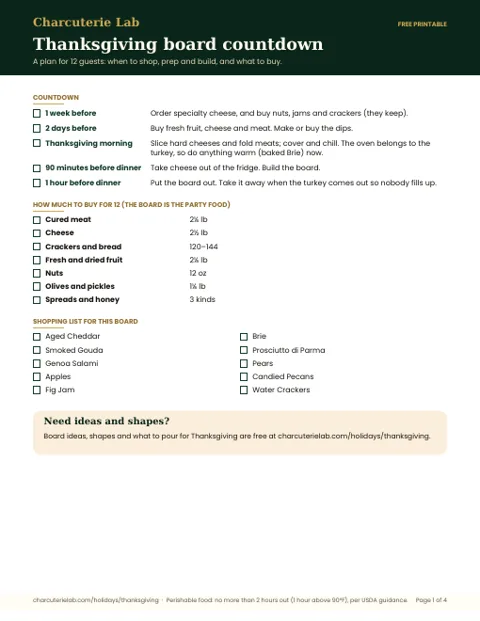
For 12 people at a grazing event, that means roughly: 2¼ lb of cheese and 2¼ lb of charcuterie, 2–3 boxes of crackers, 3–4 condiment bowls, and significant fruit coverage.
Plan for a replenishment round halfway through. Crackers go stale and fruit weeps; having backup portions wrapped in the fridge means the board stays fresh-looking without requiring a full rebuild.
Cheese Selection for Winter
Choose four to five cheeses for a holiday board — more variety, wider appeal, better visual texture contrast.
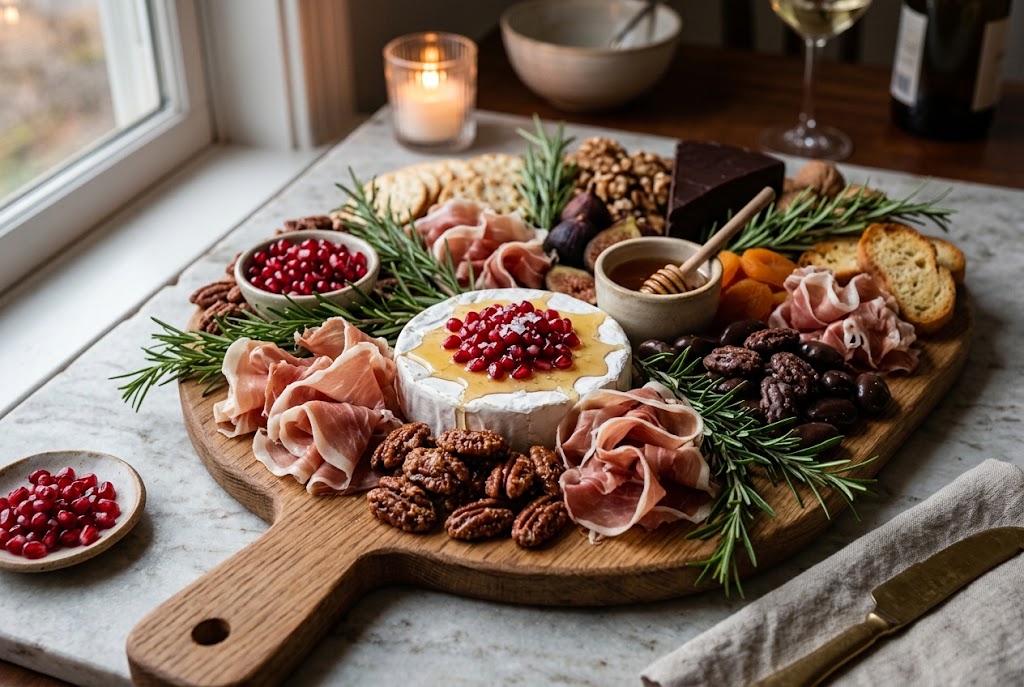
Brie or Camembert (the centerpiece): A full wheel of Brie is the classic holiday board anchor. Place it whole (lid removed if pre-cut, or scored in a cross pattern), surrounded by a ring of pomegranate arils and a few rosemary sprigs tucked alongside. It becomes the visual center of the board. Brie's mild, buttery richness bridges the full range of accompaniments.
Aged Comté or Gruyère (the depth): 12–18 month Comté brings the same aromatic terpene compounds as rosemary — when they're on the board together, each one makes the other taste more complex. Slice into thin planks or fan slices, or break chunks for a rustic effect. Tyrosine crystals will be visible in good aged versions.
Aged Cheddar (the bite): A sharp orange-white Cheddar provides color contrast and the familiar flavor anchor that mixed-audience holiday crowds appreciate. Slice into rectangles or cubes.
Blue (the drama): Stilton in particular is a holiday cheese — its December seasonality is part of British Christmas tradition for good reason. The flavor is intense and complex. Even guests who claim not to like blue cheese will try it in context. Keep the portion smaller (2–3 oz for 12 people) and pair a small honey dipper directly beside it.
Optional fifth: fresh chèvre or whipped ricotta with a spiced fig jam spooned over the top. This adds a bright, acidic dairy note and makes an excellent vehicle for the sweetest condiments.
Charcuterie Selection
Three to four products is right for a holiday board at scale.
Prosciutto di Parma or San Daniele: Fold into rosettes (three-fold: accordion-pleat a slice, pinch at the base, fan out) or drape in long cascading ribbons. Both read as elegant and scale well visually.
Soppressata or Genoa salami: The firmer slices fold into quarters ("coins") or half-moons. Tile them in overlapping rows along one section of the board for a different visual texture than the prosciutto rosettes.
Coppa or bresaola: Bresaola (cured beef) reads as a darker, more dramatic color against the pale cheeses and white crackers. Coppa's marbled cross-section is visually striking when laid flat. Either adds variety beyond the pork-dominant defaults.
Avoid pepperoni on a holiday board — the assertive spice and orange grease compete with the cheeses and condiments rather than complementing them.
Seasonal Condiments and Accompaniments
Cranberry sauce: Use a quality whole-berry version (or homemade), not the canned jelly. The tartness and acidity make it one of the best palate-reset condiments available. It works with Brie (the classic), but also with aged Cheddar and blue cheese.
Fig jam or quince paste (membrillo): The complex sweetness bridges the gap between salty meats and creamy cheeses. Quince paste's firm, sliceable texture can be placed directly on the board in small slabs — no bowl required.
Honey: A small crock of good honey, ideally honeycomb, positioned near the Brie and blue. Dark wildflower or chestnut honey has enough depth to match the blue; lighter clover honey works with Brie and chèvre.
Whole-grain mustard: Essential near the charcuterie section — the acidity and texture cut through the richness of cured meats and provide a savory contrast to the sweeter condiments.
Spiced mixed nuts: Candied or rosemary-spiced walnuts or Marcona almonds add crunch, warmth, and a seasonal flavor note. These are both functional (textural contrast) and visually appropriate.
The Assembly Sequence
A holiday board rewards planning. Build it in this order:
1. Establish your anchors first. Place the Brie wheel at the center or off-center (slightly off-center looks more intentional). Set your condiment bowls in the remaining positions — they're inflexible, so place them before anything else. The bowls define the geography of the board.
2. Place the remaining cheeses. Distribute them across the board so no two cheeses touch, and so each sits in a different quadrant (if the board is large enough). Different shapes: the Brie is round, slice the Comté into a wedge with a few planks fanned forward, cut the Cheddar into cubes, crumble the blue slightly for texture.
3. Add the charcuterie. Fill the spaces between cheeses. Vary the presentation: rosettes in one area, tiled salami rounds in another, cascading bresaola near an edge. Leave some gaps — you'll fill them with fruit and garnishes.
4. Fill with fruit. Clusters of grapes anchor the corners. Scatter pomegranate arils around the Brie. Tuck sliced pear or green apple into the remaining gaps. Dried cranberries or apricots can fill very small spaces.
5. Add crackers last (within 30–45 minutes of serving). Stand them upright in the gaps around cheeses or in dedicated sections. Water crackers for neutral; seeded crackers for texture; rye crispbread near the smoked or robust meats.
6. Garnish with rosemary. Plant 2–3 full sprigs vertically in the board near the Brie (press them into the cheese rind slightly to keep them standing). Lay smaller sprigs along edges. Add any remaining pomegranate arils as a final scatter.
Temperature and Timing
Pull the board from the refrigerator 30–45 minutes before serving. Cold cheese releases almost no aroma — room-temperature cheese smells and tastes the way it should. This matters more on a holiday board because guests will spend time looking at it before they eat from it; you want the aroma to be present when they arrive.
Put crackers on at the last moment — no more than 30–45 minutes before service, and keep back-up portions in their boxes. Crackers absorb moisture from soft cheeses and fruit and go limp quickly.
Replenishment: Around the halfway point, do a quiet reset — remove any depleted sections, replace with fresh crackers, add more fruit, and restuff the condiment bowls. The board should never look like it's been eaten; it should always look like it just arrived.
More board building guides: charcuterielab.com Subscribe to the Charcuterie Lab Report: charcuterie-lab-report.beehiiv.com
FAQ
What makes a charcuterie board look festive for the holidays?
Color is the most powerful lever: red (pomegranate arils, cranberries, red grapes), green (rosemary sprigs, pistachios, green grapes, fresh herbs), and white (brie, fresh mozzarella, white cheddar). These colors read as festive without requiring any non-food elements. Shape matters too — arrange elements in a wreath, Christmas tree, or star pattern for social media impact.
What cheeses are best for a holiday charcuterie board?
Crowd-pleasing cheeses are the priority for holiday gatherings: aged cheddar (sharp, familiar), brie (indulgent, crowd-friendly), and Gruyère (nutty, melts well). For elegance, add Stilton or Gorgonzola. Avoid obscure or intensely pungent cheeses at large holiday gatherings where not all guests are adventurous eaters.
What seasonal ingredients belong on a holiday board?
Winter-specific: pomegranate arils, cranberry jam, dried cranberries, red and green grapes, clementine sections, persimmon slices, fig jam, sugared pecans, and rosemary sprigs for garnish. These seasonal elements are both visually festive and complement traditional charcuterie flavors.
How do you make a charcuterie board for Christmas dinner as opposed to a cocktail party?
Dinner-adjacent boards serve smaller portions and function as an appetizer before the main course. Plan 2 oz each of cheese and meat per person, with lighter accompaniments. Cocktail party boards serve as the primary food, requiring 3 oz of each and more of the portions and greater variety to sustain guests for 2–3 hours.
How do you keep a holiday charcuterie board fresh at a long party?
Prepare two batches of perishables. Place the first batch at party start, then refresh the board at the halfway point by replenishing meats, soft cheeses, and fresh fruit. This keeps the board looking abundant and ensures food safety. Hard cheeses, nuts, and crackers hold well without replenishment.