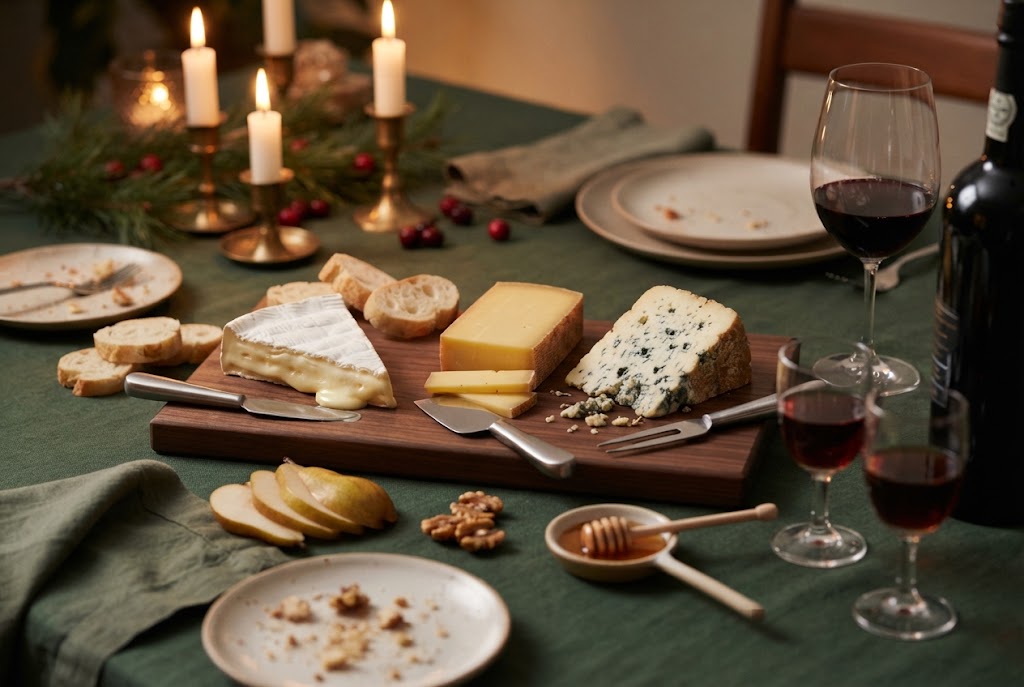
Quick Answer: A cheese course is three cheeses (one soft, one aged, one blue) with plain bread, one fruit and a few nuts, served after the main course. In France it comes before dessert; in Britain cheese and port often end the meal. Plan about 1½ to 2 oz of cheese per guest in total, take it out of the fridge while you eat dinner, and eat it mildest to strongest. To drink, keep pouring the dinner wine, or open port for Stilton or Sauternes for Roquefort.
The three-cheese formula
1. Soft
Mild and creamyBrie, Camembert, a goat cheese log or a triple-crème.
2. Firm or aged
Nutty and savoryComté, aged Gouda, Manchego, aged cheddar or Parmigiano-Reggiano.
3. Blue
The big finishStilton, Roquefort or Gorgonzola, with something sweet to drink.
A charcuterie board is built to fill people up before dinner. A cheese course does the opposite job. It comes after a big meal, so it's small: a few good cheeses, some bread, and the rest of the wine. It's an easy way to make a holiday dinner feel special without baking anything, and it gives everyone a reason to stay at the table a little longer.
When to serve it
- The French way: after the main course, before dessert. Cheese is served with bread, and usually the same wine from dinner (Taste of France).
- The British way: at the end of the meal. Stilton and port is the classic Christmas finish (Saveur).
- Instead of dessert. Add a sweet element like honey, fig jam or dried fruit and the cheese course becomes dessert. That's a good option for anyone who doesn't bake.
For a long holiday dinner, let people take a break after the main course, clear the plates, then bring the cheese out. A 15 to 20 minute pause makes room for it.
Cheese course vs. charcuterie board
| Cheese course | Charcuterie board | |
|---|---|---|
| When | After dinner | Before dinner, or as the party food |
| Cheeses | 3 (up to 5) | 3 to 5, plus meats |
| Meat | None | The main event |
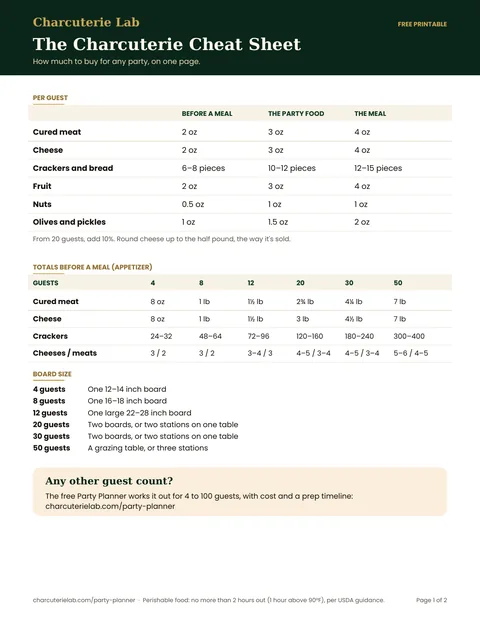
| Amount per guest | 1½–2 oz cheese in total | 2 oz each of meat and cheese before a meal |
| Sides | Bread, one fruit, nuts | Crackers, fruit, nuts, pickles, dips, spreads |
| Feeling | Slow, sit-down, a last glass of wine | Busy, help yourself |
For the before-dinner version, see what goes on a charcuterie board.
Picking the cheeses
Choose cheeses that are different from each other in texture and flavor. Three similar firm cheeses taste like one. A mix of milks (cow, goat and sheep) makes it more interesting still.
- Soft: brie, Camembert, goat cheese, or a triple-crème. Mild, creamy and the easiest place to start.
- Firm or aged: Comté, Gruyère, aged Gouda, Manchego, aged cheddar or Parmigiano-Reggiano. Nutty and savory, and the crowd-pleaser.
- Blue: Stilton, Roquefort or Gorgonzola. Salty, strong and best with something sweet.
- Adding a fourth or fifth? Try a washed-rind cheese like Taleggio, or a sheep's milk cheese like pecorino. Stop at five: after a big meal, more just goes to waste.
Not sure how strong a cheese is? Our list of cheeses from mild to strong ranks the common ones.
Four ready-made lineups
| Style | Soft | Firm or aged | Blue | Best with |
|---|---|---|---|---|
| Classic French | Goat cheese or Camembert | Comté | Roquefort | Baguette, grapes; Sauternes for the blue |
| British Christmas | A British-style soft cheese or brie | Aged cheddar | Stilton | Oatcakes, pears, walnuts; port |
| Italian | Taleggio | Parmigiano-Reggiano | Gorgonzola dolce | Honey, figs; the dinner red |
| Spanish | A soft goat cheese | Manchego | Cabrales or Valdeón | Quince paste, Marcona almonds; sherry or the dinner red |
How much cheese to buy
After a full dinner, plan about 1½ to 2 oz of cheese per guest in total. With three cheeses, that's ½ to ¾ oz of each. If the cheese is replacing dessert, go up to about 2½ oz per guest (Castello suggests 1.75 to 2.5 oz when cheese is dessert).
| Guests | Total cheese (after dinner) | Each of 3 cheeses | If it replaces dessert |
|---|---|---|---|
| 4 | 6–8 oz | 2–3 oz | 10 oz |
| 6 | 9–12 oz | 3–4 oz | 15 oz |
| 8 | 12–16 oz (¾–1 lb) | 4–5 oz | 20 oz (1¼ lb) |
| 12 | 18–24 oz (1¼–1½ lb) | 6–8 oz | 30 oz (about 2 lb) |
| 20 | 33–44 oz (2–2¾ lb, includes 10% extra) | 11–15 oz | 55 oz (about 3½ lb) |
Cheese is often sold in wedges of 6 to 8 oz, so for 8 to 12 guests, one wedge of each cheese is usually right. Leftover cheese keeps well, and odds and ends make great fromage fort.
How to serve it
- Take it out of the fridge while you eat dinner. Cold cheese tastes of very little. Take the firm and aged cheese out as you sit down to the main course (it needs 45–60 minutes), and the soft cheese and blue partway through (20–30 minutes). Leave them wrapped so the cut faces don't dry out.
- Use one board or individual plates. A board passed around the table is relaxed. Individual plates (three small pieces each, mildest at "12 o'clock" going clockwise) look like a restaurant and stop the blue from crumbling into everything.
- Put the cheeses in order. Lay them out mildest to strongest so guests know where to start. Small labels help.
- Give each cheese its own knife. Especially the blue, so its flavor doesn't end up on the brie.
- Cut so everyone gets some rind. Cut round cheeses like brie into thin wedges from the center out, like a cake, and long wedges along their length. More on cutting each shape in how to cut cheese for a board.
What to serve with it
Keep the extras simple. After dinner, the cheese is the point.
- Plain bread or crackers. Sliced baguette, water crackers or oatcakes. Rosemary, everything-bagel and other flavored crackers fight with the cheese.
- One fruit. Pears, grapes, figs or apple slices. Pear and blue cheese is a classic.
- A handful of nuts. Walnuts, Marcona almonds or pecans.
- One sweet thing, if you like. Honey with the blue, quince paste with Manchego, fig jam with the aged cheese.
- Skip the meat, pickles and dips. They belong on the before-dinner board.
What to drink
- Keep pouring the dinner wine. It's the French habit, and it's the easiest choice (Taste of France). Light reds and dry whites suit most cheeses.
- Champagne or sparkling wine. The bubbles and acidity cut through rich cheese, so it goes with almost all of them. See cheese with Champagne and Prosecco.
- Port with Stilton. The salt in the cheese and the sweetness in the wine balance each other. Decanter calls it "a classic match if there ever was one" (Decanter). See cheese with port.
- Sauternes with Roquefort. The classic French sweet-wine pairing for blue cheese (Decanter).
- Not drinking? Sparkling cider, tart cherry juice or a strong black tea all work. See zero-proof cheese pairings.
Why sweet wine with salty blue cheese? It's pairing by contrast: opposites balance each other. Our guide to pairing by contrast explains how it works.
Common mistakes
- Too many cheeses. After a three-course dinner, three is plenty. Five is the most.
- Too much cheese. You're not feeding a party. 1½ to 2 oz per guest is enough.
- Serving it straight from the fridge. Cold cheese is waxy and flat. Take it out while you eat dinner.
- Starting with the blue. A strong cheese first makes the mild ones taste of nothing.
- A crowded plate. Meats, dips and five kinds of crackers turn it back into an appetizer board.
Cheese course and dessert?
You can have both. Keep the cheese course to three small pieces each and follow it with something light, like fruit, sorbet or a few cookies. For a bigger sweet ending, see the dessert board, the Thanksgiving pie board or the Christmas cookie board.
Sources
- Taste of France: Understanding the Cheese Course, When and How to Serve It
- Castello: How Much Cheese to Serve
- Decanter: Matching Wine With Blue Cheese
- Saveur: In Praise of Stilton, the Perfect Holiday Cheese
FAQ
When is the cheese course served?
In France it comes after the main course and before dessert. In Britain cheese often ends the meal, with port. At home you can do either, or serve the cheese course instead of dessert.
How many cheeses should a cheese course have?
Three is the easiest number: one soft, one firm or aged, and one blue. Five is the upper limit after a big meal.
How much cheese per person for a cheese course?
About 1½ to 2 oz in total per guest after a full dinner, so ½ to ¾ oz of each of three cheeses. If the cheese is replacing dessert, plan up to about 2½ oz.
What order do you eat cheeses in?
Mildest to strongest: fresh or soft cheese first, then firm and aged cheese, then blue last. A strong cheese first makes the milder ones taste of nothing.
What wine goes with a cheese course?
The simplest choice is to keep pouring the wine from dinner. Champagne works with almost any cheese. For blue cheese, sweet wine is the classic pairing: port with Stilton and Sauternes with Roquefort.