A charcuterie board can serve two very different purposes: it can be the main food event at a party, or it can be the opening course before dinner. The distinction matters because the quantities, timing, and element selection that work perfectly for a standalone board will overfill guests and diminish the dinner experience if carried over to the pre-dinner appetizer context unchanged.
The appetizer board has a specific job: stimulate appetite and give guests something to eat while the room fills and the conversation starts. It should leave them wanting more, not satisfied.
Quick Answer: For a charcuterie board served as an appetizer before dinner, plan 2 oz of cured meat and 2 oz of cheese per person, enough to satisfy arriving guests without filling them before the meal. Choose mild, accessible cheeses (brie, cheddar) rather than intense blues or washed-rinds. Serve 30–60 minutes before dinner during the cocktail hour.
The Quantity Difference
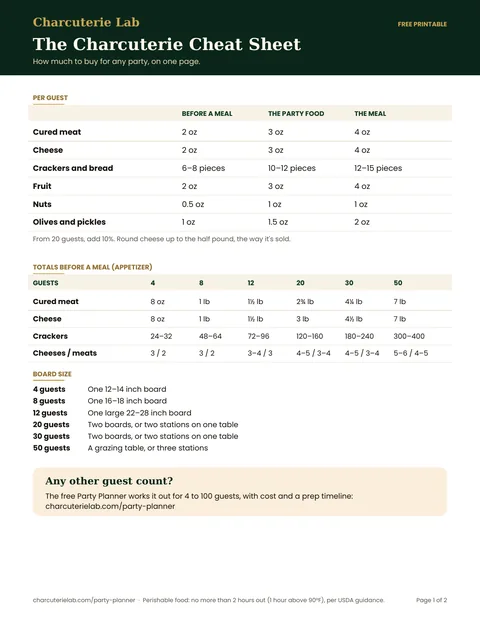
Standalone board (the party food): 3 oz cheese and 3 oz cured meat per person, and 10–12 crackers each. If the board is dinner, 4 oz of each.
Appetizer board: 2 oz cheese and 2 oz cured meat per person, and 6–8 crackers each.
That's two-thirds of a party-food board. For a dinner party of 8, an appetizer board calls for 1 lb of cheese and 1 lb of meat (vs. 1½ lb of each when the board is the party food). From 20 guests up, add 10%.
The smaller quantity isn't just about food cost — it's about calibration. Guests who fill up on cheese and prosciutto before a three-course dinner are guests who don't finish the pasta course.
Timing: When to Put the Board Out and When to Take It Away
Put the board out: When the first guests arrive, or 15 minutes before expected arrival. An appetizer board is a welcome gesture — it fills the time while late arrivals filter in and while the kitchen finishes the first course. An empty table as guests stand around is a missed opportunity.
Take the board away: 15-20 minutes before you intend to serve dinner, or when approximately half the elements have been consumed — whichever comes first. If the board is sitting out during the soup course, guests will continue grazing on it and lose interest in the first course.
The clearing of the appetizer board is a signal: dinner is about to start. It also prevents the board from looking picked-over and sad once the main event begins.
Total appetizer window: 30-60 minutes is ideal. Less than 30 minutes and guests haven't had time to settle in and enjoy it. More than 60 minutes and the board will be depleted and the appetizer-to-dinner pacing will be off.
What to Scale Back (and What to Remove)
For the appetizer context, some elements belong and some create problems:
Scale back or remove rich, filling elements:
- Heavy spreads in large quantities (whipped ricotta as a dip, large amounts of creamy cheese)
- Bread in quantities large enough to fill guests up before dinner (a few crostini per person is fine; a full baguette is not)
- Heavily caloric condiments as primary elements (a large amount of nuts, multiple dried fruit bowls)
Keep: The flavor-stimulating elements — acidic pickles and cornichons, olives, small bites of well-paired cheese and meat, light crackers. These stimulate appetite rather than satiate it.
The antipasto logic: A well-calibrated appetizer board shares the philosophy of Italian antipasto — it's a pre-meal course designed to stimulate appetite, not satisfy it. Acidic, briny, lightly fatty elements work. Heavy, sweet, filling elements work against the course's purpose.
Element Selection for Appetizer Boards
What works well as appetizer elements:
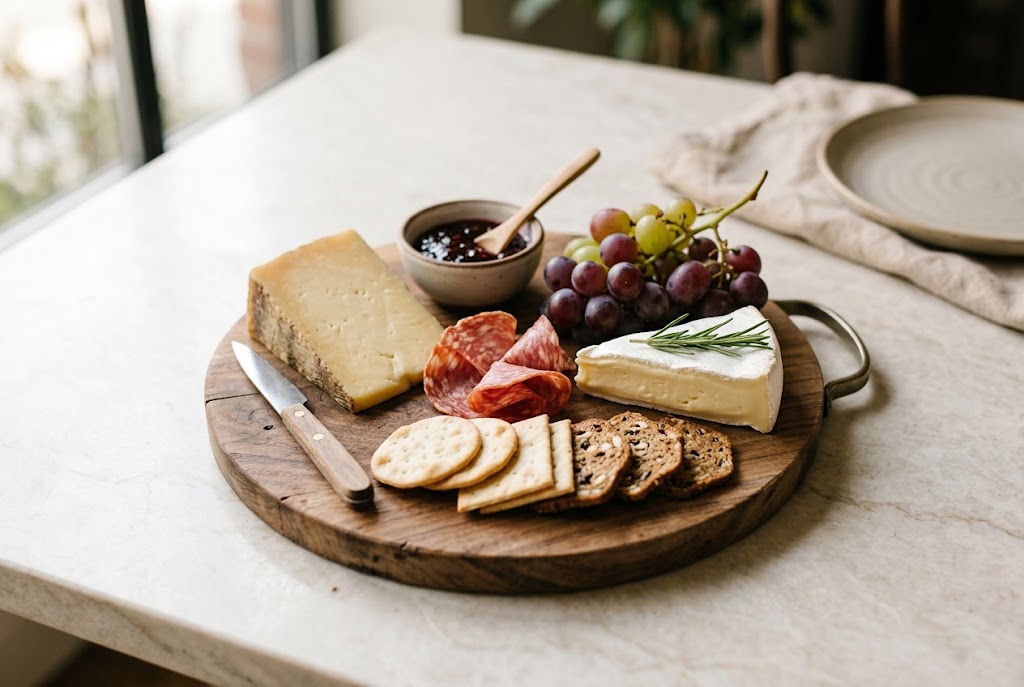
- 2-3 cheeses (not 4-5) — one soft/bloomy, one semi-firm, one aged or strong
- 2 cured meats — one mild (prosciutto or coppa), one more assertive (salami or speck)
- Cornichons or pickled peppers (acidic, stimulating)
- Olives (briny, appetite-stimulating)
- Minimal sweet condiments — one small honey or fig jam rather than multiple
- Light, thin crackers (water crackers, Carr's) rather than thick, filling crispbreads
What to reserve for standalone boards:
- Dried fruits in quantity (filling, sweet)
- Nuts in quantity (calorie-dense, filling)
- Multiple sweet condiments (quince paste, honey, and fig jam simultaneously)
- Burrata (a full serving of burrata is very filling and best as a standalone element)
Board Format for the Appetizer Context
Board size: An appetizer board for 8 people should be visibly smaller than a standalone board for the same number. A 12"x16" board is appropriate for an appetizer for 8. A 16"x22"+ board reads as the main event, which it isn't.
Don't replenish: Unlike a standalone board where replenishment during the event is appropriate, an appetizer board should be allowed to diminish naturally. The visual depletion communicates "this course is ending." Adding more food to an appetizer board delays the dinner start and undermines the pacing.
Reserve crackers: Even for an appetizer board, add crackers in stages rather than all at once — they absorb moisture faster on a board that's being actively grazed. Start with about half the crackers and add the second half 15 minutes in if needed.
Coordinating the Board with the Dinner Menu
An appetizer board before an Italian dinner should lean Italian (prosciutto, Parmigiano, olives, grissini) — it sets the flavor register for what follows. A board before a French dinner can lean toward French elements (cornichons, Brie, country pâté if available). A board before a casual American menu can be more eclectic.
Avoid duplication: If the dinner includes a pasta with aged Parmigiano, put a different hard cheese on the appetizer board. If the main is prosciutto-wrapped chicken, skip prosciutto on the appetizer board. The appetizer should introduce the meal's register without pre-empting its elements.
FAQ
How is a charcuterie board as an appetizer different from a full board?
An appetizer charcuterie board is scaled for 2 oz of meat and 2 oz of cheese per person, with 6–8 crackers each. The goal is to stimulate appetite without filling guests up before the main course. A board that is the party food uses 3 oz of each, and 4 oz if it's dinner, with more variety.
When should you serve a charcuterie board during a dinner party?
Serve the charcuterie board during the cocktail hour — 30–60 minutes before the sit-down meal. This gives guests something to eat while they arrive and settle, prevents hunger complaints if the main course is delayed, and sets a tone of abundance and care without replacing the main event.
What cheeses work best when charcuterie is an appetizer?
Light, accessible cheeses serve appetizer boards better than intense ones. Brie, mild chèvre, and a semi-firm cheddar invite eating without overwhelming palates before the meal. Save bold blues, washed-rinds, and very aged cheeses for cheese courses or boards served as the primary food.
How long before dinner should I put out a charcuterie appetizer board?
Put the board out 15–20 minutes before guests are scheduled to arrive. This way it's ready as people come in, but it hasn't been sitting long enough to dry out or lose freshness by the time everyone has gathered. For longer cocktail hours, replenish key elements (soft cheese, fruit) at the 45-minute mark.
Should an appetizer charcuterie board include bread?
Optional. If dinner will include bread (dinner rolls, a bread basket), skip bread on the appetizer board to prevent guests from filling up on carbohydrates before the meal. If dinner won't include bread, a small amount of sliced baguette or crostini is appropriate.
Quick Reference
| Standalone Board | Appetizer Board | |
|---|---|---|
| Cheese per person | 3 oz | 2 oz |
| Meat per person | 3 oz | 2 oz |
| Crackers per person | 10–12 | 6–8 |
| Cheese varieties | 3-5 | 2-3 |
| Condiment bowls | 3-5 | 2-3 |
| Time out | Full event | 30-60 min before dinner |
| Replenish | Yes | No |
| Board size (for 8) | 16"x22"+ | 12"x16" |