Building around cured meats? Cured Meat Field Guide $5 · printable PDF
Why Cured Meat Doesn't Spoil: Salt, Nitrates, and the Truth About "Uncured"
Quick Answer: Cured meat survives because of stacked defenses: salt and drying take away the water bacteria need, fermentation makes salami acidic, and nitrite blocks botulism. "Uncured" meat is usually still cured, just with celery powder instead of sodium nitrite. The white powder on salami is a good mold put there on purpose.
The four defenses
1
SaltDraws water out of the meat and out of any bacteria on it.
2
DryingA dry salami loses roughly a third of its weight as water.
3
FermentationGood bacteria make lactic acid, the source of salami's tang.
4
NitriteBlocks botulism, keeps the meat pink, slows rancidity.
A raw pork chop lasts a few days in the fridge. A salami made from the same pork can hang in a cellar for months. Here's what changes.
The hurdle idea: no single trick does it
Food scientists call it the hurdle effect. Each step on its own would be too weak to keep meat safe. Stacked together, bacteria can't clear them all.
Think of it as a series of fences. Salt slows bacteria. Drying slows them more. Acid from fermentation slows them more again. Nitrite shuts out the most dangerous one. A cured meat that skips one hurdle has to lean harder on the others, which is why recipes are precise and why home curing needs a scale, not guesswork.
Salt and drying: taking away the water
Bacteria need water to grow, but not all water counts. What matters is water activity: how much of the water in a food is free and available, rather than bound up by salt and sugar. Fresh meat has a water activity close to 1.0, the same as pure water. Most bacteria need it to stay above roughly 0.91 to grow well.
Salt pulls water out of the meat by osmosis and ties up what's left. Then the meat hangs in a cool, humid room and slowly dries. By the end, a dry salami has typically lost about a third of its weight, and its water activity has dropped into the high 0.8s, below where most spoilage and disease bacteria can multiply.
This is also why charcuterie tastes so concentrated. You're eating meat with much of the water taken out. For more on the drying rooms themselves, see aging caves.
Fermentation: the tang in salami
Salami gets a hurdle that whole-muscle cuts like prosciutto don't: fermentation. Lactic acid bacteria, either added as a starter culture or already present, eat the small amount of sugar in the mix and turn it into lactic acid, the same acid in yogurt.
That acid does two jobs. It drops the pH low enough that harmful bacteria struggle, and it gives salami its pleasant sourness. It's the reason a Genoa tastes different from a slice of prosciutto even though both are cured pork.
Nitrite: the botulism blocker
The word botulism comes from botulus, Latin for sausage. Sausages were the classic source of Clostridium botulinum poisoning, because the inside of a sausage is low in oxygen, which is exactly what that bacterium likes.
Nitrite stops it. It also:
- Keeps the meat pink. Nitrite binds to the meat's natural pigment and fixes the rosy color. Without it, cured pork turns gray-brown.
- Creates "cured" flavor. The distinctive taste of ham versus roast pork is largely nitrite.
- Slows rancidity. It protects fat from oxidizing and tasting stale.
Home and commercial curers use two curing salts. Cure #1 contains sodium nitrite and is used for short cures and cooked products like bacon and summer sausage. Cure #2 contains nitrite plus nitrate, which converts to nitrite slowly over weeks, so it's used for long, dry cures like salami.
Some traditional products skip nitrite entirely. Prosciutto di Parma is made with only pork and sea salt. It works because it's a whole muscle (the inside starts out essentially sterile), it's salted heavily, and it ages for a year or more.
What "uncured" and "no nitrates added" really mean
In the US, "uncured" almost never means the meat wasn't cured.
US labeling rules reserve the word "cured" for meat made with synthetic sodium nitrite or nitrate. Meat cured with natural sources, usually celery powder or celery juice, has to be labeled "uncured" and "no nitrates or nitrites added," with a note like "except those naturally occurring in celery powder."
But celery is naturally high in nitrate, and during processing, bacteria convert it to nitrite. The meat ends up cured in exactly the same way. Consumer groups have long argued the label is misleading, and testing by Consumer Reports found nitrates and nitrites in "uncured" meats at levels similar to conventionally cured ones.
The rule may change. After a 2019 petition from consumer groups, USDA's Food Safety and Inspection Service said it intends to propose banning "uncured" and "no nitrate or nitrite added" claims on any meat processed with a nitrate source, celery powder included. That proposal has been in the works since 2020 and, as of 2026, still hadn't been published, so today's labels remain the rule for now.
What this means at the store: buy "uncured" salami because you like how it tastes, not because you think it has no nitrite. For what that means for your health, see is charcuterie unhealthy?
The white mold on salami
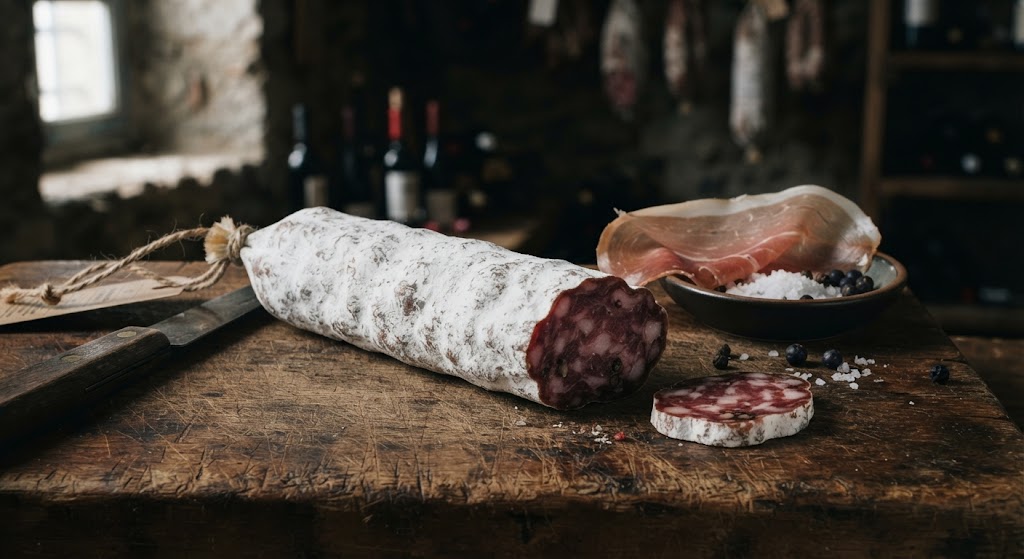
That powdery white coat on a traditional salami isn't a sign something went wrong. It's usually a beneficial mold, most often Penicillium nalgiovense, sprayed on or encouraged on purpose. It:
- Crowds out harmful molds and bacteria by claiming the surface first
- Shields the meat from light and oxygen, which slows rancidity
- Evens out drying so the outside doesn't harden before the inside dries
It's safe to eat, but it's chalky, so most people peel off the casing before slicing.
| What you see | What it is | What to do |
|---|---|---|
| Even, powdery white or off-white coat | Beneficial mold | Normal. Peel the casing if you like |
| A few small white or gray spots on a whole salami | Usually the same mold, patchier | Wipe with a cloth dampened in vinegar |
| Fuzzy green, blue-green or black patches | Unwanted mold | Throw it away |
| Slimy, sticky or wet surface | Bacterial growth | Throw it away |
| Sour or ammonia smell, beyond the normal tang | Spoilage | Throw it away |
When cured meat does spoil
- Once you slice it, the clock starts. Slicing exposes moist interior to air and your hands. Wrap it and refrigerate it.
- Pre-sliced packs are fridge items. The salt and drying help, but the package is designed to be refrigerated. Follow the date and the "once opened" instructions.
- Soft and cooked charcuterie is different. Mortadella, pâté, cooked ham and nduja have more water and fewer hurdles. Treat them like any deli meat.
- A board on the table follows the two-hour rule. See how long a charcuterie board can sit out.
- Pregnant guests should still avoid cold cured meat, because curing reduces risk but doesn't eliminate listeria. Our pregnancy-safe board guide has the swaps.
Get weekly charcuterie science in the Charcuterie Lab Report newsletter.
FAQ
Why doesn't salami go bad at room temperature?
Several protections stack up. Salt and drying pull out water so bacteria can't grow, fermentation makes the meat acidic, and nitrite blocks the bacteria that cause botulism. A whole, unopened dry salami can sit at cool room temperature for weeks. Once you slice it, wrap it and refrigerate it.
What does uncured mean on salami or bacon?
In the US, uncured usually means the meat was cured with a natural nitrate source such as celery powder instead of synthetic sodium nitrite. The celery powder is converted to nitrite during processing, so the meat is still cured. Testing has found nitrite levels in uncured products similar to conventionally cured ones.
Is the white mold on salami safe to eat?
The powdery white coating on traditional salami is usually a beneficial mold, often Penicillium nalgiovense, added on purpose to protect the meat while it dries. It's safe, but most people peel the casing off because it's chalky. Fuzzy green, black or colored patches, or a slimy, sticky surface, mean the salami should be thrown away.
Does prosciutto have nitrates?
Prosciutto di Parma is made with only pork and sea salt, with no nitrite or nitrate added. Many other prosciutto-style hams, especially outside Italy, do use curing salts, so check the ingredient list.
Are nitrates in cured meat bad for you?
Nitrite itself isn't the main concern. The concern is nitrosamines, compounds that can form when cured meat is cooked at very high heat, as with crisp-fried bacon. The World Health Organization's cancer agency classifies processed meat as a cause of colorectal cancer, which is why most health guidance suggests eating it in moderation. Most of the nitrate in a typical diet actually comes from vegetables.