Quick Answer: At normal portions, a charcuterie board is a moderate-calorie appetizer rather than a health problem on its own. The real concern is sodium: cured meats are salty. Keep meat to a couple of ounces per person, add fruit, vegetables and nuts, and treat it as an occasional spread rather than a daily meal.
The conversation about charcuterie and health usually goes one of two ways. Either someone dismisses it as indulgent and inherently bad, or someone over-defends it as basically health food. Both miss what the food science actually says.
The real answer is more specific: charcuterie in appropriate serving sizes, served as designed — an appetizer with a range of foods — is not a nutritional concern for most people. And several of its components have measurable fermentation-derived benefits. Here's what the research actually shows.
The Serving Size Problem
Almost all nutrition criticism of charcuterie boards ignores serving context entirely.
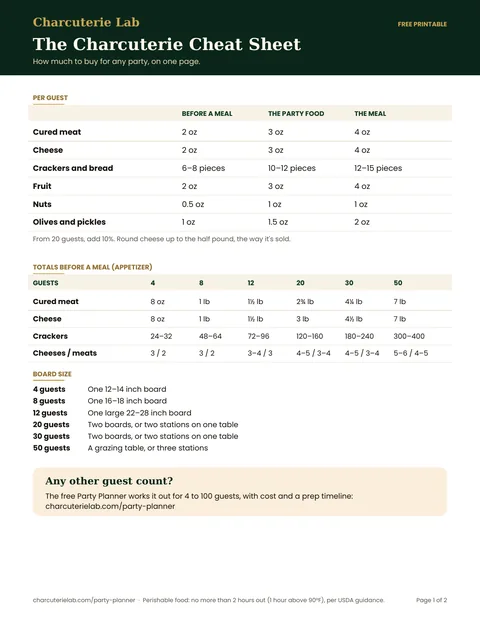
A properly built appetizer board for 8 guests contains roughly:
- 2 oz cured meat per person before a meal, 3 oz as the party food (a typical 1–2 oz serving of prosciutto = ~70–100 calories)
- 2 oz cheese per person before a meal, 3 oz as the party food (a 1 oz serving of aged cheddar = ~110 calories)
- Crackers, fruit, nuts, accoutrements contributing additional volume
A reasonable appetizer portion from a well-built board totals approximately 400–600 calories per person — comparable to a moderate restaurant appetizer or small shared plate. This is not a caloric crisis.
The problem arises when a board is treated as the main course (requiring 2–3x the quantities) or when people graze across a full meal window without accounting for it. The food itself isn't the issue — it's the context and quantity.
What "Processed Meat" Actually Means in This Context
The WHO's 2015 classification of processed meat as a Group 1 carcinogen caused significant alarm and is still cited as evidence that charcuterie is dangerous. The full picture is more nuanced.
The classification is based on an increased relative risk, not absolute risk. The specific finding: consuming 50 grams of processed meat per day (roughly 1.75 oz) is associated with approximately an 18% increased relative risk of colorectal cancer over a lifetime.
A 2 oz appetizer serving of cured meat eaten occasionally is categorically different from 50g of processed meat consumed daily as a dietary staple. Epidemiological risk categories don't translate cleanly to occasional consumption of traditional fermented and cured foods.
Additionally, the "processed meat" category in this research includes items like hot dogs and commercial deli slices alongside traditional fermented products like prosciutto, salami, and bresaola. Grouping them together obscures meaningful differences in processing methods, ingredient quality, and consumption context.
Fermentation Science: What Curing Actually Does
Several components of a traditional charcuterie board undergo fermentation processes that produce measurable functional compounds.
Lactic Acid Bacteria in Fermented Salami
Dry-cured salamis (Soppressata, Genoa, Finocchiona) undergo lactic acid fermentation during production. Lactic acid bacteria (LAB) — primarily Lactobacillus and Pediococcus species — consume sugars, produce lactic acid, and create conditions that:
- Drop pH to ~4.6–5.2, inhibiting pathogenic bacteria
- Generate bioactive peptides from protein breakdown
- Produce conjugated linoleic acid (CLA) as a metabolic byproduct
CLA is an unusual saturated fatty acid variant with a distinct carbon double-bond position. A growing body of research suggests CLA may have anti-inflammatory and anticarcinogenic properties, though study sizes and contexts vary and no clinical recommendations have been derived from this research yet.
Aged Cheese and Butyrate
Aged cheeses — particularly those made from raw or grass-fed milk — contain butyrate (butyric acid), a short-chain fatty acid produced during ripening. Butyrate is also produced by gut bacteria during fermentation of dietary fiber, and serves as the primary fuel source for colonocytes (cells lining the large intestine).
Colonic health research has consistently shown butyrate plays a role in maintaining intestinal barrier integrity and modulating inflammatory signaling. The butyrate in aged cheese isn't the same as gut-produced butyrate in mechanism, but it contributes to overall dietary butyrate exposure.
Biogenic Amines and Umami Compounds
Protein breakdown (proteolysis) during aging of both meat and cheese generates free amino acids including glutamate — the backbone of umami perception. This same proteolysis produces small amounts of biogenic amines (histamine, tyramine).
For most people these present no issue at appetizer-portion serving sizes. People with histamine intolerance or those taking MAO inhibitor medications should be more cautious with aged fermented foods.
The Saturated Fat Question
Charcuterie boards are relatively high in saturated fat — from both cured meats and aged cheeses. The standard public health guidance to limit saturated fat is based on its association with elevated LDL cholesterol and cardiovascular disease risk.
However, saturated fat research has become considerably more nuanced since the original dietary guidelines:
- A 2010 meta-analysis in The American Journal of Clinical Nutrition found no significant association between saturated fat intake and cardiovascular disease or stroke risk when evaluated independently of replacement nutrients
- More recent research distinguishes between food-matrix effects — the same saturated fat consumed in whole cheese vs. butter vs. processed products behaves differently in terms of absorption and metabolic response
- Fermented dairy specifically shows reduced inflammatory markers compared to non-fermented dairy at equivalent saturated fat intake in several randomized trials
None of this means saturated fat is irrelevant to cardiovascular health for all people. It means the relationship is more context-dependent and food-matrix-dependent than early dietary guidelines suggested.
Satiety Signaling: Why Boards Don't Lead to Overconsumption
One underappreciated aspect of the charcuterie board format is its structural tendency toward appropriate satiety.
A board combines:
- Fat — from meats, cheeses, and nuts, which triggers cholecystokinin (CCK) release, signaling fullness
- Protein — from meats and cheese, which has the highest satiety-per-calorie ratio of the macronutrients
- Fiber — from fruits, crackers, and vegetables, which slows gastric emptying
- Physical variety — diverse textures and flavors that satisfy through sensory exploration rather than requiring volume
The social format of a shared board also tends to slow eating pace naturally. People eat at a table, engage in conversation, and aren't consuming directly from individual portions. Research on eating rate and satiety consistently shows that slower eating correlates with earlier fullness signaling.
This is why appetizer boards are rarely the source of dietary excess — the format itself is self-regulating in ways that single-serve portions often aren't.
The Sodium Reality
Legitimate concern: cured meats are high in sodium. Prosciutto runs approximately 1,900–2,300 mg sodium per 100g. A 2 oz (56g) serving delivers roughly 1,000–1,300 mg — a meaningful portion of the 2,300 mg daily recommendation.
This is a real consideration for people managing hypertension or following sodium-restricted diets. It's not accurate to dismiss it.
The practical mitigation: treat cured meat as a flavoring and accent rather than the primary food. The traditional European model — a few slices of prosciutto with bread, some cheese, and fruit — naturally limits sodium exposure through the built-in serving culture around these foods.
The Actual Summary
Charcuterie boards are not health food in the sense of being nutrient-dense meal replacements. They are:
- Moderate-calorie appetizers when served at standard portions (2 oz each of meat and cheese per person before a meal, 3 oz as the party food)
- Fermented products with demonstrable LAB activity, bioactive peptides, and butyrate in the cheeses
- High-sodium in the meat components — a genuine consideration for sodium-sensitive individuals
- High-saturated-fat in a food matrix context that some research suggests behaves differently than isolated saturated fat sources
- Structurally satiety-supportive due to protein + fat + varied sensory content
The myth that charcuterie is inherently unhealthy dissolves once you apply actual serving sizes. The reasonable concern is about sodium for people who need to manage it.
Science-first takes on food every week. Subscribe to The Charcuterie Lab Report.
Sources
FAQ
Is charcuterie actually unhealthy?
In appropriate serving sizes, charcuterie is a nutritionally reasonable food. Cured meats provide protein and fat. Aged cheeses offer calcium, fat-soluble vitamins, and live cultures. Accompaniments add fiber (fruit, vegetables) and micronutrients. The concern around cured meats relates to nitrate content and sodium — both real considerations, but the impact is proportional to quantity consumed.
How much sodium is in a typical charcuterie serving?
A typical charcuterie portion (2 oz cured meat, 2 oz cheese, crackers) contains approximately 800–1,200mg sodium, depending on ingredient selection. This is significant if you're sodium-sensitive, but not extreme in the context of a full day's diet. Choosing lower-sodium meats (bresaola, mortadella) and crackers can reduce this meaningfully.
Are nitrates in cured meats dangerous?
Nitrates in cured meats have been associated with increased colorectal cancer risk in large epidemiological studies, particularly at high consumption levels (processed meat as a daily dietary staple). At the quantities involved in an occasional charcuterie board (1–2 oz of cured meat), the absolute risk increase is very small. The science does not support avoiding cured meat entirely — it supports moderation.
What is the healthiest way to approach charcuterie?
Treat it as an occasional indulgence rather than a daily staple. Choose variety — some lean meats (bresaola, prosciutto) alongside richer options. Include fresh fruit, vegetables, and nuts in the spread for nutritional balance. Use real, fermented cheeses rather than processed cheese products. A charcuterie board eaten with these principles in mind is not a nutritional concern.
Does fermented charcuterie have probiotic benefits?
Some research suggests fermented dry-cured meats contain beneficial lactobacillus and other bacterial cultures similar to those in fermented dairy. These cultures survive the curing process and may contribute to gut microbiome diversity. This is an emerging area of research, and the probiotic content of cured meats is lower than in yogurt or kefir, but the fermentation benefit is real.