Quick Answer: Camembert is a small whole-wheel soft cheese from Normandy with an earthier, more mushroomy flavor than brie. Serve it as a whole wheel and let guests cut in, with apple slices and honey beside it and prosciutto or coppa nearby. If you can find PDO Camembert de Normandie, it's the one worth buying.
Camembert and brie occupy the same section at most grocery cheese counters, look nearly identical in format, and get confused regularly. On a board, this confusion matters: they are different cheeses with different flavor profiles, different structural properties, and different ideal pairings. Knowing the distinction isn't pedantry — it's the difference between putting the right cheese in the right position on your board and using the wrong one.
What Is Camembert?
Camembert de Normandie is a French cow's milk soft-ripened cheese with PDO status, produced exclusively in Normandy from the milk of Normande breed cows. Like brie, it develops a white Penicillium camemberti bloomy rind and has a creamy, yielding paste that softens from the outside in as it ripens. The canonical wheel is about 11cm in diameter and 3cm thick — noticeably smaller and thicker than a brie wheel.
The name "Camembert" appears on cheeses produced elsewhere, including industrially-made versions from Normandy that don't meet the traditional PDO criteria. For a charcuterie board, the difference between Camembert de Normandie (PDO, raw milk, traditional production) and a generic commercial camembert is real — the PDO version has a more pronounced, earthy, mushroom-forward character. That said, a good-quality commercial camembert still performs better on a board than cheap brie.
Camembert vs. Brie: The Real Differences
This is the question most people need answered. Here's the breakdown:
Size: Brie is produced in large wheels (typically 35–37cm diameter) and sold as wedge cuts. Camembert comes in small individual wheels (11cm). On a board, this means camembert can be served as an intact wheel, which provides a visually dramatic presentation option that brie wedges don't offer.
Milk fat content: Camembert and brie have similar fat content overall, but because of camembert's smaller wheel and thicker relative dimensions, the ratio of rind to paste is higher. This affects the eating experience: camembert's rind is proportionally more prominent, contributing more of the earthy, mushroom, and ammonia character relative to the total cheese.
Flavor profile: Both undergo Penicillium camemberti ripening, but camembert typically develops a more pronounced, assertive character than most brie — earthier, more mushroom-forward, with a slight barnyard quality at peak ripeness. Brie is generally described as buttery and mild; camembert is more complex and pungent. This is partly regional (Normandy's specific terroir and Normande milk) and partly structural (the rind-to-paste ratio).
Ripening behavior: Camembert ripens more rapidly than brie due to its smaller format and thicker dimensions relative to diameter. A camembert at peak ripeness has a fully runny center; slightly past peak, the ammonia character can become overpowering. Brie is more forgiving of timing variation.
Temperature sensitivity: Both cheeses soften and can run at room temperature, but camembert — especially a good PDO version — softens more dramatically. A ripe camembert wheel left at room temperature for 45–60 minutes will be substantially liquid at the center.
The Lab Section: Why These Pairings Work
Both camembert and brie develop through surface ripening: Penicillium camemberti mold grows on the exterior rind and works inward through enzymatic activity.
Proteolysis from the outside in: The mold's protease enzymes break down casein proteins in the paste, starting from the rind and working toward the center. A perfectly ripe soft-ripened cheese has a creamy, yielding layer just beneath the rind and a firmer chalky core at the center — the gradient of ripening. Fully ripe camembert is uniformly soft throughout; overripe has an ammonia smell from excessive protein breakdown.
Lipolysis: Lipase enzymes break down fats into free fatty acids that contribute to the earthy, mushroom-like flavor compounds associated with bloomy-rind cheeses. The "mushroom" note in camembert is partly from these fatty acid metabolites and partly from dimethyl sulfide and other volatile sulfur compounds produced by the mold.
pH shift: The mold also consumes lactic acid as it grows, which raises the pH of the cheese surface from acidic toward neutral. This pH change is part of what allows the proteolytic enzymes to work effectively — and part of why ammonia develops when the cheese is overripe.
Choosing Camembert for Your Board
PDO Camembert de Normandie: If you can find it, this is the version worth buying. The raw milk, Normande breed milk, and traditional production method produce a genuinely more complex and characterful cheese. The flavor is earthier, more assertive, more memorable.
Quality commercial camembert: A well-made commercial camembert — even a pasteurized version — can be excellent. Look for camembert from French producers rather than domestic imitations; the French production methods and raw material quality generally translate better even in commercial format.
Ripeness assessment: Gently press the top of the wheel through the packaging. A ripe camembert should give slightly but not feel completely soft throughout. A completely rigid wheel is underripe and chalky; a completely soft, bulging wheel may be past peak. Aim for the middle.
Timing: Camembert is best eaten within a few days of peak ripeness. Buy it with a use-by date that gives you 3–5 days to serve it, not weeks.
How to Present Camembert on a Board
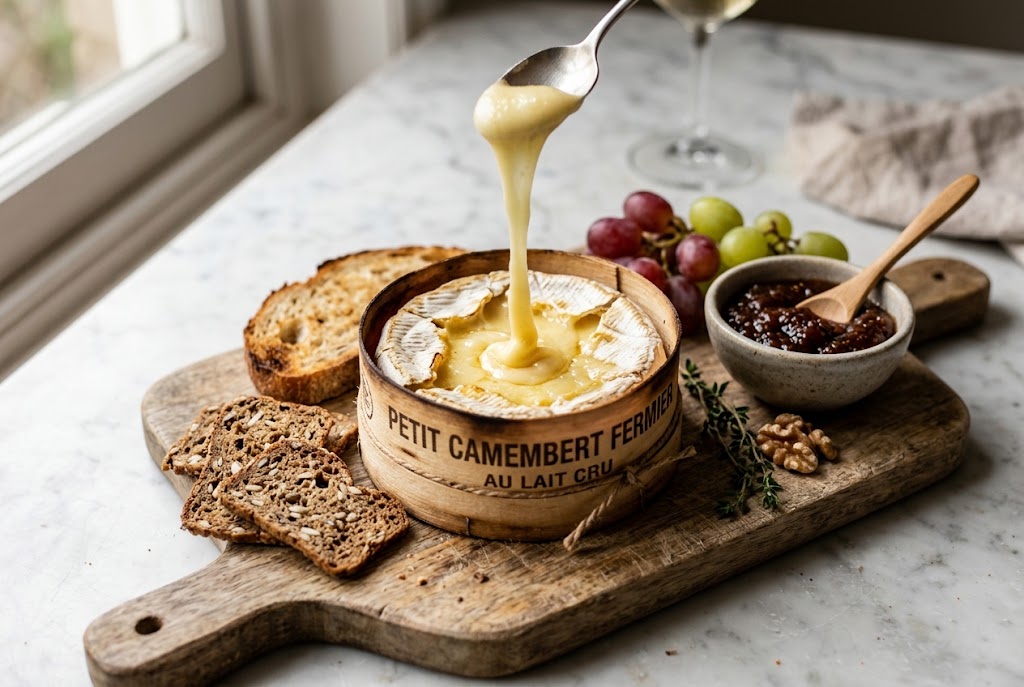
The whole wheel presentation: This is camembert's signature advantage over brie. An intact wheel of camembert, placed on the board with a small knife, allows guests to cut into a whole cheese — which is more dramatic and engaging than pre-cut wedges. Score the top rind in a crosshatch pattern to make cutting easier and signal where guests should start.
Baked camembert option: Camembert's small wheel format makes it ideal for baking. Score the top, add a drizzle of honey and fresh thyme, and bake at 375°F / 190°C for 15–20 minutes until the interior is liquid. Place the hot wheel in its wooden box or on a small board and serve immediately with crackers and bread. This transforms the cheese from a static board element into a communal, warm centerpiece.
Sliced wedges: For a more conventional presentation, cut the wheel into 6–8 wedges from the top. Serve with the wedges partially fanned open.
Temperature: Pull camembert from the refrigerator 20–30 minutes before serving. A cold camembert is rubbery and under-expressive. At room temperature, the full range of mushroom, earthy, and buttery notes opens up.
Pairing Camembert
Sweet pairings:
- Apple slices or apple butter — the classic pairing. Malic acid in apple provides both brightness and sweetness; the fruit's clean flavor complements camembert's earthy depth without competing. This is the best fruit pairing for camembert.
- Raw honey — wildflower honey works; try lavender honey with camembert for a Provençal-influenced pairing that works surprisingly well with the earthy rind notes.
- Fig jam — slightly more assertive sweet pairing; works better with a more fully ripe camembert.
- Cherry preserves — the tartness of cherry balances the earthy richness nicely; a less common but excellent combination.
Bread and cracker pairings:
- Baguette — the neutral, slightly chewy crumb and crispy crust is the natural companion. Slice thin and slightly toasted for textural contrast.
- Plain water crackers — clean vehicle that lets camembert lead.
- Walnut crackers — the nut's slight bitterness and tannin echoes the cheese's earthy notes.
Meat pairings:
- Prosciutto — the delicate sweetness of prosciutto fat plays well against camembert's earthy richness.
- Coppa — slightly spiced and nutty coppa provides a savory complement.
- Jambon de Bayonne — the French-style cured ham is a natural regional pairing.
- Avoid very spiced or smoked meats — these overwhelm the subtle complexity of camembert.
Drink pairings:
- Calvados (apple brandy) — the canonical Norman pairing. Calvados is produced in the same region as Camembert de Normandie; the apple character mirrors the fruit pairing, and the brandy's warmth amplifies the cheese's fat and earthiness.
- Dry cider (Norman style) — the regional non-wine pairing. Normandy is apple country; still or sparkling dry cider's acidity and apple notes are a natural match.
- Light Burgundy (Pinot Noir) — a medium-bodied, earthy red with low tannins. The earthiness of camembert mirrors the terroir-driven notes in Burgundy. Avoid tannic reds.
- Champagne or Crémant — effervescence cuts through the fat; the autolytic notes in Champagne complement camembert's earthiness.
Camembert at a Glance
| Property | Description |
|---|---|
| Milk | Cow's milk (Normande breed for PDO) |
| Origin | Normandy, France |
| Texture | Soft, yielding, creamy; runny when fully ripe |
| Flavor | Buttery, mushroom-forward, earthy, slightly pungent; more assertive than brie |
| Rind | White bloomy (Penicillium camemberti); edible |
| Best board role | Featured soft cheese; whole-wheel presentation opportunity |
| Ripeness for boards | Slightly soft throughout, not fully liquid |
| Sweet pairing | Apple slices, lavender honey, cherry preserves |
| Cracker pairing | Baguette, plain crackers, walnut crackers |
| Meat pairing | Prosciutto, coppa, Jambon de Bayonne |
Quick Pairing Reference
| Board Type | Camembert Pairing |
|---|---|
| French/Norman board | Coppa + apple slices + Calvados + baguette |
| Crowd-pleasing board | Honey + apple slices + prosciutto + plain crackers |
| Wine board | Baked camembert + fig jam + light Pinot Noir + walnut crackers |
| Sparkling wine board | Apple butter + prosciutto + Champagne + thin baguette |
| Adventurous board | PDO version + cherry preserves + dry Norman cider + walnut crackers |
FAQ
What's the difference between brie and camembert?
Both are bloomy-rind soft cheeses made from cow's milk, but camembert has a more pronounced earthy, mushroomy, and slightly funky character compared to brie's milder, more buttery flavor. Camembert is also typically sold as a small whole wheel (250g) rather than in larger wheels like brie. Authentic Camembert de Normandie (AOC) must be made from raw milk, giving it more complexity than pasteurized versions.
Should you eat camembert at room temperature?
Yes — always. Cold camembert is dense and bland. At room temperature (after 20–30 minutes out of the fridge), it softens to a creamy, flowing texture and its earthy, mushroomy aromas become fully expressive. Some people even warm camembert briefly in the oven (in the box) to create a fully molten interior.
How do you know when camembert is perfectly ripe?
Press gently on the top: a ripe camembert gives to the touch but doesn't collapse. When cut, the paste should be soft and creamy throughout — not chalky in the center (underripe) or fully liquid and running (overripe). The rind should be white to cream-colored; a reddish tinge or strong ammonia smell indicates past-peak ripeness.
Can you bake camembert?
Yes — baked camembert is a popular way to serve it on a board as a warm dip. Score the top, add honey and walnuts or garlic and rosemary, and bake in its box or a small ramekin at 375°F/190°C for 15–20 minutes until fully melted. Serve immediately with crusty bread.
Putting It on the Board
Serve camembert as a whole wheel whenever possible — the intact format creates a moment that wedge cuts don't. Place apple slices and honey directly adjacent. Position it near prosciutto or coppa so guests can combine them naturally.
If brie is already on the board, consider whether camembert adds genuine variety or redundancy. They occupy the same flavor slot. Choose one based on what the rest of the board needs: brie for milder, more approachable; camembert for earthier, more characterful.