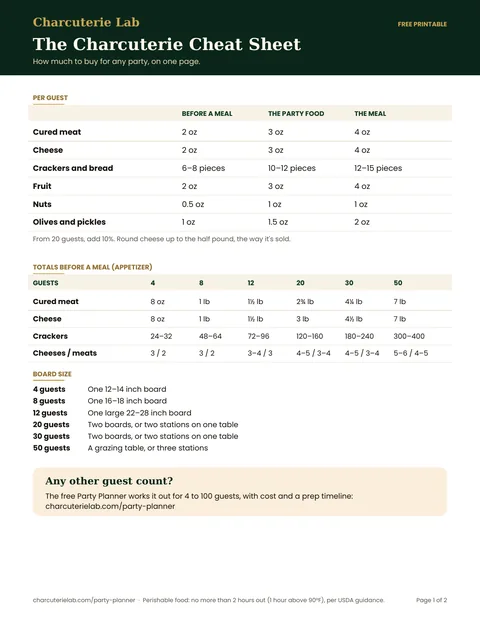
Quick Answer: Same board, smaller: 2 cheeses, 1–2 meats, 6–8 crackers and a sweet and sour extra. Plan 2 oz each per person as a snack, 4 oz as dinner. A dinner plate works. Buy fewer, better things.
Why Mini Boards Are Different
A party board is built for visual abundance and variety for many people. A mini board for one or two is built for a specific meal, snack, or occasion — it should feel intentional and curated rather than scaled-down and sparse.
The format is also different. On a party board, you buy enough of each ingredient to last the event. On a mini board, you're buying exactly what you'll eat in one sitting. This means you can afford to buy 2 oz of a genuinely great cheese rather than 8 oz of a compromise cheese — and the result will be better.
The Mini Board Formula
For one person (appetizer):
- 2 oz cheese (1 type or 1 oz of 2 types)
- 1.5 oz cured meat
- 4–6 crackers or crostini
- A few grapes, 1 sliced apple, or other fruit
- 1 teaspoon honey
- 5–6 nuts
For two people (appetizer):
- 4 oz cheese (2 types, 2 oz each)
- 4 oz cured meat (1–2 types)
- 8–10 crackers
- Small cluster of grapes + apple slices
- 1 tablespoon honey in a small dish
- Small handful of nuts
For one person (meal):
- 4 oz cheese (2 types)
- 3 oz cured meat
- 6–8 crackers or crostini
- Generous fruit
- Honey, olives, or other condiment
The Best Cheeses at Mini Scale
At mini scale, you can afford to buy the better version of a cheese because you need so little of it. A 2 oz wedge of something genuinely excellent costs $2–4 at a cheese counter and outperforms 4 oz of compromise.
Best soft option: A 2 oz triangle of very ripe brie or Camembert, or 2 oz of fresh chèvre. At room temperature, either will be creamy and flowing after 30 minutes on the board.
Best firm option: A 2 oz piece of aged manchego, aged cheddar, or a small shard of parmesan. The crystalline texture and concentrated flavor of an aged hard cheese hit differently at small scale — you taste it more carefully when there's less of it.
Skip: Large wedges designed for party boards. A 1/4 pound wedge of anything will be half-eaten and poorly stored after a mini board. Cut to order at the counter, or buy a small specialty format (mini brie rounds are made for exactly this purpose).
The Best Meats at Mini Scale
Prosciutto: 4–5 slices (roughly 1.5 oz) is enough for a mini board for two. Fold into loose rolls or drape naturally off the board edge.
Salami: A few slices, fanned or folded. Genoa salami, soppressata, or any pre-sliced variety.
Mix: 2 slices prosciutto + 4 slices salami gives two textures and flavor profiles at minimal quantity.
What to Use as a Board Surface
For a mini board, surface choice is about appropriateness to scale:
- Small wooden cutting board (8–10 inches) — the most versatile option
- Dinner plate — completely valid, especially for a weeknight board
- Slate tile from a hardware store (roughly 4×8 inches) — inexpensive and functional
- Small marble board — if you have one, perfect at this scale
The surface doesn't need to be large. The goal is to group 3–5 distinct elements with no wasted space between them.
Making It Look Full
The visual challenge with a mini board is filling the surface so it looks curated rather than sparse. Several techniques:
Angle the cheese. Don't lay cheese flat on the board. Lean a wedge against a cracker pile or position slices at a slight angle — it creates height and dimension.
Fold or roll the meat. Flat-stacked slices look like a deli portion. Folded or loosely rolled meat takes up more visual space and looks intentional.
Cluster the fruit. Six grapes loose on a board look scattered. Six grapes in a small cluster look intentional.
Use a ramekin. Even a very small dish filled with honey or a few olives adds a focal point that anchors the composition.
The Mini Board as Weeknight Dinner
A mini board for one works as a weeknight dinner. The protein (cured meat and cheese), fat (cheese, nuts), and carbohydrate (crackers, fruit) balance is more complete than most quick meals. No cooking required. Cleanup is one board and a knife.
The format: 4 oz cheese, 3 oz cured meat, 8 crackers or crostini, generous fruit, honey. On a cutting board, assembled in 10 minutes, eaten in front of whatever you want to watch. This is an entirely valid way to eat dinner on a Tuesday.
The Charcuterie Lab Takeaway
Mini boards use the same principles as party boards at a smaller scale — but the format rewards quality over quantity. Buy 2 oz of something excellent rather than 8 oz of something adequate. Use a small surface that makes 5 elements look intentional. The board is the occasion. It doesn't need guests.
Building more boards? The Charcuterie Lab ebook walks through 50 boards across every occasion — each one with exact quantities, a shopping list, and the science behind why it works.
FAQ
How much cheese do you need for a mini charcuterie board?
Plan 2 oz of cheese per person as an appetizer and 4 oz if the board is dinner. A mini board for two at appetizer portions needs about 4 oz of cheese total — pick 2 types in small quantities rather than buying large wedges. Most specialty cheese counters will cut to order; ask for 2–3 oz of each variety.
What size board do you use for a mini charcuterie board?
A small wooden cutting board (8–10 inches), a dinner plate, a slate tile, or even a small serving board works well for 1–2 people. You don't need a dedicated charcuterie board — any flat surface with enough space to group 2 cheeses, 1–2 meats, and a few accompaniments is sufficient. The format should feel intimate and curated, not sparse.
What are the best cheeses for a mini charcuterie board?
Choose 2 cheeses with different textures: one soft (brie, fresh chèvre, or burrata) and one firm (aged cheddar, manchego, or parmesan). This covers both texture categories without requiring large quantities of each. For a mini board, 2 oz of each is ideal — just enough for 3–4 bites of each type per person.
How do you make a mini charcuterie board look full?
Height and clustering create the impression of abundance on a small board. Fold meat rather than laying it flat. Position cheese at slight angles rather than flat. Use small clusters of grapes, 3–4 strawberries, and a small ramekin or spoon of honey. Scatter 10–12 nuts in gaps. A small board that looks organized and intentional reads as curated — empty space is the only thing to avoid.
Can a mini charcuterie board be a full meal?
Yes — a mini board for one can be a satisfying meal with the right quantities. Plan 4 oz cheese, 3 oz cured meat, 6–8 crackers or crostini, and generous fruit and nuts. The protein, fat, and carbohydrate balance of a well-built board is more complete than most people expect. This is the everyday format that works for weeknight dinners without any cooking.