A charcuterie board for two operates under different rules than a board built for six or ten. The quantities are smaller, but that's not the only thing that changes. The selection logic is different — with two people, you have fewer mouths to serve across a wider range of preferences, so you can afford to be more targeted. The presentation format is different — a small board reads better than a large board with half of it empty. And the purchase strategy is different — buying individual portions or specialty varieties rather than large format packages.
This guide covers the specific adjustments that make a two-person board work as well as a large board.
Quick Answer: A charcuterie board for two people works best with restrained variety: 2 cheeses (one soft, one firm), 1–2 cured meats, crackers, and 2–3 accompaniments. Prioritize quality over quantity at small scale — one excellent cheese and one great prosciutto beats five mediocre elements. For a date night, add honeycomb, fresh figs, or dark chocolate for indulgence.
Quantities for Two
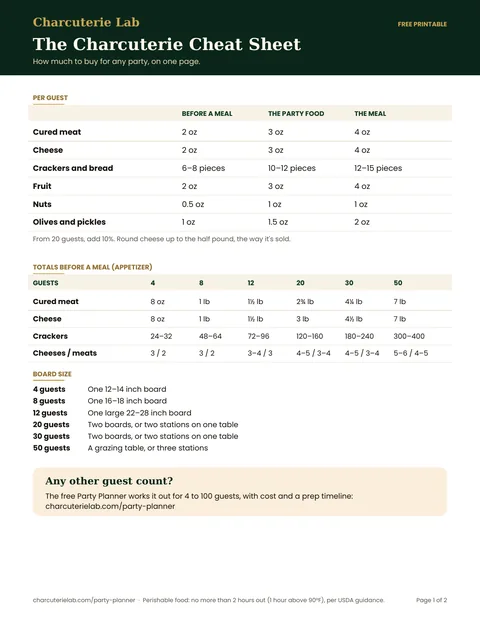
The starting framework: 2 oz of cheese and 2 oz of meat per person in total as an appetizer, or 4 oz of each if the board is dinner. At appetizer scale:
For a board that works as an appetizer or light grazing:
- 2 cheeses × 2 oz each = 4 oz total cheese
- 2 meats × 2 oz each = 4 oz total meat
- Crackers: one sleeve (or about a third of a sleeve, plus a small amount of bread)
- 1 fruit element: half a bunch of grapes, or 2 fresh figs, or 1 apple
- 1 condiment: 1 tablespoon of honey or a small ramekin of jam
For a board that replaces a meal: Double it: 8 oz of cheese (3 cheeses at 2–3 oz each) and 8 oz of meat (2 meats at 4 oz each), full cracker sleeve, more substantial fruit.
The important quantity implication: buying standard supermarket packages means buying too much of everything. A standard package of prosciutto (3 oz) is almost exactly right for two. A standard wedge of Brie (8 oz) is more than right — plan to use the rest within a few days. A large salami link (12 oz) produces significant waste for two people.
Shopping adjustment: For two-person boards, shop for smaller portions specifically. Look for:
- Pre-sliced specialty meat packs (3–4 oz, sold at the deli counter or in small packages)
- Smaller cheese formats (individual Brie rounds at 4–5 oz rather than full wedges)
- Salami sticks or small-format salami rounds rather than a full link
Many grocery delis will slice to order — ask for 3 oz of prosciutto and 3 oz of salami. This avoids the waste of buying standard packages.
Selection Rules for Two
A two-person board allows more targeted selection than a board for a crowd.
For a crowd: You need variety to cover diverse preferences — something mild for those who don't like bold cheese, something approachable for those new to charcuterie.
For two: You know the preferences at the table. If you both love aged, complex cheese, a board with Stilton and aged Manchego and Parmigiano is better than a board with Brie (selected because "beginners like it"). You don't need to hedge.
The two-person selection principles:
- Go deeper, not broader. Two excellent, intentionally paired cheeses are better than four cheeses selected for variety. A board with an aged Gouda (Maillard caramel) next to a fresh chèvre (lactic tang) is more interesting than aged Gouda + mild Manchego + Brie + Gruyère.
- Include one thing you've never tried. A board for two is the ideal format for trying an unfamiliar cheese or meat — you're not serving it to guests who might not like it, and there's no waste if it's not a hit.
- Match the occasion. A date-night board has different energy than a casual Saturday afternoon board. Match the ingredient selections to the occasion: more wine-specific pairings for a date night, simpler and more casual for low-key grazing.
Board Surface and Format
A standard 12" × 16" serving board is too large for a two-person board. With small quantities, the board looks sparse and the effect is lost.
Better options for two:
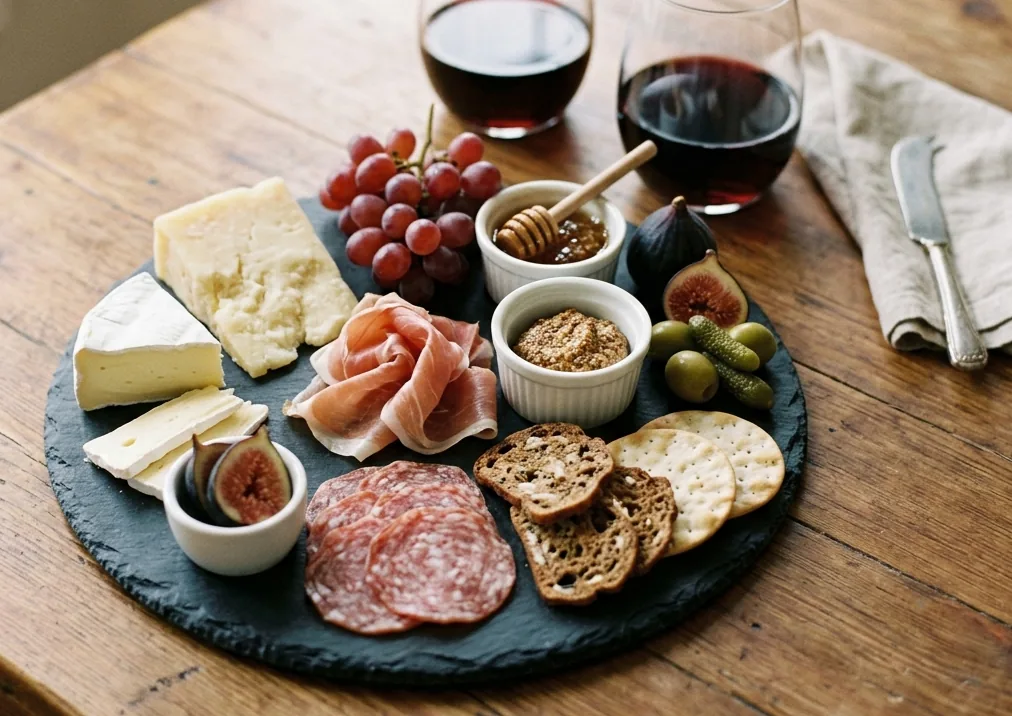
- A small wooden board or slate in the 8" × 10" to 10" × 12" range
- A large dinner plate (round, works well as a casual board)
- A small sheet of parchment paper on a countertop or table (extremely casual; works for a sofa evening)
- A small slate tile used as a sectioned surface
The rule: the board surface should be covered at about 70–80% when fully assembled. Visible surface is fine — but the board should look abundant, not sparse.
Single-board vs. multi-element layout: For two people, a single small board works. All the elements fit in close proximity, and guests are close enough to each other that reach isn't a problem.
Assembly for Two: Priorities
The same assembly order applies at small scale:
- Place the condiment bowl first. Even for two, a small ramekin of honey anchors the board.
- Place the cheeses. Two cheeses at slightly different positions — not side by side.
- Drape or fold the meats adjacent to the cheese they pair with.
- Add fruit. A small cluster of grapes or a fig half fills the visual gaps.
- Crackers last — a small pile within 30–60 minutes of eating.
The visual principle at small scale: every element should touch or nearly touch at least one other element. A small board with elements spread out looks like the board ran out of food. A small board with elements in close, slightly overlapping proximity looks abundant and intentional.
Two-Person Date Night Board Ideas
Wine-pairing board:
- Aged cheddar + chèvre
- Prosciutto + finocchiona
- Grapes + dried figs
- Honey + whole grain mustard
- Water crackers
- One specific bottle: Pinot Noir or Sauvignon Blanc
Italian-inspired board:
- Burrata (one ball) + young Pecorino
- Prosciutto + mortadella
- Cherry tomatoes + fresh basil
- Aged balsamic drizzle
- Crostini
- Vermentino or Prosecco
Bold flavors board:
- Stilton + aged Manchego
- Bresaola + soppressata
- Walnut halves + dried pear
- Dark honey
- Dark rye crispbread
- Tawny Port
Summer board:
- Burrata + fresh chèvre
- Prosciutto + lonza
- Fresh peach slices + green grapes
- Acacia honey
- Focaccia
- Rosé or light Prosecco
The Date Night Version: Three Upgrades Worth Buying
A date night board is a board for two with a slower pace: it sits out over conversation and a bottle, not grazed at a party. That shifts the buying toward fewer, better things.
- One luxurious soft cheese. A triple-crème such as Brillat-Savarin, Délice de Bourgogne or Saint André, plus one aged, crunchy cheese (aged Gouda or Parmigiano-Reggiano) for contrast. Two cheeses is enough. Take them out 20–30 minutes before serving.
- Elegant meats. Prosciutto di Parma or San Daniele with bresaola. Leave spicy salami for a party board; it overpowers a delicate soft cheese.
- One splurge accompaniment. Truffle honey drizzled on the soft cheese, a piece of honeycomb, or a few squares of 70% dark chocolate with Marcona almonds.
What to drink: Champagne or Crémant first, Prosecco on a budget, or a light Pinot Noir if you want red. Our Champagne and Prosecco pairing guide has the cheese matches.
Want it planned for you? The Date Night Pack has four printable board plans for two with shopping lists.
FAQ
What is the right size charcuterie board for two?
An 8–10" round board or a 12" rectangular board works well for two people. This size holds 2–3 cheeses (small wedges or portions), 2 oz of one or two meats, a handful of crackers, and a few accompaniments without looking sparse or overcrowded. A single dinner plate also works perfectly for an intimate board for two.
What cheeses should a board for two include?
Three cheeses in small portions: something soft and creamy (brie or chèvre), something semi-firm and familiar (cheddar or Gouda), and something with more personality (blue cheese or a washed-rind). At two-person quantities, buy small amounts of each — a 2 oz wedge of each provides roughly 1 oz per person per cheese, enough to taste without overwhelming.
How do you make a charcuterie board for two feel special rather than just a snack?
Intentionality is the difference between a romantic charcuterie board and a random snack plate. Choose a theme (Italian, French, date night), use a proper board or slate rather than a plate, arrange with intention (fold the prosciutto, fan the cheese), add one special element (honeycomb, fresh figs, dark chocolate), and pour a proper glass of wine. The care in assembly communicates intention.
What are the best meats for a board for two?
Prosciutto is the ideal meat for a board for two — it's sold in small packages (3 oz), naturally portioned for two, and works with almost every cheese and accompaniment. Bresaola or a small amount of thinly sliced salami rounds out the meat section without waste. Avoid buying full packages of multiple meats — most will go unused.
Is a board for two different from a board for a crowd?
The elements are the same; the quantity and proportion change. A board for two allows for more personalization — you can center it entirely on the specific preferences of the two people eating. It also allows for more indulgence per person (more prosciutto, a larger cheese section relative to person count) without the waste concerns of a large-crowd board.
What wine goes with a date night charcuterie board?
Champagne, Crémant or Prosecco is the safest match: the bubbles and acidity cut through rich soft cheese and prosciutto. If you prefer red, pick a light Pinot Noir served slightly cool. Skip big tannic reds like Cabernet with a triple-crème; they flatten it.
Quick Reference
| Element | Quantity for 2 (appetizer) | Quantity for 2 (meal) |
|---|---|---|
| Cheese | 2 types × 4 oz | 3 types × 3–4 oz |
| Meat | 2 types × 3 oz | 2 types × 4 oz |
| Crackers | ½–1 sleeve | 1 sleeve |
| Fruit | 1 small element | 2 elements |
| Condiment | 1 small bowl | 1–2 small bowls |
| Board size | 8"×10" to 10"×12" | 10"×12" to 12"×14" |
Get weekly board tips in the Charcuterie Lab Report newsletter.