Quick Answer: American bologna descends from mortadella, the cooked pork sausage from Bologna, Italy, but they're different sausages. Mortadella is finely ground pork studded with visible cubes of fat, seasoned with black pepper and warm spices, often with pistachios, and slow-cooked for hours. Bologna is blended completely smooth with no visible fat, can be made from beef, pork or poultry, and tastes milder and saltier. Mortadella belongs on a charcuterie board; bologna belongs in a sandwich.
Is bologna the same as mortadella?
No, but they're family. Italian immigrants brought mortadella to the US, and American meat packers turned it into a cheaper, more uniform sausage named after the city it came from. That became bologna, also spelled baloney.
Over time the two drifted far apart. Mortadella stayed a carefully made specialty. Bologna became an everyday lunch meat.
Mortadella vs. bologna at a glance
| Mortadella | Bologna | |
|---|---|---|
| Origin | Bologna, Italy | United States |
| Meat | Pork only (for Mortadella Bologna IGP) | Beef, pork, poultry or a mix |
| Texture | Silky, with soft cubes of fat | Smooth and even all the way through |
| Visible fat | Yes, at least 15% fat cubes in the IGP version | No |
| Seasoning | Black pepper, myrtle, warm spices, often pistachios | Mild: salt, coriander, nutmeg, sometimes smoke |
| Cooked? | Yes, slow-cooked in dry-air ovens | Yes |
| Size | Very large rounds, sliced at the deli | Smaller, often pre-sliced in packs |
| Price | $$ | $ |
| Best for | Boards, sandwiches, cubed with drinks | Sandwiches, fried bologna |
How they're made
Mortadella Bologna IGP has a protected recipe. Pork is ground to a fine paste, then mixed with cubes of firm neck fat that make up at least 15 percent of the sausage. Black pepper, myrtle berries and spices go in, and pistachios are optional. The huge sausages cook slowly in dry-air ovens, sometimes for a day, until the center is fully cooked.
Bologna follows a US federal standard. It's a cured, cooked sausage that's finely chopped until smooth, can be made from one or more kinds of meat with up to 15 percent poultry, may be smoked, and can contain up to 30 percent fat with no visible pieces. Cheaper bolognas may also include by-products, which must be named on the label.
How they taste
Mortadella is delicate and aromatic: savory, faintly sweet, with a little pepper and spice. The fat cubes melt on your tongue, and pistachios add a buttery crunch.
Bologna is mild, salty and uniform. It's comforting and familiar, but it doesn't have the spice, the fat cubes or the silky texture.
Which belongs on a charcuterie board?
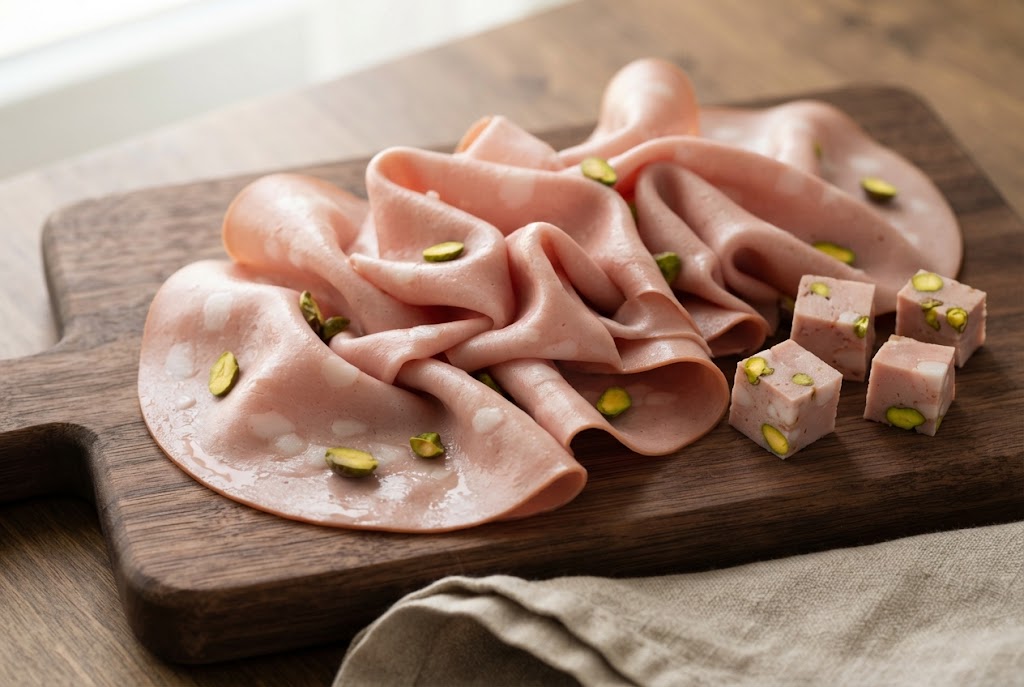
Mortadella, every time. It's one of the prettiest meats you can put out, with its pale pink slices dotted with white and green. Two ways to serve it:
- Sliced thin, folded into quarters or ruffled into loose roses.
- Cubed: ask for a single half-inch slice, cut it into cubes and serve with toothpicks, the way it's served with drinks in Bologna.
Pair it with Parmigiano-Reggiano, fresh mozzarella or burrata, pistachios, olives, focaccia and a glass of Lambrusco or Prosecco. Take it out of the fridge about 20 minutes before serving.
Bologna has a place on a casual or kids' board, rolled up or cut into shapes, but it reads as lunch meat next to real cured meats.
Which should you buy?
- For a board: mortadella with pistachios, sliced to order at the deli. Our ranking of the best mortadella brands names the ones to look for.
- For a classic sandwich: either. Mortadella makes an excellent one.
- For fried bologna: bologna.
- For pregnant guests: the CDC advises heating deli meats until steaming hot, so warm a few slices in a pan.
For pairings and serving, see the mortadella guide.