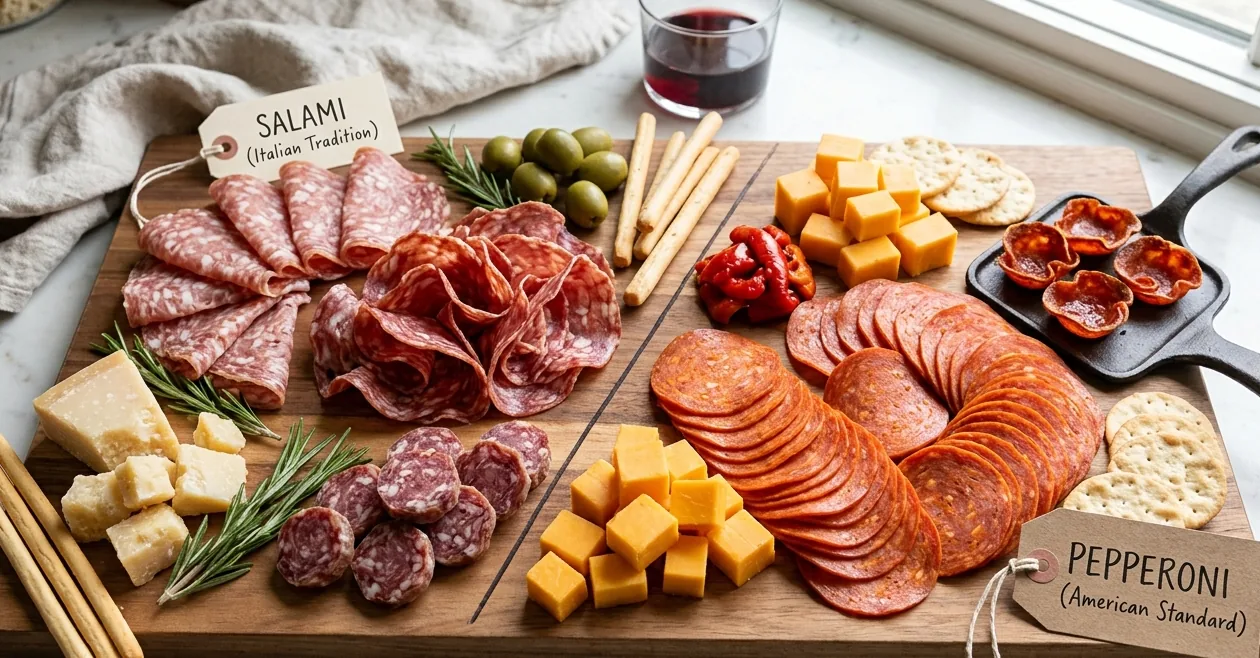
Quick Answer: Yes, pepperoni is a type of salami. Salami is the whole family of fermented, air-dried sausages; pepperoni is one American member of it. The differences: pepperoni is ground finer, seasoned with paprika and chili, usually smoked, and often made with pork and beef, so it's redder, spicier and crisps up on pizza. Most Italian salami is pork-only, milder and lies flat.
Is pepperoni the same as salami?
Not quite. All pepperoni is salami, but most salami isn't pepperoni.
"Salami" describes a method: season ground meat and fat, pack it into a casing, let it ferment, then dry it until it's firm enough to slice. That method produces dozens of sausages, from mild Genoa to fennel-scented finocchiona to fiery calabrese.
Pepperoni follows the same method. It was created by Italian-American butchers in the United States, which is why you won't find it in Italy. It's best thought of as America's own salami.
Salami vs. pepperoni at a glance
| Salami | Pepperoni | |
|---|---|---|
| What it is | A family of Italian cured sausages | One American-style salami |
| Meat | Usually pork only | Pork, or pork and beef |
| Grind | Medium to coarse; you can see the fat | Fine and even |
| Seasoning | Garlic, black pepper, wine, fennel or chili, by style | Paprika, chili, garlic, sometimes fennel |
| Smoked? | Rarely | Usually |
| Color | Deep red with white fat | Bright orange-red |
| Heat | Mild (Genoa) to hot (calabrese) | Medium-hot |
| On pizza | Lies flat | Often curls into crisp cups |
| On a board | The better choice for most boards | Best on casual or pizza-themed boards |
How they're made
Salami: ground pork and fat are mixed with salt, curing salts and the spices of its region, stuffed into casings and fermented. The fermentation gives salami its gentle tang. Then it hangs to dry for weeks or months, which firms it and concentrates the flavor.
Pepperoni: the same fermentation and drying, with three differences you can taste. The meat is ground finer, so the slice is smooth. It's seasoned heavily with paprika, which gives it the orange-red color. And it's usually smoked, which adds depth and helps it cook up crisp.
Which is spicier?
Pepperoni is spicier than most salami. Genoa, the salami most people buy, isn't spicy at all: it's garlicky and mild.
But "salami" includes hot styles too. Calabrese salami and hot soppressata use Calabrian chili and can be as spicy as pepperoni or spicier. 'Nduja, a spreadable Calabrian salami, is hotter still.
Calabrese salami vs. pepperoni
These two get compared because they're both red and spicy.
- Calabrese comes from Calabria in southern Italy. It's usually pork-only and coarsely ground, with a tangier, more rustic flavor and a fruity chili heat.
- Pepperoni is finer, smokier and more uniform, with a paprika-forward flavor.
If you like pepperoni and want the Italian version for a board, calabrese is the one to buy.
Genoa salami vs. pepperoni
Genoa salami is the opposite of pepperoni: mild, garlicky, with white pepper and sometimes wine, and no paprika. It's the easiest meat on any charcuterie board. See our Genoa salami guide for what to pair with it.
Salami vs. pepperoni on pizza
Pepperoni is made for pizza. Thin slices of a narrow, natural-casing pepperoni curl into cups that crisp at the edges and hold little pools of red oil.
Salami works too; it just lies flat and stays softer. For pepperoni-style heat, use calabrese or hot soppressata. For a milder pizza, Genoa or finocchiona are excellent.
Salami vs. pepperoni on a charcuterie board
For most boards, choose salami. It comes in more flavors, so you can match it to your cheeses:
- Genoa salami with aged cheddar or provolone
- Soppressata with fresh mozzarella and a drizzle of hot honey
- Finocchiona with pears and Pecorino
Pepperoni earns its place on a casual board, a game-day spread or a pizza-night board, and kids reach for it first. Its paprika heat can overpower delicate cheeses, so put it next to something sturdy: sharp cheddar, pepper jack or provolone.
Want the full list? See the best meats for a charcuterie board, or look up what goes with pepperoni in the Pairing Finder.
Why is it called pepperoni?
The name comes from peperoni, the Italian word for bell peppers. Ask for a pepperoni pizza in Italy and you'll likely get peppers. The closest Italian equivalent is salame piccante, spicy salami.
Which should you buy?
- For a charcuterie board: salami. Genoa for mild, soppressata or calabrese for heat.
- For pizza: pepperoni.
- For a crowd that includes kids: both. Pepperoni gets eaten first.
Get weekly charcuterie science (ingredient deep dives, pairing principles and board-building technique) in the Charcuterie Lab Report newsletter.