Quick Answer: Use the knives and picks, take a few pieces onto a plate, and step away. Don't double dip. Cut cheese the way it's already started, never just the tip. Hosts: put out small plates, napkins, a knife per cheese and a bowl for pits.
The five rules that matter most
1
Use the toolsThe knife by each cheese is for that cheese. Picks and tongs are for the meat.
2
Plate it, then step backA few pieces at a time onto a plate or napkin, then let the next person in.
3
One dip per pieceOr spoon some dip onto your plate.
4
Cut cheese fairlyFollow the existing cuts. Never take just the tip of a wedge.
5
Touch it, take itNothing goes back on the board.
There's no menu and no portions, so here are the unwritten rules for guests and hosts.
12 rules for guests
- Take a plate or napkin first. Build a small plate, then eat away from the board.
- Use the tools that are there. Each cheese knife stays with its cheese. Picks and tongs are for meat, olives and anything slippery.
- Take a few pieces at a time. Two or three items on the first pass is plenty. Come back later rather than loading up.
- Don't hover. Step away after you've filled your plate so others can reach. Conversations happen better a few feet from the food anyway.
- If you touch it, take it. Never put a piece back, even if it turns out to be the wrong cheese.
- Don't double dip. Dip once per piece, or spoon some dip or jam onto your plate.
- Cut cheese the way it's started. Follow the host's cuts, and leave the wedge in the same shape for the next person (more below).
- Don't pick out all the good bits. Taking every Marcona almond or the last of the prosciutto while leaving the crackers is noticed.
- Put pits and toothpicks in the discard bowl, or on your own plate. Not back on the board, and not hidden under a cracker.
- Taste before you pile on. Try a strong cheese or a hot honey on a small piece before building a big bite.
- Ask about anything unlabeled if you have an allergy. Nuts and gluten turn up in unexpected places, like pesto, some crackers and some cured meats (see is salami gluten-free?).
- Taking the last piece is fine once the board has been out a while. Offer it to whoever's next to you first.
Fingers or tools?
- Fingers are fine for: crackers, bread, grapes, nuts, dried fruit and anything already on a pick.
- Use a tool for: sliced meat, soft and cut cheese, olives, pickles, honeycomb, jam and dips.
- No tools out? Take what you need with your fingers, take only what you touch, and put it straight on your plate. Then quietly ask the host for a few picks.
- Feeling under the weather? Ask someone to fix you a plate. The board is shared by everyone in the room.
How to cut cheese politely
Cheese is where most board etiquette goes wrong, because a badly cut wedge leaves the next person with only rind.
- Wedges (brie, Manchego, blue): cut a thin slice along the long side, from the point back to the rind. Each slice then gets some center and some rind.
- Never cut off the nose. The pointed tip of a wedge is usually the creamiest part, and taking just the tip is the classic cheese-board faux pas (Food Republic).
- Wheels and rounds (brie, Camembert): cut a thin wedge from the center out, like a cake. Don't scoop the soft middle out and leave a shell of rind.
- Blocks and chunks (cheddar, Gouda, Parmesan): take a pre-cut piece, or cut a slice off the end, not the middle.
- Blue cheese: use its own knife and crumble a piece onto your plate, so the blue doesn't end up on the other cheeses.
- Logs (goat cheese): cut a round from the end.
Hosts can avoid all of this by pre-cutting part of each cheese. See how to cut cheese for a charcuterie board for every shape.
Double dipping: is it really that bad?
Yes, a little. A food science team at Clemson University tested it. When people bit a cracker and dipped it again, bacteria from the mouth ended up in the dip. Thin dips like salsa picked up the most, because more of the dip touching the bitten edge falls back into the bowl. Thick dips cling to the cracker instead (The Conversation, via ScienceAlert).
Most mouth bacteria are harmless, but colds and flu spread through saliva too, and holiday party season is also cold season. The fix is easy: dip once, or spoon some onto your plate. Hosts can help by giving every dip and jar its own small spoon.
Rinds, casings and garnish: what can you eat?
- Soft bloomy rinds (brie, Camembert): edible and part of the flavor. Eat them or don't, but don't scrape them off on the board. More in can you eat brie rind?
- Natural rinds on aged cheese (Parmesan, Manchego): safe but often hard. Most people leave them.
- Wax and cloth: not edible. Peel it and put it on your plate or in the discard bowl.
- Salami casings: thin natural casings are fine to eat. Thick or papery ones are usually peeled off before serving. If one is still on, peel it on your plate.
- Rosemary, thyme and other fresh herbs: edible, but mostly there for looks. A leaf or two is fine. Nobody eats the whole sprig.
- Flowers: only eat them if the host says they're edible flowers. If you're not sure, leave them.
Rules for hosts
Most guest etiquette problems are really hosting problems. If people have the right tools, they use them.
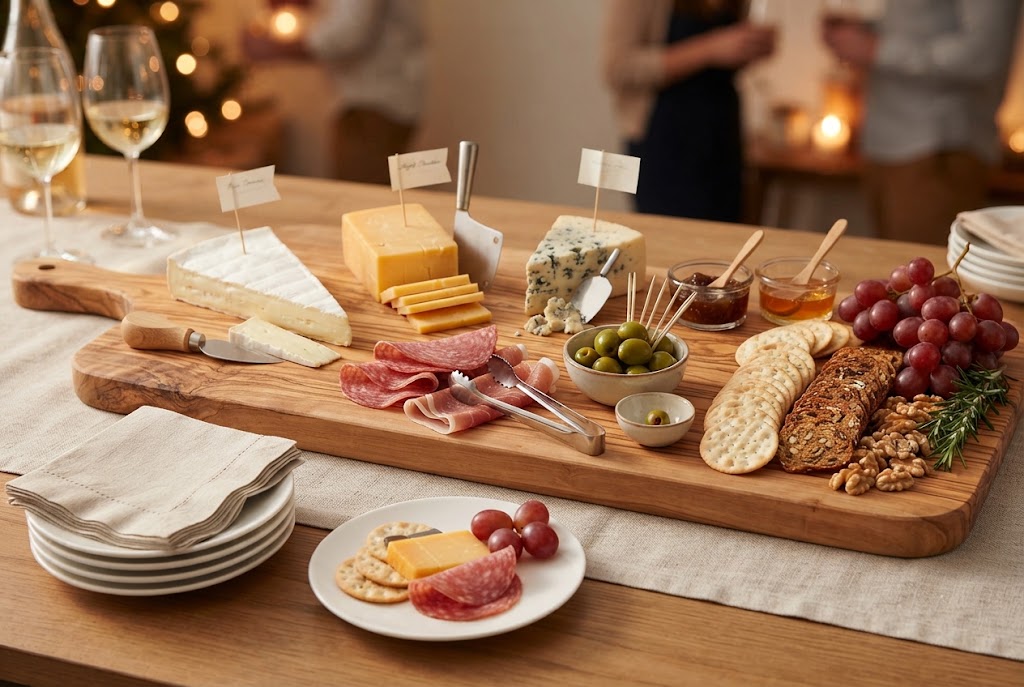
- Small plates and napkins right next to the board, so taking a plate is the obvious first step.
- A knife for every cheese, including a separate one for the blue.
- Picks or small tongs for meat, olives and pickles.
- A small spoon in every dip, jam and honey, so nobody dips straight in.
- A discard bowl for olive pits, toothpicks and rinds. Put one olive pit in it so guests understand what it's for.
- Pre-cut part of each cheese, so guests don't have to work out how to start a whole wedge.
- Labels for the cheeses, and for anything with nuts, gluten or pork. Keep gluten-free crackers on a separate plate.
- Only food-safe garnish. Use fresh herbs and flowers sold as edible. Some florist greenery and flowers aren't safe to eat, and guests will assume anything on the board is food.
- Pull it after 2 hours. Perishable food shouldn't sit out longer than that, or 1 hour above 90°F (USDA). Refill from the fridge instead of leaving it all out at once.
- Two boards for a crowd. Over about 15 guests, two smaller boards at opposite ends of the room stop the crowding.
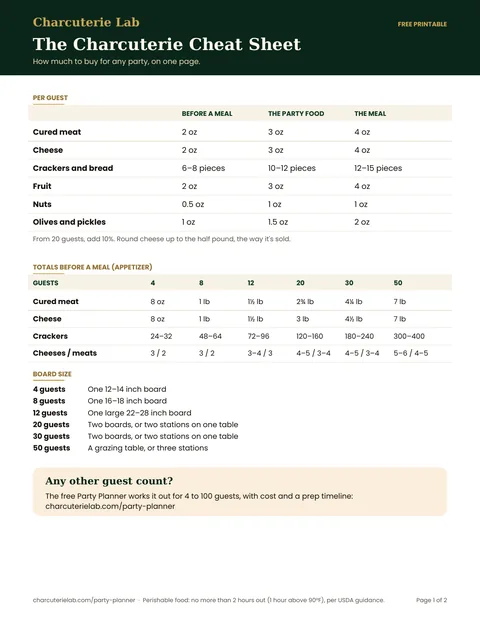
Getting the amounts right matters too: a board that runs out in 20 minutes makes everyone grab. Plan 2 oz each of meat and cheese per guest before a meal, or 3 oz when the board is the party food. The Party Planner works it out for your guest count.
At a sit-down dinner
When a board or cheese plate is passed around the table, take one or two pieces and pass it on in the same direction as the other shared dishes. If the cheese comes after dinner, eat it mildest to strongest. Our guide to the cheese course explains the order.
Sources
- The Conversation via ScienceAlert: Is double-dipping a food safety problem or just a nasty habit?
- Food Republic: The Charcuterie Board Etiquette Mistake You Didn't Know You Were Making
- USDA FSIS: What is the 2-hour rule for leaving food out?
FAQ
Do you use your fingers on a charcuterie board?
Use the knives, picks and tongs if the host put them out. Crackers, bread, grapes and nuts are fine to pick up with your fingers, but take only what you touch and put it straight on your plate.
Is it rude to eat straight off a charcuterie board?
At a party, yes. Put a few pieces on a small plate or napkin and step away so others can reach. At a small, casual gathering of close friends, grazing is usually fine, as long as you don't double dip or put anything back.
How should you cut cheese from a charcuterie board?
Follow the cuts already started. For a wedge, cut a slice along the long side from the point to the rind so the next person gets the same mix. Never cut off just the tip, or nose, of a wedge, and don't scoop the soft center out of a brie.
Can you eat the rosemary and flowers on a charcuterie board?
Fresh herbs like rosemary and thyme are edible but are mostly there for looks. Only eat flowers if the host says they are edible flowers. If you're not sure, leave the garnish.
Is double dipping on a charcuterie board bad?
Yes. A Clemson University experiment found that biting a cracker and dipping it again added bacteria from the mouth to the dip, especially in thin dips. Spoon some dip onto your plate, or dip only once per piece.