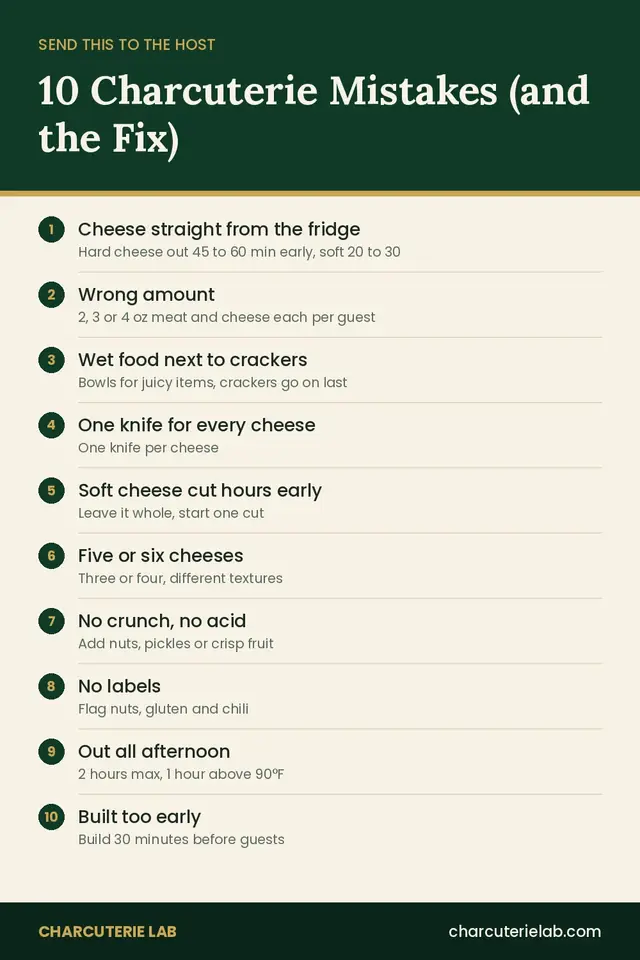
Quick Answer: The most common charcuterie mistakes are serving cheese too cold, buying the wrong amount, crowding crackers next to wet food, one knife for every cheese, cutting soft cheese ahead, too many cheeses, no crunch or acid, no labels for allergies, leaving the board out too long and building it too early. Each has a two-minute fix.
Send this to your friend before their party. None of these mistakes are hard to fix, and most of them come down to timing. Here is what goes wrong and what to do instead.
The ten mistakes at a glance
| # | Mistake | The fix |
|---|---|---|
| 1 | Cheese served fridge-cold | Pull hard cheese 45 to 60 min ahead, soft cheese 20 to 30 min |
| 2 | Too much or too little food | 2, 3 or 4 oz of meat and cheese each per guest |
| 3 | Wet food touching crackers | Bowls for anything juicy, crackers go on last |
| 4 | One knife for everything | One knife per cheese, especially blue |
| 5 | Soft cheese cut hours early | Leave soft cheese whole, start one cut |
| 6 | Five or six cheeses | Three to four cheeses of different textures |
| 7 | No crunch, no acid | Add nuts, pickles or crisp fruit |
| 8 | No labels | Label nuts, gluten and anything spicy |
| 9 | Out all afternoon | 2 hours maximum, 1 hour above 90°F |
| 10 | Built too early | Build 30 minutes before guests arrive |
1. Serving cheese straight from the fridge
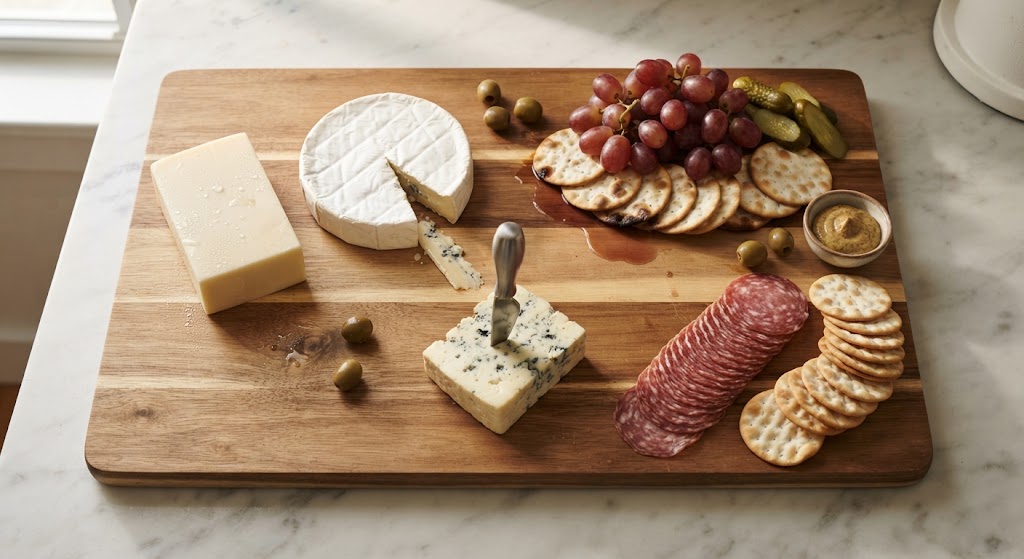
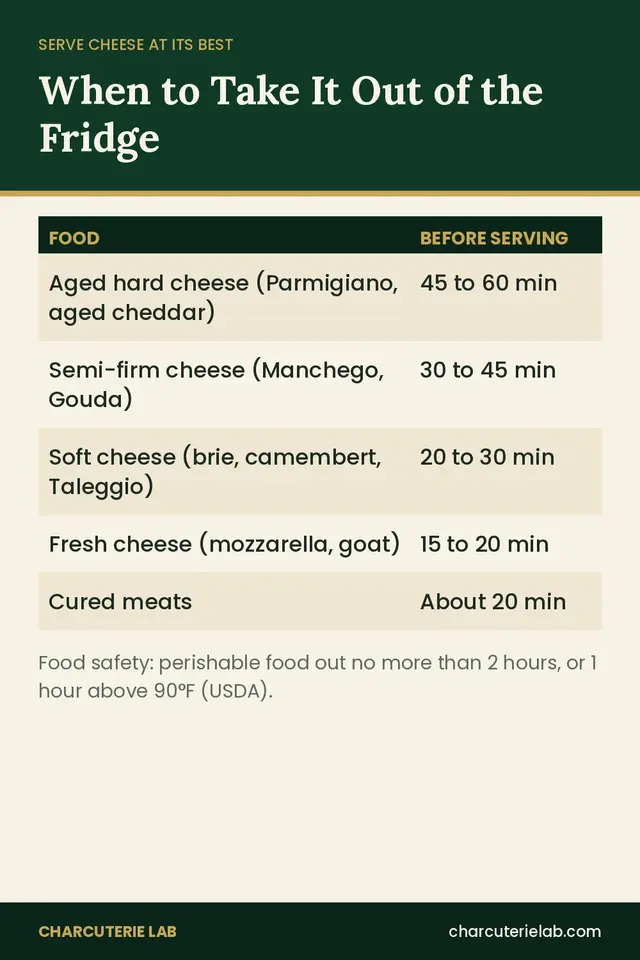
Cold cheese tastes flat. The fats are firm and the aromas stay locked in. Take aged hard cheeses out 45 to 60 minutes before serving, semi-firm cheeses 30 to 45 minutes, and soft cheeses like brie 20 to 30 minutes. Cured meats need about 20 minutes. Our cheat sheet has the full timing table.
2. Buying the wrong amount
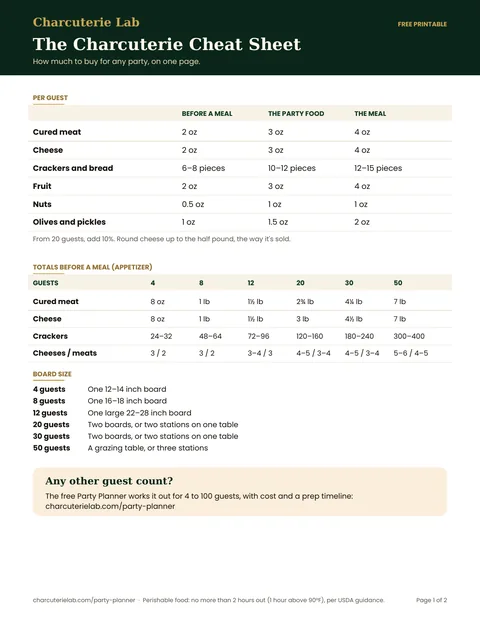
The rule we use on every board: meat and cheese each at 2 oz per guest when a meal follows, 3 oz when the board is the party food and 4 oz when the board is dinner. From 20 guests up, add 10%. The Party Planner does the math for any headcount.
3. Wet food next to crackers
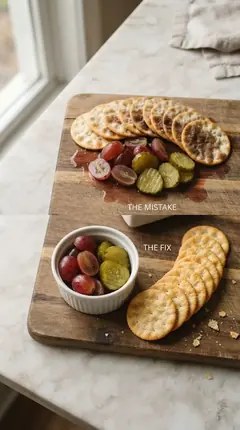
Grapes, pickles, olives and jam all leak. Put anything juicy in small bowls, and add crackers last so they stay crisp. Keep a basket of extra crackers on the side for refills.
4. One knife for every cheese
A knife that just cut blue cheese will make your brie taste like blue cheese. Give each cheese its own knife, and pick the right shape: a soft-cheese knife for brie, a spade for hard cheese, a small fork or spreader for crumbly blue.
5. Cutting soft cheese hours ahead
Pre-cut brie and camembert weep and dry out at the edges. Leave them whole and make one or two starter cuts so guests know it is fine to dig in.
6. Too many cheeses
More cheese does not make a better board. It makes a confusing one. Three or four cheeses with different textures (one soft, one firm, one aged, one blue or goat) give guests a range without a wall of beige. The best cheese guide shows how to pick them.
7. Forgetting crunch and acid
Rich cheese and salty meat need contrast. Crunch comes from nuts, crisp crackers and raw vegetables. Acid comes from cornichons, pickled onions, green apple or a dry sparkling wine. Without them, every bite starts to taste the same.
8. No labels
Guests with nut allergies, celiac disease or a dislike of heat need to know what they are eating. Small labels or toothpick flags on anything with nuts, gluten or chili take five minutes and save awkward questions.
9. Leaving the board out all afternoon
Per USDA guidance, perishable food should sit out no more than 2 hours, or 1 hour when it is above 90°F. For a long party, build a smaller board and refill it from the fridge.
10. Building too early
A board built at noon for a 6 pm party has warm meat, dry cheese and bendy crackers by the time anyone eats. Prep the night before (slice hard cheese, fold meats, wash fruit), then build 30 minutes before guests arrive.
Before your next board
Save this list, and send it to whoever is hosting next. For amounts and timing on one page, get the free charcuterie cheat sheet, and for a full plan you can copy, browse the Board Library.
Get one board idea a week, plus the free charcuterie cheat sheet, when you join the Charcuterie Lab newsletter.