Quick Answer: The easiest way is not to transport a finished board at all. Pack each part in its own container, carry it in a cooler, and build the board when you arrive. It takes about 15 minutes. If you have to travel with it built, use a board with a rim or a lidded tray, pack it tightly so nothing can move, press plastic wrap down onto the food, and set it flat on the floor of the air-conditioned car. Keep it at 40°F or below on the way. The 2-hour clock starts when you set it out.
Three ways to bring it
Best
Pack it, build on arrivalContainers in a cooler, 15 minutes of building at the party. Works for any drive.
Short drives
Travel with it builtA rimmed board or lidded tray, packed tight, wrapped and kept cold.
Easiest to carry
Cups or jarsSingle servings that stand upright in a box or cooler. Good for picnics and offices.
Holiday season is when most boards go on the road: to Thanksgiving at a relative's house, a Friendsgiving, an office party or a cookie swap. The usual problem isn't the drive. It's a board built at home, covered loosely and slid onto the back seat. By the time it arrives the grapes have rolled into the honey, the crackers are soft and the salami has slid into one corner.
Option 1: Pack it and build when you arrive (best)
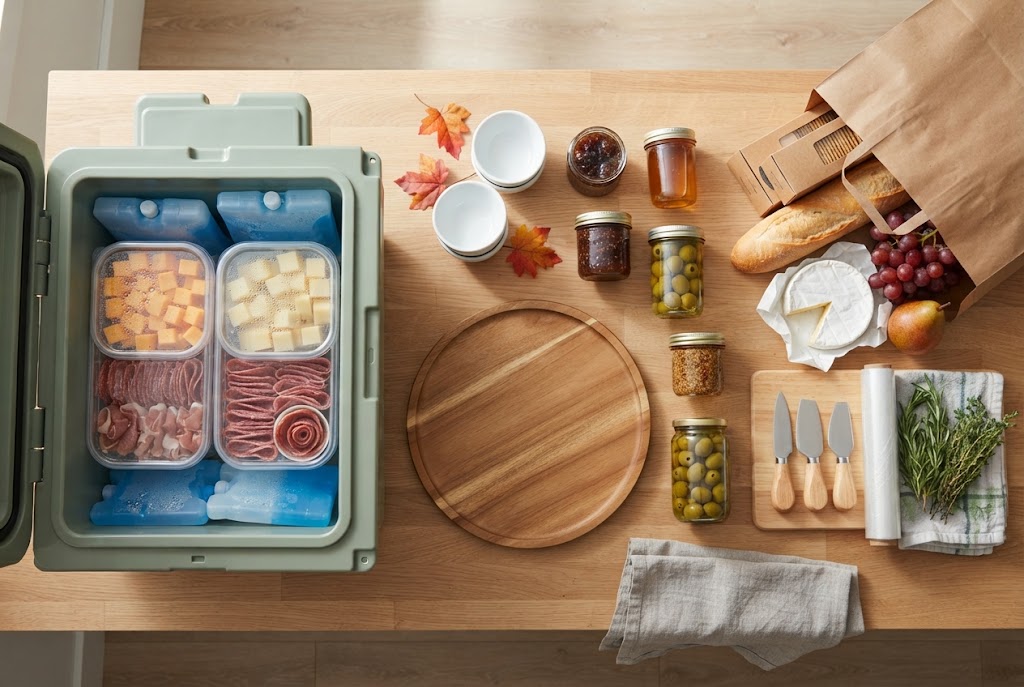
This is what caterers do. Everything travels in its own container, and the board goes together in a few minutes at the party, so it looks freshly made.
- Hard and semi-firm cheese: cut at home. Slice or cube the cheddar, Gouda, Manchego and Gruyère and pack each one in its own container. Cutting is the slowest part, so do it the night before.
- Soft cheese: whole and wrapped. Bring brie, Camembert and goat cheese uncut. Score or slice them on the board.
- Cured meat: folded in rows. Fold or roll the salami, prosciutto and soppressata and lay them in a shallow container, with parchment between layers so they don't stick. A salami rose can travel fully made in a small lidded cup.
- Jam, honey, mustard and dips: in lidded jars. Bring the bowls and spoon them out on arrival.
- Olives and pickles: drained. Pack them without their brine so nothing drips.
- Crackers and bread: in a separate bag, not the cooler. Cooler moisture softens them. Leave crackers in their sleeves and slice the baguette at the party, or bring it pre-sliced in a sealed bag.
- Fruit: whole where you can. Grapes in bunches, berries in their clamshells. Cut apples and pears at the party, since they brown.
- Herbs: wrapped in a damp paper towel. Rosemary and thyme go on last.
Label the containers in building order (1 cheese, 2 meat, 3 bowls, 4 fillers). In a busy kitchen with the host asking you questions, it saves a lot of searching. For what to prep the night before, see making a charcuterie board the night before.
Option 2: Travel with the board already built
This works for short drives, or when you have to walk in with a finished board. Movement is the problem, so build it so nothing can move.
- Use a board with a rim, or a lidded tray. A flat wooden board has nothing to stop food from sliding off the edge. A rimmed tray, a sheet pan, a charcuterie box with a lid or a large food storage container with a lid all work better. A flat board can go on top of a sheet pan for support.
- Pack it tighter than usual. Gaps are where things slide. Fill every space, and use cheese wedges and folded meat as bumpers between other items.
- Put anything round or wet in lidded cups. Whole olives, nuts, cherry tomatoes, jam and honey are the usual troublemakers. Small lidded containers (2 to 4 oz) keep them in place. Open bowls of honey or dip don't survive a car ride.
- Leave the crackers off. Bring them in a bag and tuck them in when you arrive. Wrapped against moist food, they go soft within an hour.
- Wrap it tight, not tented. Press plastic wrap down onto the food, then wrap it around and under the board two or three times. A loose cover lets things shift and lets meat dry out.
- Leave the garnish for later. Herbs and edible flowers get crushed under plastic wrap. Add them at the party.
Keeping it cold on the way
Soft cheese and sliced meat are perishable, so treat them like any other cold party food. The USDA's advice for taking food to a potluck: go straight from the fridge into a cooler, use ice or gel packs to keep it at 40°F or below, and ride with it in the air-conditioned part of the car, not a hot trunk (USDA).
- Packed containers: lay ice packs on the bottom and on top of the containers in the cooler.
- A built board that won't fit in the cooler: set it on a sheet pan on top of a layer of gel packs, or on a large frozen ice pack, inside an insulated bag or box.
- Hard cheese and whole dry salami are sturdier than soft cheese and sliced meat. If space is tight, put the soft cheese and sliced meats in the cooler first.
The 2-hour rule: perishable food shouldn't sit out for more than 2 hours, or 1 hour above 90°F. Time in a cooler at 40°F or below doesn't count, so the clock starts when the board goes on the table. More on that in how long a charcuterie board can sit out.
In the car
- On the floor, not the seat. Car seats slope backward, and a board on a seat slides off at the first hard stop. The floor in front of a back seat is flat and close to the air conditioning.
- Put something grippy underneath. A non-slip shelf liner, a yoga mat or a folded towel stops the board or cooler from sliding.
- Wedge it in. Put bags or a second cooler on either side so it can't shift.
- Keep it flat on the walk in. Carry the board with both hands under it. Have someone else get the door.
When you arrive
- Ask for counter space and a little fridge room ahead of time. On Thanksgiving the host's fridge is usually full, so your cooler can act as your fridge until it's time to build.
- Take the hard cheese out first if the party starts within the hour. Hard cheese tastes best after 45–60 minutes out of the fridge, soft cheese and meat after 20–30 minutes.
- Build in order: cheese and bowls first, then the meat, then fruit and nuts in the gaps. Crackers and herbs go on last.
- Keep some back. At a long party, put out about 60% and leave the rest in the cooler to refill later.
- Bring a container for leftovers and pack them back into the cooler within 2 hours.
Which method for which party?
| Where you're going | Best method | Why |
|---|---|---|
| Thanksgiving or Friendsgiving | Pack and build on arrival | Long drives, full fridges, and the board comes out before dinner anyway |
| Office party | Cups or a built board in a lidded tray | Little time to build, often no fridge |
| A friend's house, under 30 minutes away | Travel built | Arrives looking finished |
| Picnic, tailgate or beach | Cups or jars in a cooler | They stand upright and stay cold |
| A big party (20+ guests) | Pack and build, or two smaller boards | One huge board is hard to carry flat |
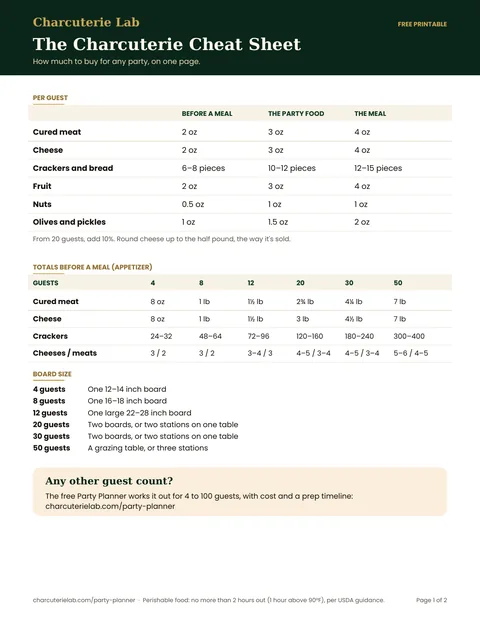
For single servings that travel well, see charcuterie cups and jarcuterie. For amounts, see how much charcuterie for Thanksgiving, or let the Party Planner work it out for your guest count.
Packing checklist
- The board (or a rimmed tray or sheet pan)
- Cooler and ice or gel packs
- Labeled containers of cheese, meat, olives and fruit
- Lidded jars of jam, honey, mustard and dips, plus the small bowls to serve them in
- Crackers and bread in a separate bag
- A cheese knife for each soft cheese, small spoons for the jars, cocktail picks
- A small cutting board and paring knife for fruit
- Herbs in a damp paper towel
- Plastic wrap, paper towels and napkins
- A non-slip mat or towel for the car
- An empty container for leftovers
- Gluten-free crackers in their own sealed bag, if a guest needs them, so they don't touch the regular crackers
Common mistakes
- Wrapping a board with crackers on it. They're soft by the time you arrive. Crackers always travel separately.
- Putting the board on the car seat. It slides on the first stop. Use the floor.
- Open bowls of honey or jam. They spill into everything. Use lidded jars and spoon them out at the party.
- Leaving it in a warm car while you run another errand. Go straight there, or keep the board in the cooler.
- Building a board too big to carry flat. Two medium boards are easier to carry than one huge one, and guests can reach two ends of the table.
Sources
- USDA: USDA Shares Food Safety Recommendations for Your Potluck
- USDA FSIS: What is the 2-hour rule for leaving food out?
FAQ
What is the best way to transport a charcuterie board?
Pack the parts in separate containers in a cooler and build the board when you arrive. It takes about 15 minutes and nothing slides, gets crushed or goes soggy. If you have to travel with it built, use a board with a rim or a lidded tray, pack it tightly, press plastic wrap onto the food and set it flat on the floor of the air-conditioned car.
How do you keep a charcuterie board cold while traveling?
Go straight from the fridge to a cooler with ice or gel packs, which keeps food at 40°F or below, and ride with it in the air-conditioned part of the car rather than a hot trunk. A built board can sit on a sheet pan on top of ice packs.
Can you make a charcuterie board ahead and take it somewhere?
Yes. Cut the hard cheese, fold the meat and fill the bowls the night before, pack them in containers, and do the final build at the party. Crackers, cut fruit and herbs go on last.
How long can a charcuterie board be out of the fridge?
No more than 2 hours at room temperature, or 1 hour above 90°F. Time in a cooler at 40°F or below doesn't count, so the clock starts when the board is set out.
How do you keep food from sliding on a charcuterie board in the car?
Pack it tightly so there are no gaps, use bigger pieces like cheese wedges and folded meat as bumpers, put loose round foods like olives and nuts in lidded cups, wrap the board tightly with plastic wrap pressed onto the food, and set it on a non-slip mat or towel on the car floor.