Quick Answer: To start a charcuterie business, first check your state and county health rules: most cottage food laws exclude meat, and many exclude cheese, so most board businesses work from a licensed commercial or shared kitchen with a food permit. Then get liability insurance, set up a business name, and launch with a short menu of 3 to 5 sizes. Price from your costs: a common starting point is ingredient cost × 3, plus packaging and delivery, which lands most small businesses at about $12 to $20 per guest.
Charcuterie boards are one of the most popular food side businesses, because people pay well for something that looks like a gift and saves them time before a party. But it isn't like selling cookies from home. Meat and cheese need to be kept cold, and that changes which permits you need, where you can build boards, and how you deliver them. Get those three things right and the rest is a business of good shopping, consistent sizes and pretty boxes.
Step 1: Find out what your state allows (before you sell a single board)
Most states have cottage food laws that let people sell some foods made in a home kitchen. These laws were written for shelf-stable foods like bread, cookies and jam, and they usually exclude foods that need refrigeration.
- Minnesota: asked directly whether charcuterie boards are allowed, the state says no, because "most charcuterie boards contain meat and cheese," and those need a food license (Minnesota Department of Agriculture).
- Nebraska: "Meat of any type is not allowed," including cured meat on charcuterie boards. Cheese is allowed only if it's held at 41°F or colder during transport and sale (Nebraska cottage food FAQ).
- Texas: meat and meat products are excluded from cottage food sales, and foods that need time or temperature control require registration with the state health department (Texas Cottage Food Law FAQ).
What this means for you: in most of the US, a charcuterie board business needs a food establishment or catering permit and an inspected kitchen. Common routes:
| Route | How it works | Good for |
|---|---|---|
| Shared or commissary kitchen | Rent licensed kitchen time by the hour | Most new board businesses |
| Rent from a restaurant or church kitchen | Use an inspected kitchen during off hours | Low cost, if your health department approves it |
| Your own licensed space | A small storefront or permitted home kitchen where allowed | Once orders are steady |
Every state and county is different, and rules change. Call your county or city health department, tell them exactly what you want to sell (store-bought cured meats and cheeses, cut and arranged, sold cold and delivered), and ask which permit fits. The Charcuterie Business Starter Kit has the full list of questions to ask on that call.
Step 2: Set up the business basics
- Business structure and registration. Register your business name with your state. Many small food businesses form an LLC; talk to an accountant or your state's small business office about what fits you.
- Liability insurance. Food businesses need general and product liability coverage. Many shared kitchens and event venues require proof of insurance before they'll let you in.
- Food safety training. Many health departments require a certified food manager or food handler card. Even where it isn't required, it's worth taking.
- Sales tax. Prepared food is taxable in many states. Register for a sales tax permit if your state requires it.
- Payments and orders. A simple order form, a deposit for large orders and a clear cancellation policy will save you most of the problems new board businesses run into.
Step 3: How much to charge for a charcuterie board
Pricing is where most new board businesses go wrong. They price against what the boards "look like," then discover their time was free.
Start from your costs, not from competitors. A widely used starting formula from board-business guides is:
Price = (ingredient cost × 3) + packaging + delivery
That keeps food cost at about 30 to 35% of the price, a typical target for food businesses (ClientCasa). Then check the result against your time: after ingredients, packaging and card fees, does a small order still pay you a fair hourly rate?
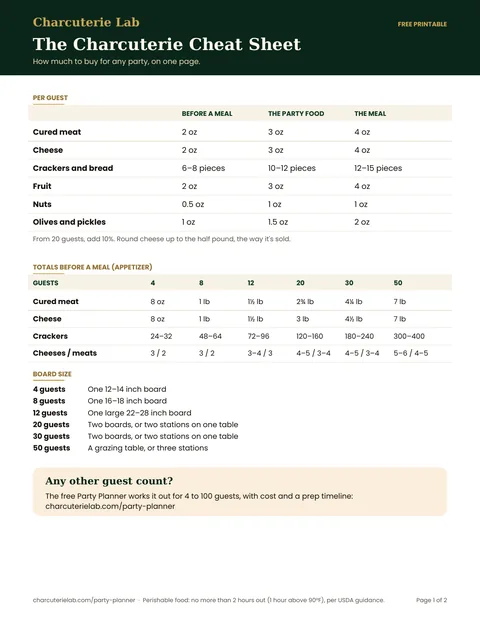
One worked example. Using our standard amounts (2 oz of cheese and 2 oz of meat per guest for a board before a meal), a board for 6 needs about 12 oz of cheese and 12 oz of meat. If your ingredients come to about $26 and your box and labels about $4, the formula gives roughly $26 × 3 + $4 = $82, about $14 per guest. That's in line with what others charge.
What board businesses charge (2026 guides):
| Size | Serves | Typical price | Per guest |
|---|---|---|---|
| Box for one | 1 | About $14 | About $14 |
| Small board | 2 to 4 | About $40 to $75 | $13 to $25 |
| Medium board | 6 to 10 | About $75 to $160 | $13 to $20 |
| Large board | 12 to 20 | About $160 to $300 | $12 to $18 |
| Grazing table | 25+ | About $12 to $35 per guest, plus setup | $12 to $35 |
Ranges from Homegrown's 2026 pricing guide and ClientCasa. Prices vary a lot by city.
Small boards cost more per guest. The box, the labels and the time to style a board don't shrink when the board does, so price small boards and single boxes higher per person.
Our kit includes a fill-in pricing worksheet that adds your real ingredient costs, packaging, labor and overhead and gives you a price for each size, plus a cost-per-ounce sheet so you can re-price in two minutes when cheese prices change.
Step 4: Build a short, consistent menu
New board businesses that offer "anything you want" spend hours on every quote. Start with 3 to 5 fixed sizes and one or two themes, and keep the contents consistent so you can buy, prep and price on autopilot.
A starter menu that covers most orders:
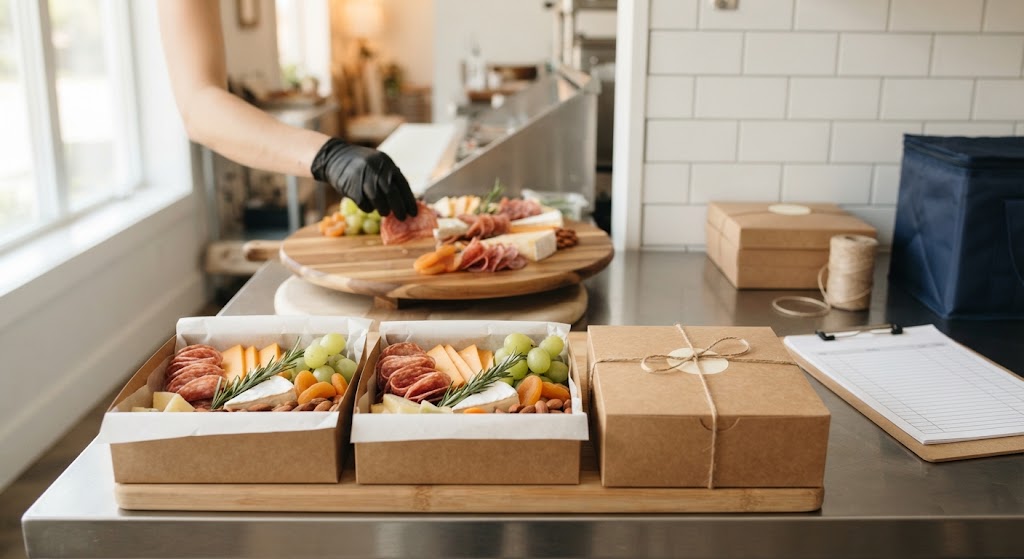
- A box for one or two (gifts, date nights, office treats)
- A small board for 4 to 6
- A party board for 10 to 12
- A large board for 20 or more
- Grazing tables as a custom quote, once you've done a few large boards
For each size, decide the amount of cheese, meat, crackers and extras by weight, the container, and the price. Our how much charcuterie per person guide covers the amounts per guest. The kit turns them into a size chart for every menu item, with the box or board size each one fits.
Step 5: Shop smart and keep it cold
- Buy consistent products. Customers who reorder want the same board. Choose cheeses and meats you can get every week. Our store guides for Costco, Sam's Club and other stores rank what holds up.
- Keep the cold chain. Keep meat and cheese in the fridge until you build, build close to pickup or delivery time, and deliver in a cooler. Give every customer a card with storage instructions and the 2-hour rule for perishable food (USDA).
- Label allergens. Nuts, wheat, milk and sesame are common on boards. List what's on each board, and keep a nut-free option on the menu.
Step 6: Name it and get your first customers
Naming tips: say what you sell (board, graze, grazing, box), add your town, your name or a style word, and keep it easy to spell out loud. Before you commit, search your state's business registry, Instagram and Facebook handles, and the USPTO trademark database, because many board businesses use similar names.
First customers:
- Photos sell boards. Shoot every board in daylight from above before it leaves. Your first 10 boards are your portfolio.
- Start with holidays. Thanksgiving, Christmas, Valentine's Day and Mother's Day are when people order boards and boxes as gifts. Post your holiday menu at least 3 to 4 weeks ahead.
- Local partners. Realtors (closing gifts), wineries, salons and offices order boxes in bulk.
- Take deposits. For large boards and grazing tables, take a deposit when you confirm the date.
Mistakes new charcuterie businesses make
- Selling from home without checking the rules. It's the fastest way to get shut down, and it can void insurance.
- Underpricing small boxes. Packaging and time are almost the same as for a medium board.
- Custom everything. Fixed sizes make buying, prepping and pricing faster.
- No order cutoff. Set a cutoff (for example, 48 hours ahead) so you can shop and prep properly.
- Forgetting delivery time. Driving, parking and setup add up. Charge for delivery or set a radius.
The Charcuterie Business Starter Kit ($9.99)
Everything in this post as 20 printable pages of tools and expert tips you'll use every week:
- Pricing worksheet that turns your real costs into a price for each size, plus a 12-rule pricing playbook
- Cost-per-ounce tracker for re-pricing when ingredient prices change
- Size chart with cheese, meat, crackers and extras by weight for 7 menu sizes
- Food safety and transport rules for sellers, and a health department call sheet
- What travels well: which cheeses, meats and extras hold up in a box, and the box-day test
- Styling that sells: 10 rules for boards that photograph well, plus a layout sketch page
- Menu engineering and upsells, with scripts and an add-on profit table
- Menu and price sheet, order form and a grazing table quote checklist
- Customer message scripts for quotes, reminders, reviews, rush orders and complaints
- Marketing plan and seasonal calendar with caption starters
- 72-hour order timeline, supplies list, customer care cards and a weekly profit log
Get the Charcuterie Business Starter Kit for $9.99, an instant PDF download you can print as many times as you need.
FAQ
Can I sell charcuterie boards from home?
Usually not under a cottage food permit. Most state cottage food laws exclude meat and many exclude cheese, because they need refrigeration. Minnesota's guidance, for example, says most charcuterie boards need a food license. Most board businesses work from a licensed commercial or shared kitchen, or get a caterer or retail food license, so check with your state or county health department.
How much should I charge for a charcuterie board?
Most small board businesses charge about $12 to $20 per guest, with the higher end for small boards and boxes. A common starting formula is ingredient cost times about 3, plus packaging and delivery, which keeps food cost near 30 to 35% of the price. Check that small orders still pay you a fair hourly rate.
Do I need a license to sell charcuterie boards?
In most places, yes. Because charcuterie boards contain meat and cheese that must be kept cold, health departments usually treat them as a food business that needs a permit and an inspected kitchen. Requirements vary by state and county, so ask your local health department before you take orders.
How much money do you need to start a charcuterie business?
It depends mostly on your kitchen. Shared or commercial kitchens are usually rented by the hour, so you can start without building your own. Add permits, liability insurance, boards and boxes, a cooler for delivery, and ingredients for test boards and photos.
What should I name my charcuterie business?
Pick a name that says boards or grazing, fits your town or style, and is easy to spell. Search your state's business registry, social media handles and the federal trademark database before you buy a domain or print labels, because many board businesses use similar names.
Sources
- Minnesota Department of Agriculture: Cottage Food Law Guidance
- Nebraska Cottage Food Law FAQ (University of Nebraska–Lincoln)
- Texas Cottage Food Law: FAQ
- Homegrown: How Much Should You Sell Charcuterie Boards For? (2026)
- ClientCasa: How to Price Charcuterie Boards and Grazing Tables
- USDA FSIS: "Danger Zone" (40°F to 140°F)
This post is general information, not legal advice. Rules for food businesses vary by state, county and city; confirm with your local health department.
Get one board idea a week, plus the free charcuterie cheat sheet, when you join the Charcuterie Lab newsletter.