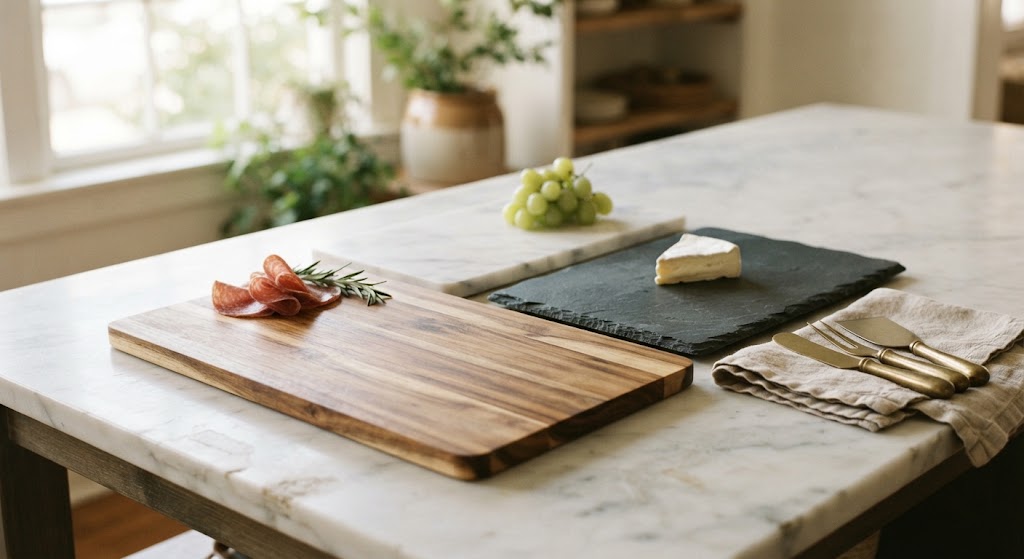
Quick Answer: Buy a wood board, 16 inches or longer. Budget: Fresh Nest Co bamboo (about $20). Gift: CTFT board and knife set (about $30). Slate looks best in photos; marble keeps soft cheese cool.
You don't need to spend much. You need the right material for how you serve.
How we picked these: these are picks from editors who tested or reviewed boards (NBC Select and Food Network), checked against what each material does on a board. We haven't scored them with stars. Prices are typical, last checked October 2026. Links to Amazon are affiliate links.
Our picks at a glance
| Pick | Board | Typical price |
|---|---|---|
| Best budget | Fresh Nest Co Extra Large Bamboo Board | under $30 |
| Best board and knife set | CTFT Cheese Board and Knife Set | $30–80 |
| Best marble | Thirteen Chefs Villa Acacia Marble Board | $30–80 |
| Best for beginners | Sophistiplate Charcuterie Board with Placement Guide | $30–80 |
| Best oversized | etúHOME Rectangle Pine Charcuterie Board | $100+ |
| Best personalized | Mark & Graham Wood and Marble Beveled Cheese Board | $30–80 |
| Splurge | Williams Sonoma Marble Honeycomb Cheese Board with Knives | $100+ |
| Best small-space board | Uncommon Goods Compact Swivel Cheese Board | $30–80 |
Fresh Nest Co Extra Large Bamboo Board
Best budget · Best for: A big board for little money
Food Network's budget pick: an extra-large bamboo board, about $18 to $25, praised as durable and well made, with no worry about stains and spills (Food Network).
- Why we like it: Big enough for a party board at a budget price.
- Keep in mind: Bamboo looks plainer than hardwood.
- Where to buy: Check price on Amazon
CTFT Cheese Board and Knife Set
Best board and knife set · Best for: A complete gift
NBC Select's editor's pick: a 13 by 13 inch bamboo board with raised edges and a hidden drawer holding four cheese knives, chalk and slate labels, about $30 (NBC Select).
- Why we like it: Board, knives and labels in one box.
- Keep in mind: 13 inches suits 4 to 6 people. Basic knives.
- Where to buy: Check price on Amazon
Thirteen Chefs Villa Acacia Marble Board
Best marble · Best for: Keeping cheese cool
NBC Select's budget pick: a 16 by 12 inch marble board raised on non-slip rubber feet, about $43. It doesn't absorb smells or colors, and the height shows off the board (NBC Select).
- Why we like it: Marble's cool surface for less than most.
- Keep in mind: Heavy, and acidic foods can etch marble.
- Where to buy: Check price on Amazon
Sophistiplate Charcuterie Board with Placement Guide
Best for beginners · Best for: A first board
A 22 by 17 inch wood board printed with a guide to where the cheese, meat and fruit go, plus a handle for carrying, about $75. Recommended in NBC Select for beginners (NBC Select).
- Why we like it: Takes the guesswork out of a first board.
- Keep in mind: The guide is part of the board for good, so it looks less clean once you know what you're doing.
- Where to buy: Check price on Amazon
etúHOME Rectangle Pine Charcuterie Board
Best oversized · Best for: A big party or grazing table
Food Network's pick for an oversized board: reclaimed wood, 33.5 by 16 inches, about $140, with room for several cheeses and crackers (Food Network).
- Why we like it: Room for a 12-person board on one piece of wood.
- Keep in mind: Pine is a softwood, so it marks more easily than hardwood. Too big for most dishwasher-free sinks.
- Where to buy: Check price on Amazon
Mark & Graham Wood and Marble Beveled Cheese Board
Best personalized · Best for: A monogrammed gift
Acacia and marble in two sizes (10 by 6 or 16 by 9 inches), from about $45, and it can be engraved. An NBC Select reviewer said it "feels heavy and good quality" (NBC Select).
- Why we like it: Engraving turns it into a wedding or housewarming gift.
- Keep in mind: Sold by Mark & Graham, not on Amazon. Marble can stain.
- Where to buy: Mark & Graham
Williams Sonoma Marble Honeycomb Cheese Board with Knives
Splurge · Best for: A gift that looks expensive
NBC Select's splurge pick: a 16 by 9 inch marble board etched with a honeycomb pattern and gold-finish bees, with three cheese knives, about $110 (NBC Select).
- Why we like it: Board and knives, ready to wrap.
- Keep in mind: Sold by Williams Sonoma. Marble chips if dropped.
- Where to buy: Williams Sonoma
Uncommon Goods Compact Swivel Cheese Board
Best small-space board · Best for: Small kitchens and apartments
A bamboo board that swivels open into stacked tiers, with bowls and a slide-out drawer of knives, folding flat to store. Picked by both NBC Select and Food Network; about $47 to $98 depending on size.
- Why we like it: Stores in a cupboard, opens into a full spread.
- Keep in mind: Moving parts; more of a gadget than a classic board.
- Where to buy: Uncommon Goods
Add the knives: a board needs three knives, one each for soft, semi-hard and hard cheese. See the best cheese knife sets.
Wood: the workhorse
Wood is the most versatile board material, and for most people building boards at home it's the only one they need. It doesn't pull heat out of cheese the way stone does, food grips its surface instead of sliding, and the grain sets off the colors of meat and cheese.
- What to buy: a hardwood such as walnut, maple, cherry or acacia. Acacia is dense and cheap; walnut looks the most elegant. End-grain boards wear better and are kinder to knives, but cost more.
- Size: 12 by 18 inches is the useful minimum; 16 by 24 or larger is better for entertaining.
- Care: hand wash, dry standing up and oil it monthly with food-grade mineral oil. Never the dishwasher.
Slate: the presentation board
Slate's dark gray surface gives the strongest contrast of any material: reds of salami, whites of cheese and greens of herbs all pop, which is why boards photograph best on it. You can also write cheese names on it with chalk. It stays slightly cool, which helps brie hold its shape a little longer.
- What to buy: at least 3/4 inch thick, with smooth edges and rubber feet. Thin slate chips and cracks.
- Keep in mind: you can't cut on it, and a large slate is heavy.
Marble: the cold board
Marble stays noticeably cooler than the room, especially if you chill it first. That's useful for soft cheese on a warm day, smoked salmon and anything creamy. It looks classic, but it's heavy, chips if knocked, and acidic foods like lemon or vinegar can etch it.
- Best for: cold-served boards, pastry and chocolate, and formal spreads.
- Keep in mind: cheese tastes best at room temperature, so take soft cheese off marble 30 minutes before eating if it's been chilled.
Wood vs. slate vs. marble
| Wood | Slate | Marble | |
|---|---|---|---|
| Visual contrast | Warm, moderate | High (dark background) | Elegant, moderate |
| Temperature | Neutral | Slightly cool | Noticeably cool |
| Durability | High | Medium | Low (chips easily) |
| Weight | Light to medium | Medium to heavy | Heavy |
| Cut on it? | Yes (hardwood) | No | No |
| Typical price | $20–150 | $20–80 | $30–200+ |
What size board do you need?
| Guests | Board size |
|---|---|
| 2–4 | 8–12 inches |
| 4–8 | 12–16 inches |
| 8–12 | 16–20 inches, or two boards |
| 12+ | An oversized board or a grazing table |
For exact amounts per guest, use the Party Planner, and see charcuterie board sizes for shapes.
The practical recommendation
Buying one board: buy wood, 16 inches or longer. Adding a second: add slate for parties and photos. Only then consider marble, if you often serve cold or want the look. Giving a board as a gift? Pair it with knives and a book that tells them what to put on it: our charcuterie gift guide has ready-made sets, and 50 Boards, Built by Science suggests a board surface for every build.
FAQ
What is the best charcuterie board to buy?
For most people, a large acacia or other hardwood board, 16 inches or longer: it works for every occasion and costs $20 to $40. For a complete gift, the CTFT Cheese Board and Knife Set (about $30) comes with knives and labels in a hidden drawer.
What is the best material for a charcuterie board?
Wood is the most versatile: knife-friendly, warm-looking and sold at every price. Slate gives the strongest color contrast for parties and photos. Marble stays cooler than the room, which helps soft cheese, but it is heavy and chips.
What size charcuterie board do I need?
For 2 to 4 people, an 8 to 12 inch board. For 4 to 8 people, 12 to 16 inches. For 8 to 12 people, 16 to 20 inches or more, or two boards. When in doubt, size up.
Is bamboo a good charcuterie board material?
Yes, for a budget board. Bamboo is hard, cheap and easy to clean. Buy from a seller that says the board is food safe, and expect it to dull knives a little faster than hardwood.
Is a charcuterie board a good gift?
Yes, especially paired with cheese knives or a board book. A board and knife set costs about $30, and a personalized wood-and-marble board about $45.
How do you clean and maintain a wooden charcuterie board?
Hand wash with mild soap and warm water, never in the dishwasher, and dry it standing up. Rub in food-grade mineral oil or board cream once a month so it doesn't dry out and crack.