A birthday charcuterie board faces a problem that most boards don't: it has to work for everyone. not only the guest of honor and their two best friends who share the same palate — but the full party range. Kids who want crackers and plain cheese. Guests who've never eaten cured meat in their lives. The one friend who claims to be lactose intolerant but always eats the Brie anyway. And the two people in the corner debating whether the salami is Genoa or Calabrese.
Building a board that genuinely works for that crowd, stays presentable for two to three hours, and still has enough personality to warrant a photo is a specific design problem. Here's how to solve it.
Quick Answer: For a birthday charcuterie board, choose universally loved ingredients that span age ranges: aged cheddar, brie, and Gruyère for cheese; prosciutto and salami for meat; grapes, strawberries, and seasonal fruit for color. For 20 guests as the primary food, plan 3–4 lbs cheese and 2.5–3 lbs meat. For a crowd, use multiple boards or a grazing table format.
The Quick Answer — Birthday Party Board
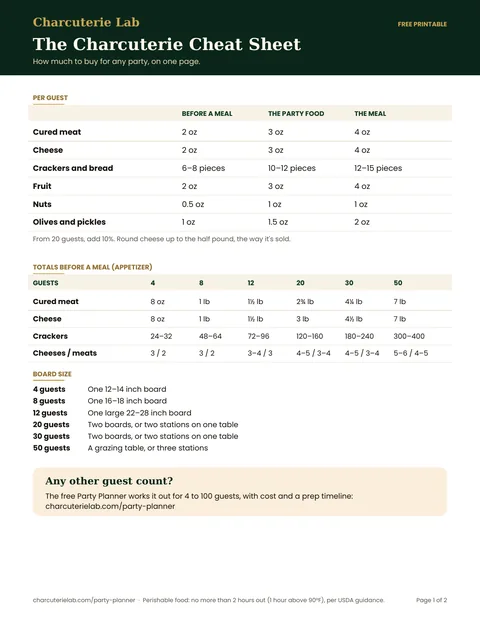
Rule of thumb: 2 oz each of meat and cheese per person if a meal follows, 3 oz each if the board is the party food, plus 10% from 20 guests up.
| Guests | Meat total | Cheese total | Crackers/Bread |
|---|---|---|---|
| 10 | 20 oz | 20 oz | 2 varieties |
| 16 | 32 oz | 32 oz | 2–3 varieties |
| 24 | 48 oz | 48 oz | 3 varieties |
| 30+ | Two boards | Two boards | 3 varieties |
The birthday board anchor trio: One universally loved meat + one universally loved cheese + one visually striking ingredient that gets people talking.
The Crowd Problem (and How to Solve It)
The core challenge with a birthday board isn't the food — it's the range of familiarity. A crowd of 16 will typically contain guests at every point on the charcuterie-comfort spectrum. Design for all of them simultaneously by building the board in zones.
The accessible zone is where most guests will gravitate first. This should contain familiar ingredients: prosciutto, Genoa salami, a mild cheese (Havarti, young Gouda, or mild cheddar), water crackers, fruit, and something sweet (honey, jam). Nothing here should require explanation. The goal is that a guest who has never been to a cheese shop can walk up, build a cracker, and feel confident immediately.
The interesting zone is adjacent to the accessible zone, positioned to be visible and inviting but not mandatory. This is where you put the aged Parmigiano, the funky soft cheese, the spicier salami, the aged Manchego. Adventurous guests will migrate here. Curious guests will follow them. No one is pushed.
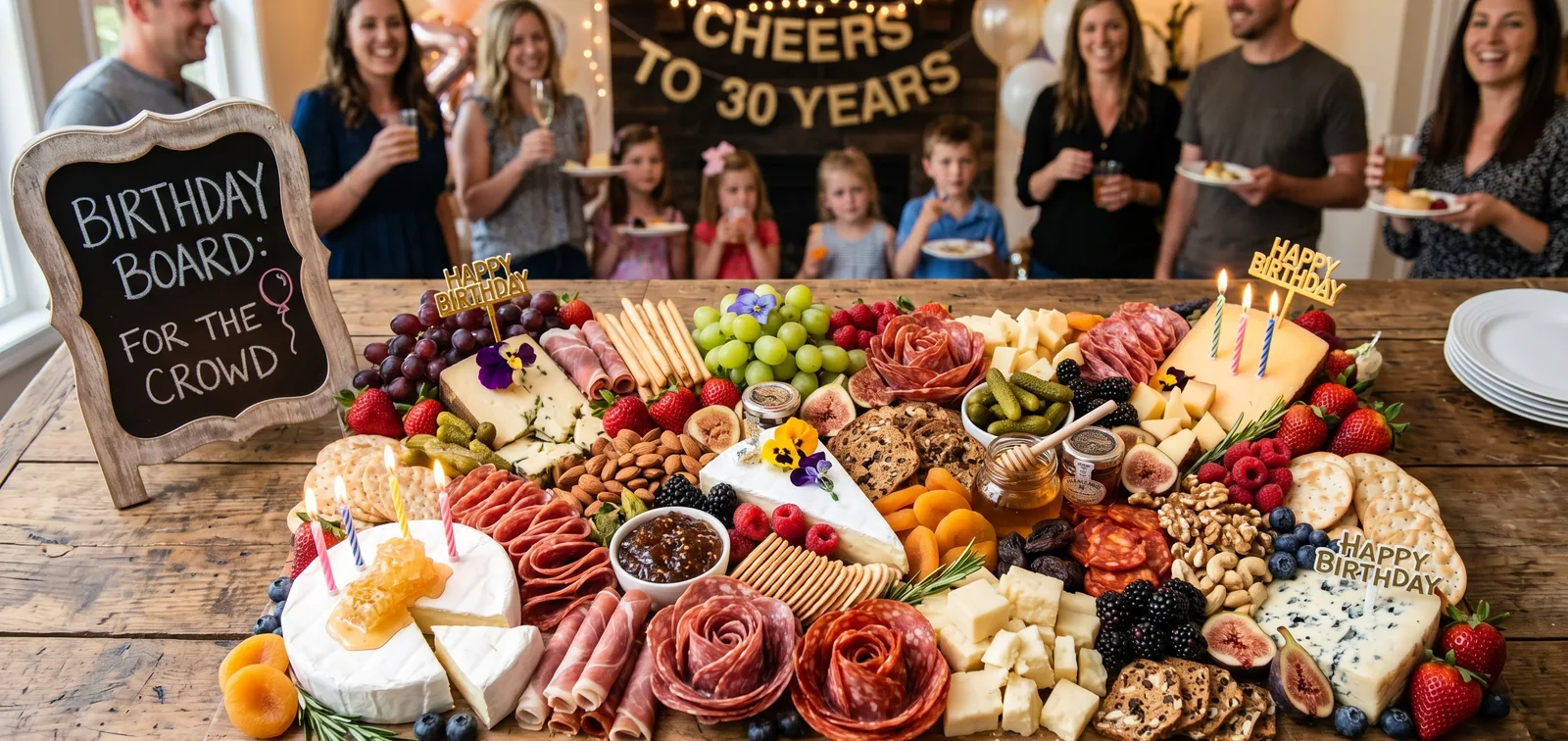
The visual anchor lives at the center of the board or at the natural eye-entry point. This is the item that generates the first comment — a whole Brie wheel with honey pooled on top, a wedge of vivid Mimolette, a rosette of bresaola built into a fan. This ingredient doesn't have to be the most complex; it has to be the most eye-catching.
Meat Selection: Wide Range, Clear Anchors
Prosciutto di Parma (mandatory): The universal crowd-pleaser of the charcuterie world. Silky, mild, visually elegant — everyone eats it. For a birthday board, prosciutto is non-negotiable. Fold into loose ruffles or drape from the edge of the board for visual drama.
Genoa salami (mandatory): More accessible than sopressata or finocchiona, mild enough for salami skeptics, familiar enough that no one needs to ask what it is. This is your volume meat.
Sopressata or coppa (optional, for the interesting zone): Sopressata's coarse grind and assertive flavor gives guests something to taste and discuss. Coppa's marbled cross-section is visually impressive and its spice profile is approachable. Either one works as the third meat.
What to skip for large parties: 'Nduja (too polarizing and too messy at scale), lardo (confuses guests who don't know it), culatello (too expensive to use in crowd quantities and its subtlety is lost in party noise).
Cheese Selection: One Soft, One Hard, One Bold
The soft cheese (crowd entry point): A properly tempered whole Brie wheel is the best birthday board cheese that exists. It photographs beautifully, generates immediate excitement when cut open, pairs with almost everything, and is universally familiar. Pull it from the refrigerator 30–45 minutes before the board goes out. Score the top in a cross-hatch pattern and place honey and fresh fruit alongside.
The hard cheese (texture contrast): Aged cheddar is the right call for a birthday board — it's familiar and approachable, but a good 18-month Vermont cheddar has the crystalline texture and complex flavor of a European aged cheese. Americans are comfortable with it, and international guests recognize the style. Cube half and leave the other half as a wedge for visual variety.
The bold cheese (interesting zone): Aged Manchego, 12-month Comté, or a small wedge of Parmigiano-Reggiano. The Parmigiano option is the most socially useful — its name recognition is universal, its crystalline texture makes it fun to break, and guests who have only seen it grated on pasta are genuinely surprised by it eaten in chunks.
Optional fourth cheese: A small soft blue (Gorgonzola Dolce or Cambozola) at one end of the board, clearly positioned near its best pairings (honey, walnuts). Not for everyone — which is exactly why it makes the board more interesting.
The Longevity Problem: Boards That Hold for 2–3 Hours
A birthday board goes out when the first guests arrive and gets picked at for the next two to three hours. Several ingredients handle this poorly.
Ingredients that hold well: Hard and semi-hard cheeses (cheddar, Manchego, Comté), cured whole-muscle meats (prosciutto, salami), dried fruit, nuts, sealed preserves and honey, hard crackers.
Ingredients that need management: Soft cheeses like Brie reach peak ripeness and then begin to over-ripen if left unrefrigerated too long. In a warm party environment (above 72°F), a whole Brie should be replaced or refreshed after 90 minutes. Consider keeping a backup in the fridge.
Fresh fruit timing: Strawberries and sliced stone fruit brown within an hour of cutting. Grapes, whole berries, and whole figs hold for 2–3 hours without quality loss. Save cut fresh fruit for a refresh at the 90-minute mark.
The refresh strategy: For a 3-hour party, put out 75% of the board at the start and hold back 25%. At the 90-minute mark, do a quick refresh — pull the most picked-over items, add fresh crackers, add the held-back ingredients. The board looks renewed and gives guests a reason to return.
Visual Strategy: Birthday Board Presentation
A birthday board has one job the regular charcuterie board doesn't: it has to produce a great photo. The guest of honor will photograph it. Guests will photograph it. It needs to look intentional.
The abundance principle: Birthday boards should look full, even overflowing. The visual anxiety of empty spaces on a party board is real — guests interpret empty space as "someone already took the good stuff." Fill in gaps with nuts, dried cranberries, or extra crackers to maintain density.
Color distribution: Build the board with color in mind before ingredient placement. Red (prosciutto, salami, strawberries) → white/cream (Brie, crackers, aged cheeses) → dark (salami, dried dates, dark grapes) → green (grapes, herbs, snap peas). Alternate rather than cluster.
The centerpiece: Place the visual anchor first, then build outward. A Brie wheel at center with honey drizzled in a spiral works. A cluster of bresaola rosettes works. A carved wedge of Parmigiano broken into irregular shards works. The centerpiece establishes the visual hierarchy for everything else.
FAQ
How do you make a charcuterie board festive for a birthday?
The key is color and personal touches. Use the birthday person's favorite foods as anchors — their preferred cheese, meat, or fruit. Add visual celebration elements: fresh flowers (edible or as garnish), gold or silver picks in cheeses, a small arrangement of birthday-colored fruit. For a kids' birthday, include fun shapes cut from cheese and colorful fruit kabobs.
What size charcuterie board do I need for a birthday party?
For a birthday party where the board is the primary food: plan 3 oz each of cheese and meat per person, plus 10% from 20 guests up. For 20 guests, that's about 4½ lb of cheese and 4¼ lb of meat. Use multiple boards or a grazing table format for parties of 15+.
What is the best cheese for a birthday charcuterie board?
Choose universally loved cheeses to maximize enjoyment across age groups and preferences: aged cheddar (familiar, crowd-pleasing), brie (creamy, visually appealing), and Gruyère or Gouda (nutty, approachable). Save adventurous selections for a smaller, more curated event where you know your audience.
Can you make a birthday charcuterie board instead of a cake?
A charcuterie "cake" — a layered, round arrangement of cheese, meats, and accompaniments shaped like a cake — is a popular alternative for birthdays, especially for adults who don't want traditional cake. These are primarily decorative: they're assembled for photo and presentation purposes, then dismantled for guests to eat.
How far in advance can you build a birthday charcuterie board?
Build the non-perishable sections (crackers, nuts, dried fruit, chocolate) the day before and cover. Add cheeses 2–4 hours before the event. Add cured meats and fresh fruit 1 hour before. Do a final garnish pass 15 minutes before guests arrive. This approach prevents last-minute stress while keeping the board looking its best.
The Takeaway
A birthday charcuterie board is a crowd management problem as much as a food problem. Solve it with zones (accessible and interesting), with longevity-aware ingredient choices, and with a visual anchor that generates the first comment. Two oz each of meat and cheese per guest, three-cheese anchoring structure (soft + hard + bold), and a refresh strategy at 90 minutes. The goal is a board that works for everyone, stays impressive for hours, and earns its place in the party photos.
Want more charcuterie science delivered weekly? Subscribe to The Charcuterie Lab Report — we dig into the food science behind every ingredient on your board.
For more: see charcuterie board serving sizes and how long a charcuterie board can sit out.