Taleggio on a Charcuterie Board
Quick Answer: Taleggio is a washed-rind cheese from Lombardy that smells pungent but tastes mild, buttery and slightly sweet; the smell is mostly in the rind. Serve it at room temperature, tell guests about the smell-versus-taste gap, and pair it with prosciutto or bresaola.
Taleggio has a reputation problem. Its smell stops people before they ever taste it — an assertive, barnyard, almost aggressive aroma that signals intensity and warns off the cautious. Those people miss one of the most interesting disconnects in the cheese world: Taleggio smells like it means business, and then turns out to be mild, buttery, and almost sweet on the palate.
Understanding why requires understanding what a washed rind actually does — and what it doesn't do.
What Washed-Rind Aging Actually Means
Taleggio is a washed-rind cheese. During aging, the rind is periodically wiped with brine — traditionally seawater in Taleggio's case, though modern production uses saltwater solutions. This moisture creates an ideal environment for a specific group of bacteria: Brevibacterium linens (B. linens), the organism primarily responsible for Taleggio's distinctive smell.
B. linens is not just present; it thrives. The repeated brine washing keeps the rind moist, keeps the B. linens population active, and suppresses competing organisms. The orange-pink color that develops on Taleggio's rind is characteristic of B. linens colonization — it's a biological signature, not a dye or additive.
Here's the critical detail: B. linens is surface-active. It colonizes the rind and remains there. It does not penetrate into the paste of the cheese in meaningful concentrations. The enzymatic activity — the protein breakdown, the sulfur compound production, the volatile aroma molecules — happens at the surface, not throughout the interior.
The result is a cheese that has essentially two flavor profiles occupying the same block.
The Aroma-Taste Disconnect
The compounds that make Taleggio's rind smell intense are well-characterized. The primary culprits are methanethiol and butyric acid, produced as B. linens metabolizes the sulfur-containing amino acids in the rind's protein.
Methanethiol is the compound responsible for the "sulfurous" or "farmyard" quality — the same compound family that gives Limburger, Époisses, and Munster their assertive character. Butyric acid contributes a sour, slightly rancid note that intensifies the overall impression. Together they create an aroma that can genuinely clear a room if the cheese is warm and the rind is exposed.
The paste beneath this active rind surface is a completely different story. Without the B. linens population and its associated enzymatic activity, the interior of Taleggio develops through standard lactic acid fermentation and mild proteolysis. The result is yielding, creamy, low-acid, and decidedly mild — closer to a fresh mozzarella or young Fontina in flavor than to anything the rind would suggest.
This is the disconnect: the aroma compounds are concentrated on the exterior. The taste experience — what actually contacts most of your palate — is the interior paste. When you eat Taleggio without the rind, you're not avoiding the cheese; you're tasting the part that makes Taleggio worth eating.
Taleggio DOP: Origin and Production
Taleggio is produced in the Lombardy region of northern Italy, with DOP (Protected Designation of Origin) status requiring production in a defined area that includes Bergamo, Brescia, Como, and several neighboring provinces. The name comes from Val Taleggio, the valley where the cheese originated — traditionally aged in the valley's natural caves, where the cool temperature and high humidity created ideal conditions for washed-rind development.
Modern Taleggio is aged on wooden boards for a minimum of 35 days. The brining is done weekly during the first phases of aging. As the rind develops, the brine washing frequency may be reduced, but the characteristic B. linens colonization is established early and maintains itself through the aging period.
The standard format is a roughly 8 × 8 × 2-inch square slab — a distinctive shape that makes Taleggio immediately recognizable in the cheese case. Weight runs around 4.5 lbs for a full piece; retail is sold in wedges cut from this form.
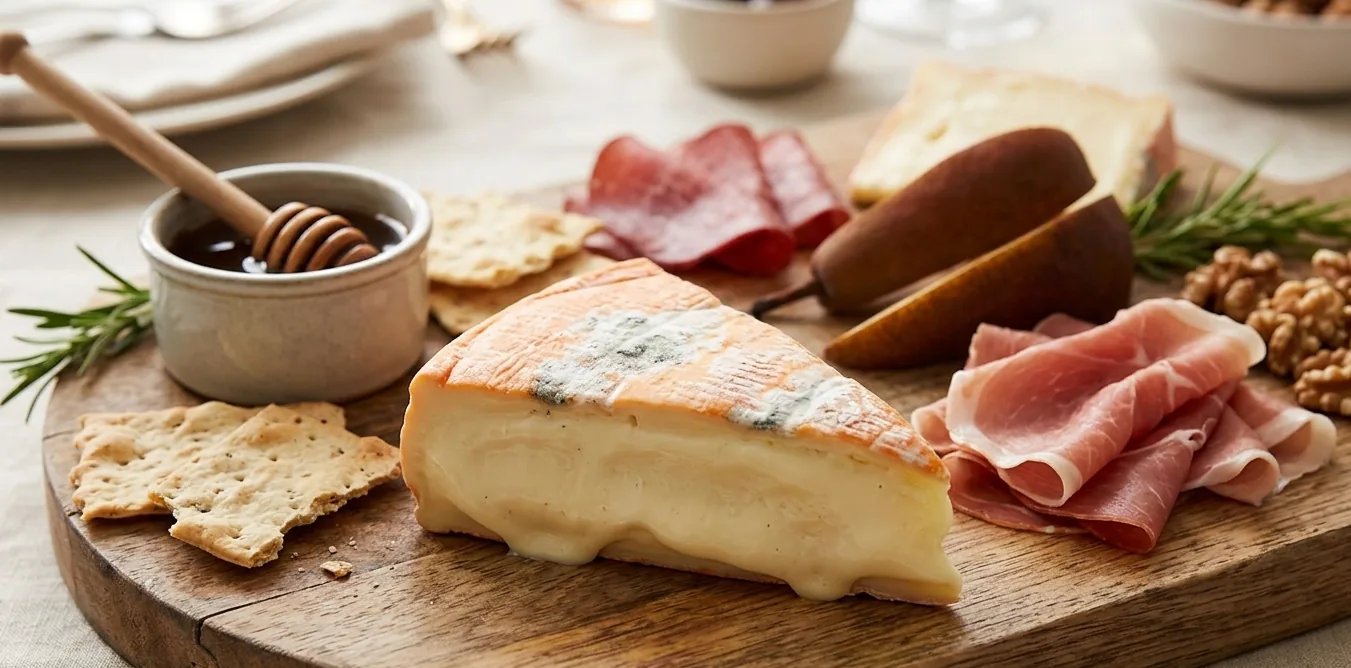
Quality Taleggio: look for an intact orange-pink rind with no gray or black mold (gray indicates contamination beyond the intended organisms), a paste that yields slightly when pressed but doesn't collapse, and a smell that is assertive but not ammoniated. Ammonia indicates over-ripeness — the proteins have been breaking down too long without sufficient gas exchange.
How Taleggio Behaves on a Board
Taleggio has practical implications for board building that differ from most other cheeses.
Temperature matters more than usual. Cold Taleggio is almost neutral — the volatile aroma compounds are less active at refrigerator temperature, and the paste is firm and relatively flavorless. Room-temperature Taleggio (30+ minutes out of the fridge) is a completely different product: the paste softens to near-melting, the aroma becomes present and expressive, and the flavor reveals the butterscotch-tinged richness that makes it interesting. Always serve Taleggio at room temperature.
The rind is edible but strong. Guests who are tentative about the aroma can be directed to the interior paste without the rind — a clean cut removes it easily. This is not a cop-out; it's a legitimate tasting strategy for a cheese with this kind of surface activity. If you're serving a mixed-experience crowd, pre-slice Taleggio into rind-removed pieces alongside one intact piece for those who want the full experience.
It spreads. At proper serving temperature, Taleggio becomes semi-soft and spreadable — it works beautifully spread on a neutral cracker with a thin slice of prosciutto on top. This makes it more versatile on a board than its reputation suggests: guests who won't eat a pungent slice often happily spread mild-tasting Taleggio paste onto a cracker without knowing what it is.
Board placement: Keep Taleggio away from delicate mild cheeses — the aroma, not the flavor, can be disruptive at close range at room temperature. Position it with some space around it, ideally near the accompaniments that pair best with it.
Pairing Logic
Prosciutto di Parma or San Daniele: The pairing is a Lombardy classic. The clean salt and delicate fat of long-cured prosciutto let Taleggio's buttery paste register without competition. The rind's intensity is softened by the fat content.
Bresaola: The leanness and beef-derived umami of bresaola complement Taleggio's richness as a contrast rather than echo. The acid undertone in bresaola (from the aging process) cuts through the paste effectively.
Pear: Fresh Bartlett or Bosc pear provides sweetness and clean acidity — the fruit's sugar bridges the rind's intensity while the acidity refreshes the palate after the rich paste. The pairing is one of those rare sweet-savory combinations where both elements genuinely improve.
Honey: A dark, assertive honey — chestnut, buckwheat, or raw wildflower — is a better match than mild clover honey. The stronger flavor holds its own against the rind and brings out sweetness in the paste.
Grissini or plain flatbread crackers: Neutral, crunchy vehicles that don't compete with the cheese's flavor. Avoid seeded crackers (they add too much competing flavor) or very buttery crackers (the fat stacks unhelpfully against Taleggio's already rich paste).
Wine: Dry, light-to-medium reds with minimal tannin work best. Dolcetto d'Alba is a traditional pairing — low tannin, cherry-dominant fruit, natural acidity that cuts through the paste. Avoid high-tannin reds (the tannins amplify the rind's bitterness) and oaked whites (the oak and the rind compete).
How to Talk About It on the Board
Taleggio rewards a brief introduction — not because guests need instruction, but because the aroma gap creates an opportunity. "This one smells pungent but tastes mild and buttery — the smell is all rind, the paste underneath is different" is a 10-word setup that converts tentative grazers into converts. The sensory surprise is the experience.
For guests who need more nudging: spread a small amount of the paste (rind removed) on a cracker with a sliver of prosciutto, hand it to them, and let them taste before they smell. The order matters.
More ingredient deep dives: charcuterielab.com Subscribe to the Charcuterie Lab Report: charcuterie-lab-report.beehiiv.com