Quick Answer: Most charcuterie board elements are naturally dairy-free — all cured meats, fruit, vegetables, nuts, olives, honey, and most condiments contain no dairy. The only swap is cheese. Cashew-based plant-based cheeses (particularly from artisan producers) provide the best board functionality. Hummus, nut-based dips, and avocado fill the creamy role. A well-built dairy-free board leans into abundant produce and meat variety rather than trying to replicate the cheese section.
Check the salami too: some salami and cooked sausages use milk powder as a binder. Our vegan and dairy-free guide lists every board ingredient, with the ones to check.
What's Already Dairy-Free on a Standard Board
Before adding any alternatives, take stock of what's already completely dairy-free:
Naturally dairy-free (no changes needed):
- All cured meats (prosciutto, salami, bresaola, coppa, capicola) — check labels on flavored varieties, but traditional whole-muscle and plain fermented meats contain no dairy
- All fresh fruit (grapes, apple, pear, figs, strawberries, berries)
- All dried fruit (apricots, dates, cranberries, figs)
- All nuts (almonds, walnuts, Marcona almonds, pistachios)
- Most crackers and breads (check labels for butter)
- Olives, cornichons, pickled vegetables
- Honey and most fruit jams
- Hummus and most legume-based dips
- Dark chocolate (70%+) — check label for milk solids
This means the only genuine substitution on a dairy-free board is the cheese section. Everything else can stay identical to a standard board.
The Vegan Plant-Based Board, fully planned
The exact shopping list with amounts and prices, a timed build from prep to serving, and a swap for every ingredient. Plus 49 more boards.
Serves 8–12 · $45–$70 · 25–30 min prep
That's 28¢ a board. Read board 01 free
Plant-Based Cheese: What Works and What Doesn't
The plant-based cheese category has improved significantly. The gap between a good cashew-based cheese and a poor processed vegan slice is enormous — choose carefully.
Best options for a board:
Cashew-based soft cheese (Miyoko's, Treeline, similar artisan producers): The most convincing plant-based cheese for board use. Creamy, spreadable, and mildly tangy from fermentation cultures. Serves the same role as fresh chèvre or cream cheese on a standard board. Some producers offer herb-rolled or smoked varieties.
Cashew-based aged-style hard cheese: Several artisan producers make aged cashew cheeses that approximate the texture of a firm cheese. The flavor doesn't fully replicate proteolysis-driven complexity, but the texture is workable for slicing and the nutty base flavor pairs reasonably with board accompaniments.
Almond-based cheese: Lighter than cashew-based, slightly grainier texture. Works better as a spread than a sliceable hard alternative.
What doesn't work: Processed vegan cheese slices (too rubbery, don't hold shape at room temperature), shredded vegan cheese (wrong format entirely for a board).
The Creamy Anchor Without Cheese
If plant-based cheese isn't available or doesn't meet your standards, several naturally dairy-free elements can fill the creamy, spreadable role:
Hummus — Thick, creamy, protein-rich. Available in many flavor variations (roasted garlic, roasted red pepper, lemon herb). Serve in a ramekin with a small spoon and olive oil drizzle.
Avocado or guacamole — The richest dairy-free spread available. Season simply (salt, lemon, chili flake) and serve in a small bowl. Sits well against cured meat and crackers.
White bean dip — Blended white beans with garlic, lemon, and olive oil. Neutral, creamy, high-protein. A board-appropriate alternative to soft cheese.
Baba ghanoush — Roasted eggplant with tahini. Smoky, rich, slightly sweet. Pairs well with cured meats and vegetables.
Building the Dairy-Free Board
The structure is the same as any board — anchor elements, fill elements, sweet elements, acidic elements — but the cheese section is replaced and the produce section expands.
For 6–8 guests:
Meat section (if not also vegan):
- Prosciutto, 4–5 oz
- Genoa salami, 4 oz
- Bresaola, 3 oz (lean, mild, dark red visual contrast)
Plant-based cheese section:
- Cashew-based soft cheese, one log or small wheel (4–6 oz)
- Aged-style cashew cheese, sliced (3–4 oz) if available
- Hummus in a ramekin (3–4 tablespoons)
Produce and fillers:
- Grapes (one bunch — red or green)
- Sliced apple or pear
- Dried apricots and dates
- Cherry tomatoes
- Cucumber rounds
- Bell pepper strips
Crackers and bread:
- Water crackers (most are dairy-free)
- Rice crackers
- Crostini (check if butter-free)
Condiments:
- Honey
- Fig jam
- Castelvetrano or kalamata olives
- Roasted Marcona almonds
Visual Strategy: Making It Look Full
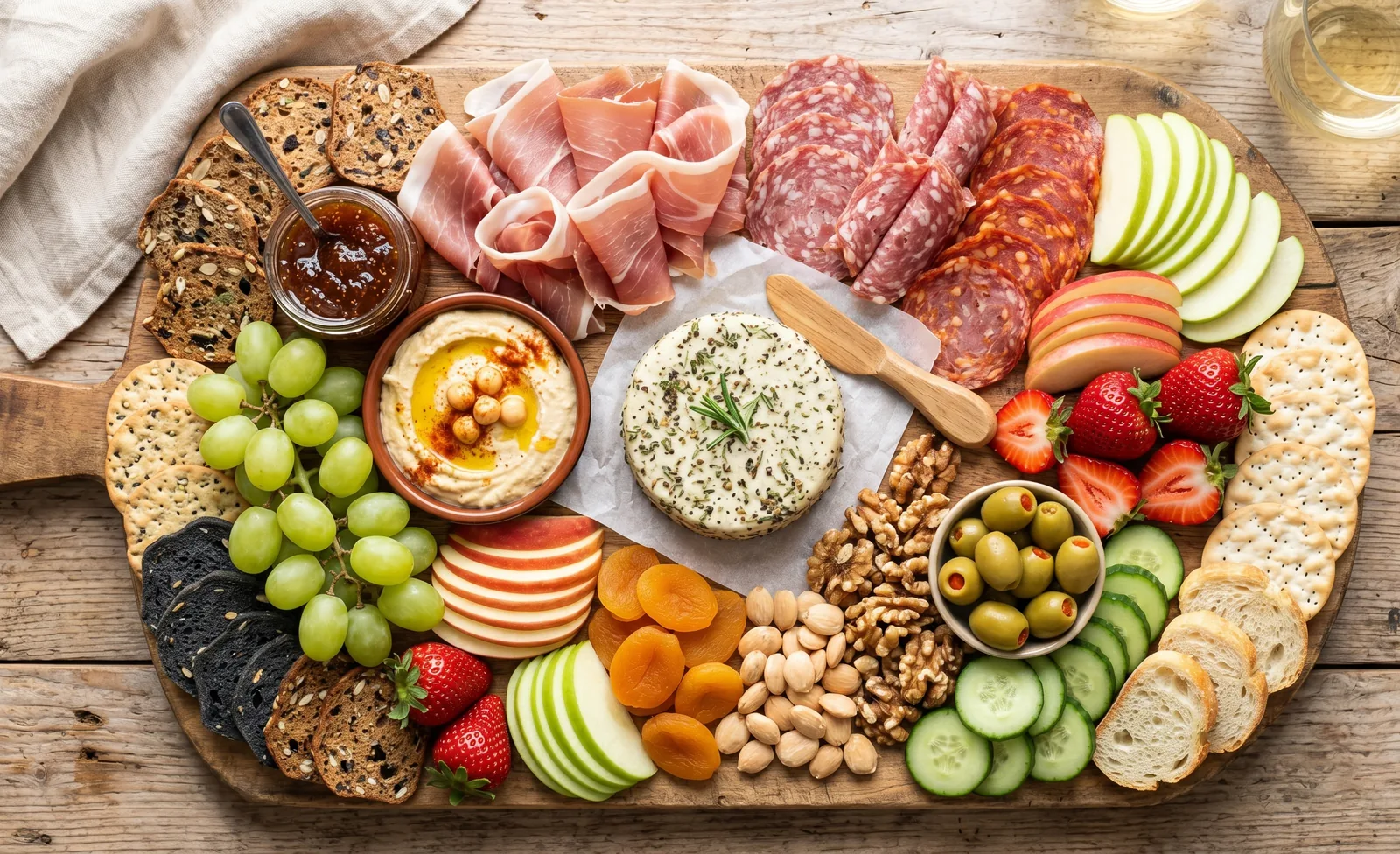
A dairy-free board can look sparse if the produce section isn't robust. The solution: more variety, more color, more texture.
Expand fruit variety: 4–5 fruit types (grapes, strawberries, apple, dried apricots, pear) rather than 2 creates visual abundance and genuine flavor range.
Use vegetables actively: Cherry tomatoes, cucumber rounds, and bell pepper strips aren't filler — they're color and crunch elements that function exactly like produce on any board.
Multiple ramekins: Hummus in one ramekin, honey in another, fig jam in a third. Multiple small bowls create visual interest and functional variety.
The Charcuterie Lab Takeaway
A dairy-free board isn't a compromised board — it's a different balance point. Most board elements are already dairy-free; the only genuine substitution is cheese. Lean into plant-based cheese where it's genuinely good (artisan cashew-based products), supplement with hummus and avocado-based spreads, expand the produce section, and don't try to replicate a cheese-heavy board's structure. Build from strength.
Building more boards? The Charcuterie Lab ebook walks through 50 boards across every occasion — each one with exact quantities, a shopping list, and the science behind why it works.
FAQ
What do you use instead of cheese on a dairy-free charcuterie board?
Plant-based cheese alternatives (cashew-based, almond-based, or coconut-oil-based) provide the soft, spreadable, and aged hard cheese roles. Hummus and high-quality nut-based dips fill the creamy condiment role. Avocado or guacamole can anchor the soft section. For a fully plant-based board, focus more heavily on cured meats (if not also vegan), diverse fruits, nuts, and vegetables — the board doesn't require cheese to be satisfying.
Is cured meat dairy-free?
Yes — virtually all cured meat is naturally dairy-free. Prosciutto, salami, bresaola, coppa, and other traditional cured meats contain only pork or beef, salt, spices, and sometimes wine or vinegar. Check labels on flavored or pre-seasoned varieties for added dairy, but traditional whole-muscle cured meats and plain salamis contain no dairy ingredients.
What are the best plant-based cheese alternatives for a charcuterie board?
Cashew-based cheeses (particularly from Miyoko's Creamery and similar artisan producers) have the most convincing texture and flavor for board use. Aged cashew-based alternatives can approximate hard cheese flavor profiles with some success. Almond-based soft cheese works as a spreadable element. Avoid low-quality processed vegan slices — they have a rubbery texture that doesn't function well on a board.
What naturally dairy-free foods work well on a charcuterie board?
Most board elements are naturally dairy-free: all cured meats, all fresh fruit, all vegetables, all nuts, most jams and honeys, olives, cornichons, hummus, and most crackers and bread. A dairy-free board built around these elements — with plant-based cheese as one component — can be visually full and genuinely satisfying without any compromises on the non-cheese elements.
How do you make a dairy-free charcuterie board look full?
Lean into abundant produce, varied textures, and strong visual contrast. More fruit variety (grapes, berries, citrus segments, sliced apple, dried apricots) fills visual space and creates color contrast that compensates for the absence of several cheese wedges. Hummus and a plant-based spread in separate ramekins create focal points. Vegetables (cucumber rounds, bell pepper strips, cherry tomatoes) add color and texture that a cheese-focused board often lacks.