A cheese board is a collection of cheeses. A charcuterie board is a collection of cured meats — and everything built around them. The two overlap significantly in practice, which is why the terms get used interchangeably, but they describe different focal points. If you're staring at a beautiful spread of meats, cheeses, fruits, crackers, and condiments, you're almost certainly looking at something that combines elements of both.
Quick Answer: A cheese board focuses exclusively on 3–5 cheeses with minimal accompaniments — it's a focused dairy tasting experience. A charcuterie board includes cured meats as a central element alongside cheese, crackers, fruit, and condiments. Charcuterie boards are broader in scope and more commonly used for entertaining; cheese boards are appropriate for formal cheese courses or dedicated tastings.
The Precise Definitions
Charcuterie is a French word (pronounced shar-KOO-tuh-ree) derived from chair (flesh) and cuit (cooked). It originally described a type of butcher shop specializing in prepared and preserved pork products — prosciutto, salami, pâté, rillettes, saucisson. In its strictest sense, charcuterie refers only to the meat products themselves. A charcuterie board, by extension, is a board that features these cured meats as its primary focus.
A cheese board is exactly what it sounds like: a board centered on cheese, with accompaniments chosen to complement the cheese selection. It might include some cured meat, but the cheese is the focal point — the selection is curated, the arrangement draws attention to the cheeses, and the pairing logic is built around what makes each cheese shine.
| Charcuterie Board | Cheese Board | |
|---|---|---|
| Focal point | Cured meats | Cheese |
| Primary elements | Salami, prosciutto, coppa, pâté | Aged, soft, blue, semi-soft cheeses |
| Supporting elements | Cheese, crackers, condiments, fruit | Crackers, fruit, honey, condiments |
| Origin | French charcuterie tradition | General European cheese service tradition |
| Occasion | Cocktail parties, entertaining, meal | Wine service, formal cheese course |
Where the Lines Blur
In American entertaining culture, "charcuterie board" has become the default term for any elaborate spread of meats, cheeses, and accompaniments — regardless of whether the meats or the cheeses are the actual star. This usage is now so widespread that fighting it is essentially pointless. When someone says they're making a charcuterie board for a party, they almost certainly mean the full spread.
The more useful distinction isn't about the name — it's about the focal point and how you build around it.
If cheese is your anchor: Choose 3–4 cheeses across texture and intensity categories. Select accompaniments that complement the specific cheeses (honey for aged and blue, fruit for soft and fresh). Cured meats are a supporting element. This is a cheese board, whatever you call it.
If cured meats are your anchor: Select 2–3 meats with contrasting flavor profiles (something delicate like prosciutto, something assertive like salami, something spreadable like a pâté). Choose cheeses and condiments that complement the meat's flavor profiles rather than the other way around. This is a charcuterie board in the original sense.
Most boards people build in practice are genuinely both — which is exactly why the term "charcuterie board" has come to mean the whole spread. It's a reasonable shorthand.
Does the Term Actually Matter?
For home entertaining purposes: no. Call it whatever communicates what you're serving. For understanding how to build a better board: yes. Knowing what your focal point is shapes every other decision — which cheeses, which meats, which condiments, how much of each.
At Charcuterie Lab, we take the wide view. A well-built board uses science — the salt-sweet principle, acid-fat balance, texture contrast — to make every element taste better than it would alone. Whether you call that a charcuterie board, a cheese board, or a grazing spread doesn't change the principles that make it work.
Quick Reference: What Goes on Each
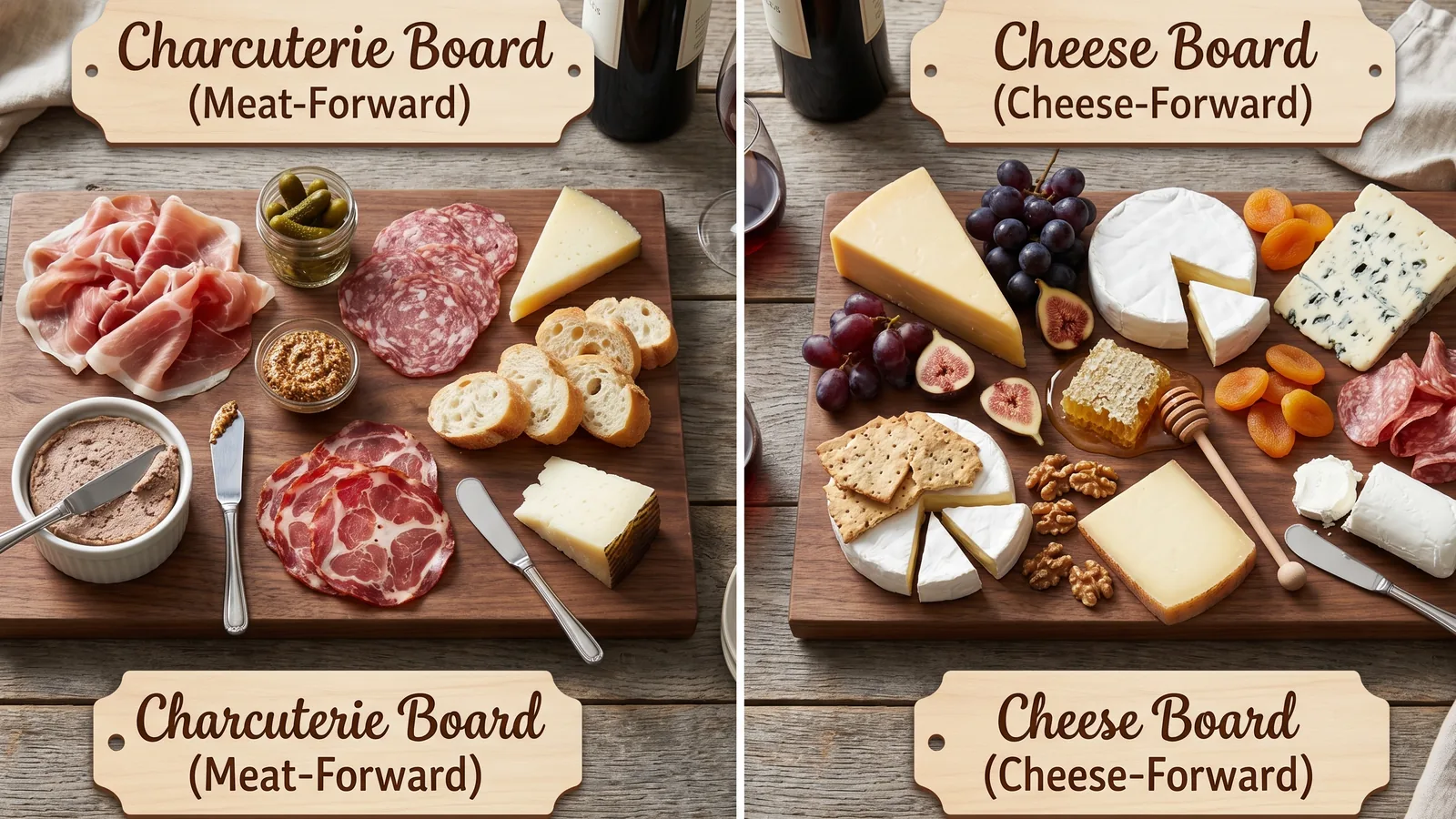
Classic Charcuterie Board — Meat-Forward
- Prosciutto, salami, coppa or soppressata, optional pâté
- 1–2 cheeses (mild complements: fresh mozzarella, brie, provolone)
- Cornichons, whole grain mustard
- Baguette or crostini
- Dried fruit, olives
Classic Cheese Board — Cheese-Forward
- 3–4 cheeses: one soft (brie), one aged (cheddar or gruyère), one blue (gorgonzola), one wild card (manchego, goat)
- 1–2 accompaniment meats (prosciutto or salami, as supporting elements)
- Honey, fig jam, fruit preserves
- Water crackers, neutral bread
- Fresh and dried fruits, nuts
FAQ
What is the difference between a charcuterie board and a cheese board?
A cheese board focuses exclusively on a curated selection of cheeses, typically 3–5 varieties served with minimal accompaniments (crackers, fruit, honey). A charcuterie board includes cured meats as a central element alongside cheese. In common usage, the terms overlap significantly, but technically a charcuterie board is the broader category that includes both meat and cheese, while a cheese board is focused purely on dairy.
Which is better — a charcuterie board or a cheese board?
Neither is objectively better — they serve different purposes. A cheese board is appropriate for a focused tasting, a post-dinner cheese course, or a gathering of cheese enthusiasts. A charcuterie board is more versatile as a cocktail-hour spread, a party centerpiece, or a casual meal. Most social occasions are better served by a full charcuterie board with both meat and cheese.
Is charcuterie always required on a charcuterie board?
No — the term "charcuterie board" is used colloquially for almost any food board, including vegetarian versions with no cured meat. The word technically refers to the craft of cured meat production, but in common usage it has expanded to describe the format (a board with curated food elements) rather than the specific inclusion of meat.
Can you have a charcuterie board without cheese?
Yes. A meat-forward board with charcuterie, pickles, mustard, and bread without any cheese is a legitimate format, particularly in French and German charcuterie traditions. However, cheese adds visual variety, flavor contrast, and textural diversity that most contemporary boards depend on for balance.
What is an antipasto platter and how does it differ?
An antipasto platter is an Italian-style spread that includes cured meats and cheeses alongside marinated vegetables, olives, and anchovies. It's similar to a charcuterie board but rooted specifically in Italian culinary tradition and typically less concerned with decorative arrangement than with flavor authenticity. All antipasto platters can be considered a type of charcuterie board; not all charcuterie boards are antipasto platters.
The Bottom Line
Charcuterie is the French tradition of cured and preserved meats. A cheese board is a curated cheese-forward spread. What most people build — and what most parties serve — is a hybrid of both, and "charcuterie board" has become the common language for that hybrid. The distinction matters less than the principle: know your focal point, build around it with intention, and use flavor science to make every element earn its place.
Want to build better boards? Subscribe to the Charcuterie Lab Report — weekly pairing science and board ideas delivered to your inbox.