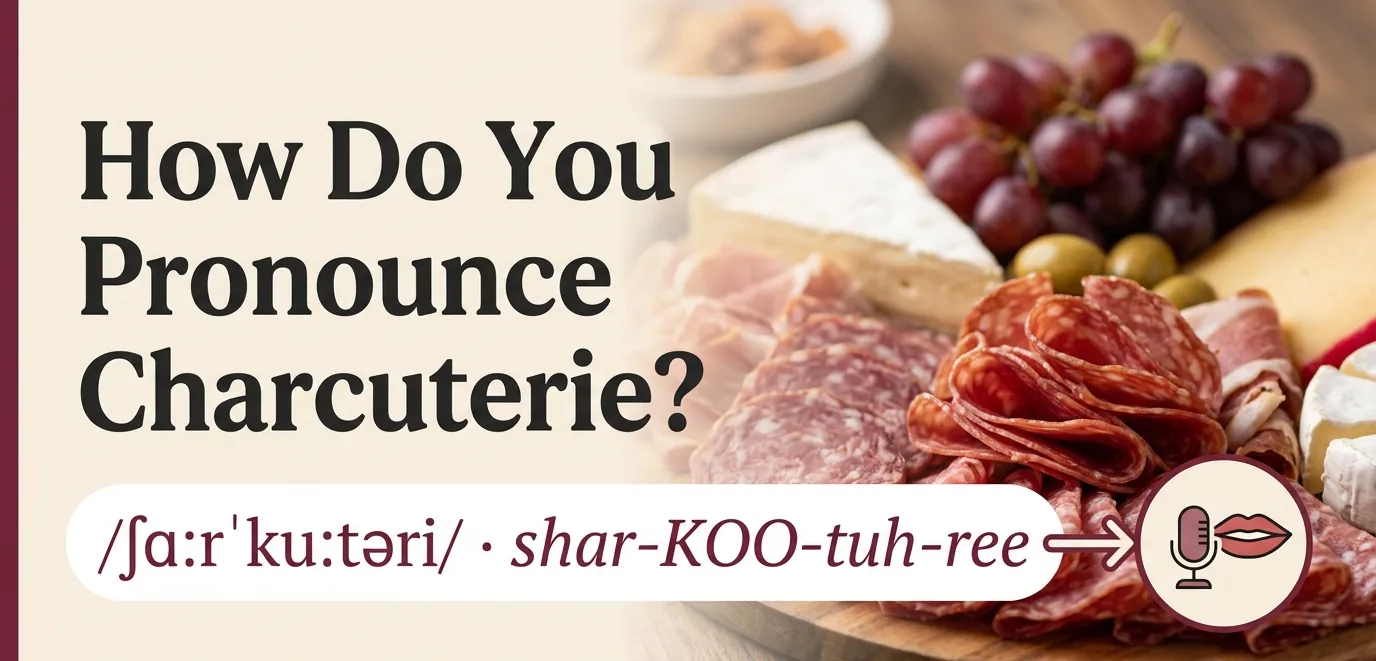
Charcuterie is pronounced shar-KOO-tuh-ree. The stress falls on the second syllable, and the final "e" is silent. In standard phonetic notation: /ʃɑːrˈkuːtəri/. It's a French word — and once you hear the rhythm of it, you'll never second-guess it again.
The Phonetic Breakdown
If you're staring at the word and your brain is going sideways, here it is syllable by syllable:
| Syllable | Sounds Like | Notes |
|---|---|---|
| Char | "shar" | The "ch" makes a "sh" sound, as in "chef" |
| cu | "KOO" | This is the stressed syllable — hit it harder |
| te | "tuh" | Soft, almost swallowed |
| rie | "ree" | The final "e" is silent — stop before you say it |
Put it together: shar · KOO · tuh · ree
Say it a few times out loud. The French rhythm is almost musical once you stop fighting it.
The Three Most Common Mispronunciations
Most people fall into one of these traps:
"char-KOO-ter-ee" — The most common mistake. Adding a full "ter" instead of the softer "tuh" breaks the French flow. Close, but not quite.
"char-coo-TREE" — Misplacing the stress on the last syllable. In French (and in English borrowings from French), the stress typically lives in the middle, not at the end.
"char-COO-ter-EE" — Pronouncing the silent final "e." The "ie" in French is pronounced like "ee," but the word ends there. There's no extra syllable.
The irony: most mispronunciations are overcorrections. The word is actually easier to say than it looks once you relax the ending.
Where the Word Comes From
Charcuterie is a French word with a direct and practical origin. It breaks down into two Latin-derived roots:
- Chair (flesh) — from the Latin caro, meaning meat
- Cuit (cooked) — from the Latin coctus, meaning cooked
Together, they form charcutier — the French term for a pork butcher who specializes in prepared and preserved meats. A charcuterie shop (une charcuterie) was where you went for saucissons, pâtés, rillettes, and cured hams.
The French formalized this trade in the 15th century, when Parisian charcutiers were granted a guild charter limiting them to selling cooked or salted pork products. The word stuck, the craft spread, and the tradition eventually made its way onto boards at dinner parties everywhere.
What Charcuterie Actually Means Today
Technically, charcuterie refers to cured, prepared, or processed meat products — primarily pork. Prosciutto, salami, soppressata, pâté, rillettes, and bresaola all qualify. The craft is as much science as it is tradition: salt, time, temperature, and microbiology combine to transform raw meat into something complex and shelf-stable.
In modern usage — especially in the United States — "charcuterie" has expanded to describe the entire board: meats, cheeses, fruits, condiments, crackers, and whatever else gets arranged alongside. Purists will note that's technically a plateau de charcuterie et fromages, but the broader meaning has won, and it's not going back.
At Charcuterie Lab, we take the wider view — and we take the science seriously. Every ingredient on a well-built board is there for a reason, and those reasons are rooted in flavor chemistry, texture contrast, and the way salt, fat, acid, and sweetness interact on the palate. The word may be French, but the science is universal.
Does the Pronunciation Actually Matter?
The short answer: only to you.
No one at a dinner party is going to grade your French accent. But there's something satisfying about knowing how to say the thing you love. It signals fluency — not snobbery. "Shar-KOO-tuh-ree" rolls off the tongue confidently. The mispronounced versions have a way of making people trail off mid-word, which is exactly the energy you don't want when you've just built a beautiful board.
More practically: if you're Googling, searching Pinterest, or looking for specific ingredients, spelling and saying the word correctly gets you better results. That alone makes it worth knowing.
The Bottom Line
Charcuterie: shar-KOO-tuh-ree. French in origin, rooted in the words for flesh and cooked, and now the name for one of the most satisfying ways to entertain. Say it right, build it with intention, and understand the science behind why certain things taste incredible together — that's the Charcuterie Lab approach.
Ready to go deeper? The word is just the beginning.
Want the science behind every ingredient on your board? Subscribe to the Charcuterie Lab Report — weekly pairing science, ingredient deep dives, and board ideas delivered to your inbox.