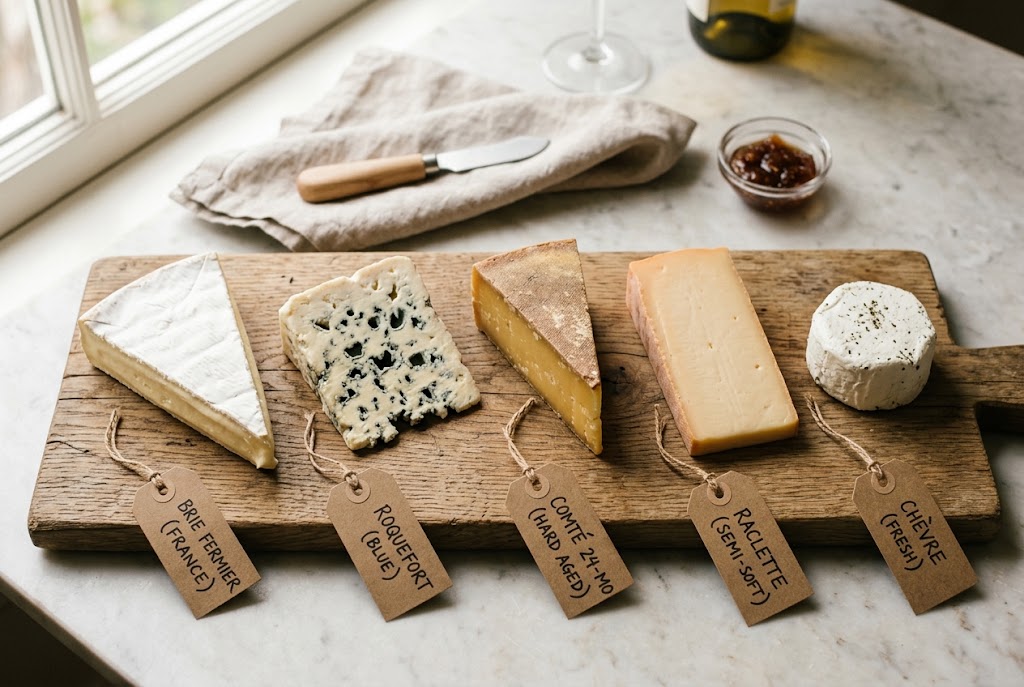
Types of Cheese for a Charcuterie Board: The Four-Texture Framework
The single most reliable framework for building a charcuterie cheese selection is texture. Not flavor profile, not origin, not milk type — texture first. When you have contrasting textures, you automatically have contrasting flavors, and the board becomes more interesting than any single-note selection of similar cheeses.
Quick Answer: Use four cheese textures: one soft or bloomy rind (brie, Camembert, triple-crème), one semi-firm (Gruyère, manchego, Havarti), one aged hard (aged cheddar, aged gouda, Parmigiano), and optionally one blue (Gorgonzola Dolce, Stilton, Roquefort). Three to four varieties total. This combination gives every guest something to reach for and creates the full range of flavor the board should deliver.
The Four-Texture Framework
Category 1: Soft and Bloomy
These are the creamy, spreadable cheeses with white Penicillium rinds. They're mild, accessible, and the first thing most guests reach for.
Best choices:
- Brie — mild, buttery, universally liked. The default soft cheese for any board.
- Triple-crème brie — enriched with cream, even richer than standard brie. Pairs with sparkling wine and honey.
- Camembert — earthier and more mushroom-forward than brie. Better as a featured centerpiece than as one of four cheeses.
- Fresh chèvre — tangy, spreadable, made from goat's milk. A different flavor profile than the Penicillium-rind cheeses.
Role on the board: Mild anchor, approachable starting point, pairs with honey, fig jam, and fruit.
Amount: 2–3 oz per person of this category.
Category 2: Semi-Firm
Cheeses with moderate firmness, often nutty or milky in flavor. These are the workhorses of the board — versatile, crowd-pleasing, and excellent with both meats and crackers.
Best choices:
- Gruyère — nutty, slightly sweet, excellent with everything. A Swiss classic.
- Manchego — Spanish sheep's milk, firm and slightly salty with a distinctive rind. Pairs with quince paste.
- Havarti — mild, creamy, very approachable. Good for boards with less adventurous guests.
- Comté — French mountain cheese with deep complexity at longer aging. Not quite semi-firm when young, but more accessible than fully aged versions.
- Fontina — Italian, semi-soft, mild and slightly funky. Good for boards with Italian character.
Role on the board: Versatile middle ground, pairs with most meats and condiments, visually interesting when sliced (Manchego's herringbone rind is distinctive).
Category 3: Aged Hard
The crystalline, intensely flavored cheeses that anchor the bold end of the board. These pair with big red wines, full-flavored cured meats, and the more assertive condiments.
Best choices:
- Aged cheddar — sharp, crystalline, universally familiar. The reliable anchor.
- Aged gouda (belegen or overjarig) — caramel and butterscotch from the Maillard reaction. The most distinctive aged choice.
- Parmigiano-Reggiano — the highest-glutamate cheese on most boards. Deeply savory, slightly granular, excellent shaved or broken into chunks.
- Pecorino Romano — sharp, salty, sheep's milk. More assertive than Parmigiano.
- Mimolette — French orange-hued aged cheese with a caramel-and-nut flavor that's striking both visually and on the palate.
Role on the board: Bold flavor anchor, pairs with full red wine, aged salami, grain mustard, and dried fruit.
Category 4: Blue (Optional but Powerful)
Blue cheese is the most divisive category and the most interesting. Use it when the board's audience can handle intensity.
Best choices:
- Gorgonzola Dolce — creamy, mild, the most approachable blue. Best for mixed or uncertain crowds.
- Stilton — crumbly, walnut-forward, the best winter blue. The English classic.
- Roquefort — sharp, complex, sheep's milk. AOC-protected French blue from limestone caves.
- Maytag Blue — American blue, slightly milder than Roquefort, excellent with honey.
Role on the board: Bold, assertive element that makes everything adjacent taste more interesting by contrast. Always pair with honey nearby.
How to Build the Selection
For a general board (4–8 guests):
- 1 soft/bloomy
- 1 semi-firm
- 1 aged hard
- Optional: 1 blue
For a crowd-friendly board: Replace the blue with a second semi-firm that's familiar (Havarti or Comté).
For an adventurous or wine-pairing board: Include the blue and consider a more unusual aged hard — aged gouda or Mimolette instead of cheddar.
For a small board (2 people): Two cheeses: one soft, one aged. Contrast over variety at this scale.
Placement Logic
Place the four cheeses as anchors first — in corners or quadrants of the board. The soft cheese goes near the fruit and honey; the aged hard goes near the mustard and cornichons; the blue goes on one end with honey adjacent.
Meats, condiments, and crackers fill the space between the cheese anchors. The cheese placement determines the flow of the board.
Building more boards? The Charcuterie Lab ebook walks through 50 boards across every occasion — each one with exact quantities, a shopping list, and the science behind why it works.
The Charcuterie Lab Takeaway
Build your cheese selection around the four-texture framework: soft, semi-firm, aged hard, and optionally blue. Three to four varieties total. Each category brings a different flavor register, pairing profile, and textural experience — the combination is more interesting than any collection of similar cheeses. Place them as anchors first, then build the rest of the board around them.
FAQ
How many types of cheese should be on a charcuterie board? Three to four cheese varieties covers the ideal range for most boards. One soft or bloomy (brie, Camembert), one semi-firm (Gruyère, manchego, Havarti), one aged hard (aged cheddar, aged gouda, Parmigiano), and optionally one blue (Gorgonzola, Stilton, Roquefort). Four textures create variety without overwhelming guests.
What is the best soft cheese for a charcuterie board? Brie and triple-crème brie are the strongest choices — creamy, mild, and accessible to nearly every guest. Camembert is earthier and more distinctive, better used as a featured centerpiece. Fresh chèvre works well as a spreadable, tangy soft option with a different flavor profile than the bloomy rinds.
What aged cheese works best on a charcuterie board? Aged cheddar, aged gouda, and Parmigiano-Reggiano are the most versatile aged hard cheeses. Aged cheddar is sharp and crystalline — familiar, universally liked. Aged gouda has caramel Maillard notes that pair with sweet accompaniments. Parmigiano-Reggiano's glutamate richness makes it the most umami-forward option.
Does a charcuterie board need blue cheese? No — blue cheese is optional. It adds bold, assertive flavor that not all guests enjoy. If you include it, use 1–2 oz per person (a small amount goes a long way) and place it on one end of the board with honey adjacent. Gorgonzola Dolce is the most approachable blue for mixed crowds.
How much cheese should each person get on a charcuterie board? Plan 2–3 oz of total cheese per person for an appetizer board. For a board serving as a meal, increase to 4–5 oz total. Distribute across your cheese selection — don't buy 3 oz of one cheese for a guest; buy 1 oz of three varieties so they experience the range.