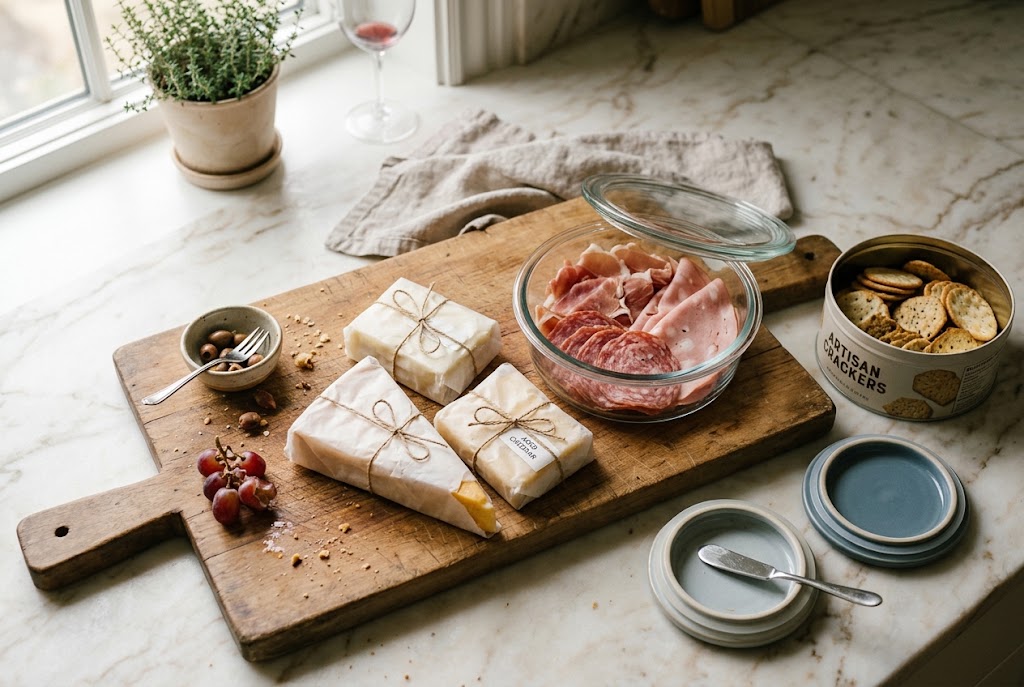
How to Store Charcuterie Board Leftovers
What to Save and What to Discard
Not everything on a charcuterie board is worth saving. The first decision after a board is deciding what to carry forward.
Save:
- Cheese (all types, if properly wrapped promptly)
- Unopened or lightly used cured meats
- Whole nuts (almonds, walnuts) — these are stable
- Condiments (return jams, honey, mustard to their jars)
- Any whole fruit that hasn't been cut
Discard:
- Crackers and bread that have been sitting out — these absorb humidity and go soft
- Cut fruit that sat out more than 30 minutes — oxidation and texture degradation makes them unpleasant
- Soft cheese that's been at room temperature more than 2 hours
- Any meat that dried significantly at the edges or was handled extensively
The core principle: err toward saving cheese and meats, which hold well, and err toward discarding anything starchy or fresh that was exposed to air.
How to Store Cheese
Cheese is the element most worth saving and the one most often stored incorrectly.
The two-layer rule: Wrap each cheese individually in parchment or cheese paper first, then loosely in plastic wrap or beeswax wrap. The inner layer (parchment) allows the cheese to breathe and prevents trapped moisture that accelerates unwanted mold. The outer layer (plastic or beeswax) keeps the cheese from drying out in the refrigerator environment.
Never wrap cheese in only plastic film. The trapped moisture creates anaerobic conditions that encourage off-flavors and the wrong molds, particularly in soft-rind cheeses like brie.
Different cheeses, different considerations:
Hard aged cheeses (Parmigiano, aged cheddar, Manchego Viejo): The most forgiving to store. Wrap in parchment and store up to 5–7 days. Surface mold can develop — trim it away and the interior is typically fine.
Semi-firm cheeses (Manchego Curado, Gouda, young Provolone): Store up to 4–5 days in parchment. Keep the cut surface covered.
Soft-rind cheeses (Brie, Camembert): Most time-sensitive. Store in parchment, consume within 2 days. After that the rind can become overly ammoniac and the interior loses structure.
Fresh cheeses (chèvre, fresh mozzarella, burrata): 1–2 days maximum. Fresh mozzarella and burrata should be stored in their liquid (water or whey); burrata rarely survives overnight without quality loss.
Refrigerator placement: Store cheese in the vegetable drawer or the warmest zone of the refrigerator (typically the top shelf if the refrigerator has bottom freezer configuration). The coldest zone (nearest the back of the bottom shelf) is too cold and accelerates moisture loss.
How to Store Cured Meats
Cured meats that haven't been opened (still in their packaging) can return to the refrigerator in their original packaging. Opened packages and any meat that was plated on the board need different handling.
Opened or plated meats: Transfer to an airtight container or wrap tightly in plastic wrap. Avoid folding multiple meat types together — prosciutto will absorb the flavors of a spiced salami within a few hours. Store each meat type separately.
Timing: Consume within 3–4 days. Prosciutto and bresaola are the most time-sensitive once opened — their high moisture content relative to hard salamis means they degrade faster. Hard salamis (Genoa, soppressata) hold up to 5 days properly wrapped.
Signs a cured meat has turned: A sour or rancid smell, excessive surface sliminess, or a color shift to gray-brown rather than the original red-pink. Surface white spots on hard salami are typically salt crystallization — this is not spoilage.
How to Store Crackers and Condiments
Crackers and bread: Do not refrigerate. The cold, humid refrigerator environment is the worst place for crackers — they'll go soft within hours. Store at room temperature in a sealed zip-lock bag or airtight container. They'll hold 2–3 days in good condition.
Jams, fig jam, honey: Return to their original jars and store according to the manufacturer's guidance. Most commercial jams return to the refrigerator after opening. Honey stores at room temperature indefinitely.
Mustard: Return to jar, refrigerate. Holds months.
Fresh accompaniments (fruit, vegetables): Best consumed same-day once cut. Uncut fresh fruit (whole strawberries, uncut pear) stores 2–3 days refrigerated in a separate container from cheese and meats.
How Long Leftovers Last
| Element | Storage Method | Duration |
|---|---|---|
| Hard aged cheese | Parchment + plastic, refrigerator | 5–7 days |
| Semi-firm cheese | Parchment + plastic, refrigerator | 4–5 days |
| Soft-rind cheese | Parchment, refrigerator | 2 days |
| Fresh cheese | Original liquid, refrigerator | 1–2 days |
| Hard salami | Airtight container, refrigerator | 5 days |
| Prosciutto / bresaola | Airtight container, refrigerator | 3–4 days |
| Crackers | Room temperature, sealed bag | 2–3 days |
| Jam / condiments | Original jar, per label | Weeks–months |
| Cut fresh fruit | Refrigerator, covered | 1 day |
What to Do With Charcuterie Board Leftovers
The best leftovers from a board have a natural second life:
Cured meats + eggs: Prosciutto, salami, or coppa in scrambled eggs or a frittata. Bresaola on toast with arugula and olive oil.
Hard cheese + pasta: Grate remaining Parmigiano or aged cheddar into pasta. Manchego melts reasonably well into quesadillas.
Soft cheese + toast: Chèvre or brie spread onto toast with leftover honey is one of the better breakfasts that comes out of board leftovers.
Mixed board leftovers: A flatbread pizza with leftover salami, cheese, and olives works with almost any combination of board leftovers. Fifteen minutes in a hot oven.
Building more boards? The Charcuterie Lab ebook covers 50 complete boards — each with exact quantities so you buy only what you need and minimize what's left over.
Common Mistakes
Storing cheese in only plastic wrap. Plastic traps moisture and creates the wrong conditions for both hard and soft cheeses. Always use parchment as the inner layer.
Refrigerating crackers. They go soft immediately. Room temperature in a sealed bag is always the correct approach.
Storing different meats together. Prosciutto will take on the flavor of spiced salami within hours. Separate containers for each meat type.
Waiting too long to wrap leftovers. Every hour a cut cheese sits uncovered accelerates dehydration and surface oxidation. Wrap within 30 minutes of finishing the board.
The Charcuterie Lab Takeaway
Most charcuterie board leftovers are worth saving, but only if stored correctly immediately after the board is cleared. Cheese in parchment, meats in separate airtight containers, crackers at room temperature, condiments back in their jars. Hard cheeses last nearly a week; fresh cheeses need to be used the next day. The leftovers from a good board are worth the 10 minutes of proper storage — they'll produce at least one strong weekday meal.
FAQ
How long do charcuterie board leftovers last in the refrigerator? Hard cheeses last 3–5 days wrapped properly in parchment then plastic. Soft cheeses (brie, chèvre) are best within 2 days. Cured meats last 3–4 days in an airtight container. Fresh fruit and raw vegetables should be consumed within 1 day. Crackers don't refrigerate well — keep them at room temperature in a sealed bag.
How do you store cheese from a charcuterie board? Wrap each cheese individually in parchment paper first, then loosely in plastic wrap or beeswax wrap. The parchment lets the cheese breathe without drying out. Never wrap cheese in only plastic — it traps moisture and accelerates unwanted mold. Store in the warmest part of the refrigerator (the vegetable drawer) rather than the coldest zone.
Can you freeze leftover charcuterie board items? Cured meats can be frozen with moderate success — texture changes slightly but flavor holds. Hard cheeses (Parmigiano, aged cheddar) freeze adequately when crumbled, but whole blocks become crumbly after thawing. Soft cheeses (brie, chèvre) do not freeze well — the texture breaks down completely. Crackers and fresh accompaniments should not be frozen.
What can you do with leftover charcuterie board ingredients? Cured meats work well in scrambled eggs, pasta, or flatbreads. Leftover hard cheese (Parmigiano, cheddar) grates into pasta or soups. Soft cheese (chèvre, brie) spreads onto toast or melts into a simple sauce. Most leftover board elements translate well into a strong weekday breakfast or quick lunch without much additional effort.
Should you store different charcuterie items together? No — store each element separately. Cheeses absorb odors from cured meats readily; a mild brie left in the same container as spicy salami will take on its flavors within hours. Condiments go back in their original jars. Crackers store separately from everything else at room temperature. Separation is the key rule for maximizing leftover quality.