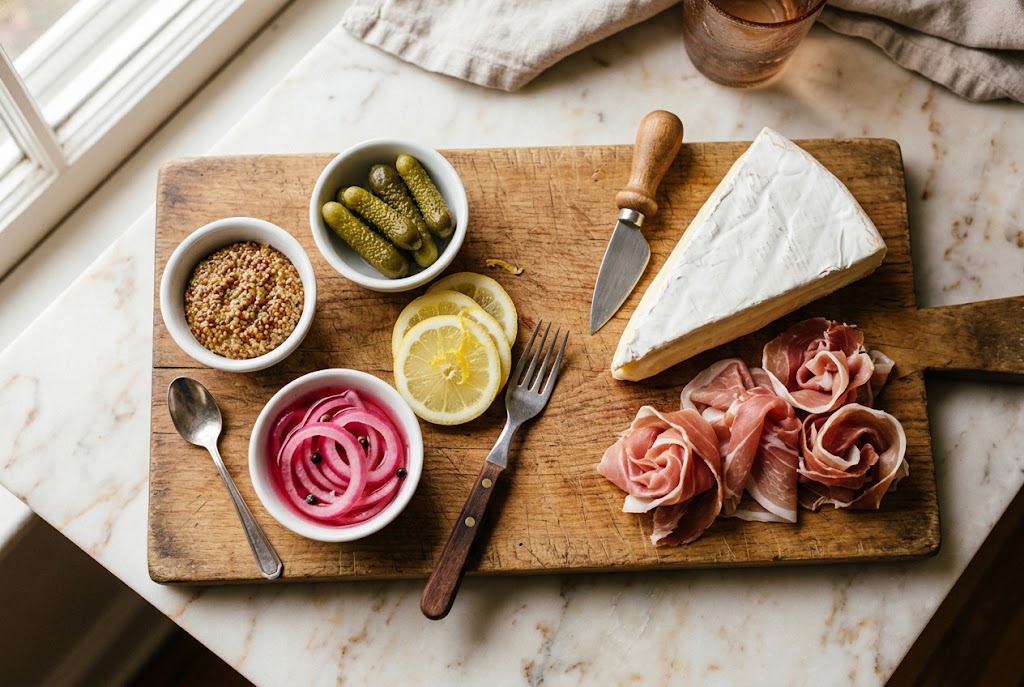
Why Acidic Elements Reset the Palate on a Charcuterie Board
The cornichon is the most underestimated element on a charcuterie board. Most people think of it as garnish — something briny and small that fills the gaps. It is actually doing physiological work that makes every subsequent bite of cheese and meat taste better than it would without the interruption.
The mechanism is palate reset, and understanding it explains why every well-built board needs an acidic element distributed throughout — not clustered in a corner.
The Problem: Palate Fatigue from Fat and Salt
Rich foods cause a specific form of sensory adaptation. As you eat fatty, salty foods — cured meats, aged cheeses, crackers — several things happen in sequence:
Fat coats the palate. Triglycerides and phospholipids from fat form a film across taste receptor cells and the surfaces of the mouth. This lipid coating physically reduces the contact between flavor compounds and taste receptors. Subsequent bites of the same food taste less intense — not because the food changed, but because your palate's ability to register it has decreased.
Sensory-specific satiety engages. The brain habituates to repeated flavor signals and downregulates their perceived intensity. Continued eating of the same food produces diminishing returns in perceived flavor.
Salt receptor sensitivity decreases. Continued sodium exposure desensitizes ENaC (the epithelial sodium channels) involved in salty taste perception. The same prosciutto tastes less salty on the fifth bite than it did on the first.
The combined effect: after several bites of rich, salty charcuterie and aged cheese, the palate is coated, habituated, and partially desensitized. This is palate fatigue — and it's why the seventh bite of prosciutto doesn't taste as good as the first.
What Acid Does
Acidic foods work against palate fatigue through several mechanisms:
Acid stimulates salivation. Acidity activates sour taste receptors (ASIC and OTOP1 channels on type III taste cells) which triggers a strong salivary response. Saliva physically washes the lipid coating from taste receptor cells — the fat film that was blunting your perception is mechanically removed. The receptor surface is restored.
Acid denatures fat film. At low pH, the lipid coating on mucosal surfaces is disrupted directly. Acids break down the organized fat layer through chemical interaction with the phospholipid components.
Acid resets sodium sensitivity. The pH shift from acidic foods triggers a partial reset of the ENaC channels. Salty foods taste saltier again after an acidic interlude.
Tannin washing: Some acidic elements (red wine, certain fruit) also contain tannins. Tannins bind to the salivary proteins (proline-rich proteins and mucins) that carry the flavor compounds of rich foods. Tannin binding clears the palate of those protein-bound flavor compounds, creating a cleaner baseline.
The net effect: a single cornichon, briny grape, or bite of whole-grain mustard restores palate sensitivity enough for the next bite of prosciutto to taste like the first one again.
The Elements That Do This Best
Cornichons: Small French gherkins pickled in white wine vinegar. High acidity (the vinegar), briny salt, and a firm texture that mechanically scrubs the palate. The strongest palate reset on a standard board. One or two between richer bites.
Grapes: Contain tartaric and malic acid — the same acids found in wine. The acidity resets the palate gently. The skin tannins do additional flavor-compound washing. Grapes distributed throughout the board (not only clustered at the corners) mean guests naturally encounter a reset before approaching the next section of cheese or meat.
Whole-grain mustard: The acetic acid from the vinegar base provides a sharp reset, and the pungent sinigrin compounds (from mustard seeds) provide an additional olfactory reset — clearing the nasal passage of lingering aromatics. Use it as a condiment near the meats specifically.
Pickled peppers or pepperoncini: Higher in acidity than cornichons, with the addition of capsaicin triggering blood flow and clearing sensation. More aggressive reset for boards heavy in fat and aged cheese.
Olives: The brine provides acidity and salt; the oil in the olive provides fat, which is paradoxical — but the acid of the brine does enough work. Castelvetrano olives are milder; Cerignola or Sicilian olives are more assertive.
Fruit vinegars and condiments: Aged balsamic applied to cheese or burrata provides a concentrated acid hit that performs a targeted palate reset in that specific bite. Cranberry sauce on a holiday board serves the same function at scale.
Board Application
Distribute acid throughout the board, not in a single bowl. A cornichon bowl tucked in one corner is accessible to guests who notice it and unreachable to guests grazing elsewhere. The result is uneven palate reset: some guests get the benefit, others don't.
Better: cornichons in a bowl at the center or distributed in two small bowls at opposite ends; grape clusters anchoring multiple corners; a second fruit option (sliced pear, apple) scattered into the gaps. Whole-grain mustard near the meat section. Every section of the board should have an acidic element within reach.
Size the acid appropriately. A large bowl of cornichons next to a small amount of cheese creates proportion problems — the board looks like a pickle board with cheese accompaniments. Small bowls, moderate quantities, distributed.
The sequence suggestion: For formal serving, you can describe the acid elements explicitly: "The cornichons are there as a palate reset — take one between bites of the richer cheeses and the prosciutto." Most guests have never been told what the cornichon is doing. Naming it changes how they use it.
More pairing science: charcuterielab.com Subscribe to the Charcuterie Lab Report: charcuterie-lab-report.beehiiv.com
FAQ
What is acid contrast in charcuterie? Acid contrast is the pairing principle where a high-acid food (cornichons, mustard, tart fruit, pickled vegetables) is placed alongside a rich, fatty, or salty food to cleanse the palate between bites. The acid stimulates salivation and cuts through fat, making each subsequent bite taste as vivid as the first.
Which acidic elements work best on a charcuterie board? Cornichons and other pickled vegetables offer the sharpest, most immediate acid hit. Whole-grain mustard provides moderate acidity with added aromatic complexity. Tart fruits (green apple, unripe grapes, citrus segments) contribute natural fruit acids (malic, citric) with sweetness. Pickled grapes or pickled cherries are more unusual but highly effective. Each works through the same acid-fat contrast mechanism.
Can you have too much acid on a board? Yes — a board where every accompaniment is acidic becomes monotonous and fatiguing in the opposite direction. Acid should function as punctuation, not the primary content. Balance acidic elements with sweet anchors (honey, jam) and neutral crackers that reset the palate without adding a flavor dimension.
Does wine's acidity serve the same palate-cleansing function? Yes — this is one of the reasons wine and charcuterie pair well together. Wine's acidity performs the same palate-cleansing function as cornichons or tart fruit. This is also why high-acid wines (Riesling, Barbera, Champagne) tend to pair better with rich charcuterie than low-acid, heavily oaked wines that can amplify the heaviness.