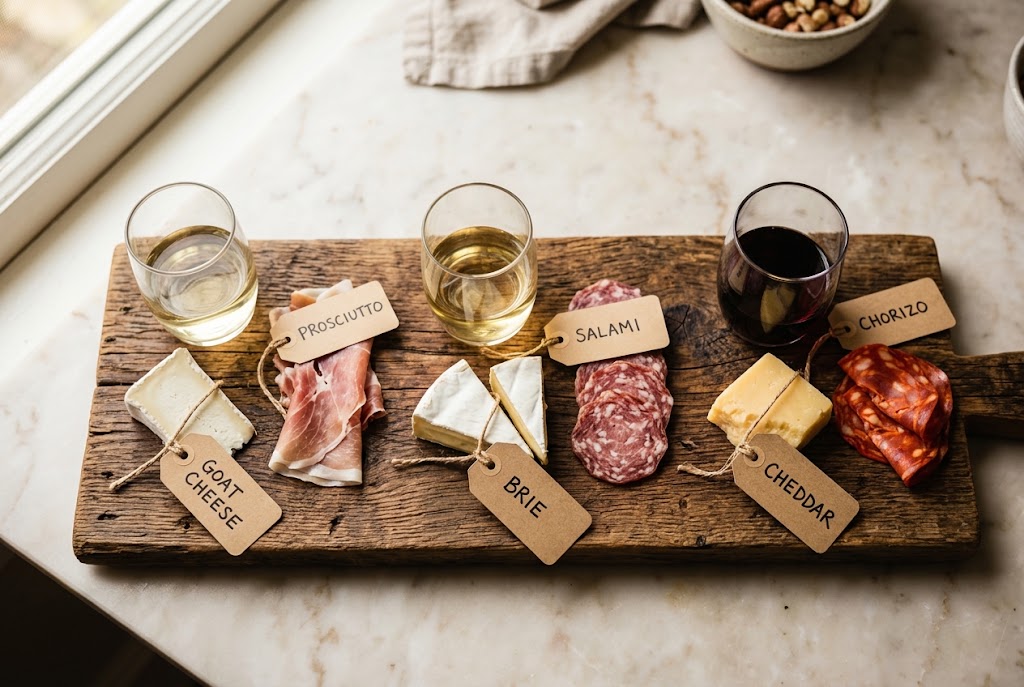
Wine and Charcuterie Pairing Guide
Quick Answer
The best wine for a charcuterie board is dry rosé — it has the acidity to cut through fat, enough fruit to work with sweet condiments, and low tannin that won't clash with any element on the board. If you're choosing one bottle, choose rosé.
For specific pairings: Fino sherry with jamón ibérico, Pinot Noir with bresaola, white Burgundy with aged Comté, Barolo or Barbaresco with coppa or prosciutto.
Wine and charcuterie work together through the same underlying mechanisms as all food pairing — fat buffering tannins, acid refreshing the palate, aromatic compound echoes between food and wine. Understanding these mechanisms makes specific pairing choices obvious rather than arbitrary.
Why Rosé Is the Universal Board Wine
Dry rosé has three characteristics that make it uniquely versatile for charcuterie boards:
Acidity. Rosé retains the acidity of red wine grapes without the tannin load. This acidity cuts through fat (the primary flavor compound in most charcuterie) and resets the palate between bites, performing the same function as cornichons or grapes.
Fruit profile. The red fruit flavors in dry rosé (strawberry, raspberry, watermelon in Provençal styles) echo the natural sweetness in prosciutto and aged cheese, creating a compound-echo pairing rather than simple contrast.
Low tannin. Without significant tannin, rosé doesn't clash with any element on the board. High-tannin reds require fatty, salty meats to buffer the astringency — without that buffer they taste harsh. Rosé requires nothing; it works beside any cheese or meat.
Best style for boards: Provençal rosé (Grenache, Mourvèdre, Cinsault blends). Dry, mineral, pale pink, with crisp acidity. Avoid off-dry or "blush" rosé — residual sugar is not useful here.
The Red Wine Problem (and Solution)
Red wine and charcuterie is a complicated pairing because tannins require management. Tannins bind to proline-rich salivary proteins and create the drying, astringent sensation — pleasant in the right context (a fatty Barolo with fatty prosciutto) and unpleasant in the wrong one (a tannic Cabernet with lean bresaola).
The rule: match tannin level to fat level in the meat.
| Wine | Tannin | Pair with |
|---|---|---|
| Barolo, Barbaresco | High | Fatty prosciutto, coppa, lardo |
| Chianti, Sangiovese | Medium | Prosciutto, salami, soppressata |
| Pinot Noir, Dolcetto | Low | Bresaola, lighter whole-muscle meats |
| Beaujolais (Gamay) | Very low | Almost any charcuterie |
A board with multiple meats is best with a medium-tannin, medium-body red — something like Chianti Classico or Sangiovese-based wines. If the board is prosciutto-forward (fatty, salty), it can take a bolder tannin structure.
White Wines
White wines are an underrated board choice. Their acidity works for fat-cutting, their mineral character pairs with aged cheeses, and they don't require tannin management.
White Burgundy (Chardonnay): The classic pairing for Comté and Gruyère. The mineral and nutty characteristics of aged alpine cheeses echo the oxidative/nutty notes in white Burgundy. Medium-to-full body handles the fat of aged cheese and whole-muscle meats.
Chablis or unoaked Chardonnay: Sharper acidity, lower body. Best with prosciutto and fresh cheeses. The high acidity cuts through prosciutto fat effectively.
Sauvignon Blanc: The herbal, grassy notes in Sauvignon Blanc create a compound echo with the herbal cure spices in some salamis (finocchiona's fennel, certain coppa preparations). Also works beside fresh chèvre — a classic pairing where the wine's citrus and herb notes mirror the cheese's tang.
Fino or Manzanilla Sherry: The best match for jamón ibérico on a board. The nutty, saline, oxidative character of Fino Sherry matches the nutty sweetness and ocean-mineral quality of long-cured jamón at the compound-echo level. One of the great pairings in Spanish food culture.
Sparkling Wine
Sparkling wine works with charcuterie boards because carbonation performs palate-clearing work mechanically. The bubbles scrub fat from the palate surface, performing a version of the acid-reset function.
Champagne or Cremant: High acidity + bubbles = maximum fat-cutting. Excellent beside fatty whole-muscle meats (prosciutto, coppa) and rich soft cheeses. The toasty, bready notes in aged Champagne create aromatic echoes with aged rinds.
Prosecco: Lower acidity, more fruit-forward, slightly off-dry in many versions. Works with milder boards — prosciutto and fresh mozzarella, Brie, fruit-forward condiments. The approachable profile makes it a crowd-pleaser.
Franciacorta (Italian sparkling): The Italian equivalent of Champagne method, from Lombardy. Traditional with Taleggio and northern Italian charcuterie (speck, bresaola).
Specific Pairing Quick Reference
| Pairing | Why it works |
|---|---|
| Fino sherry + jamón ibérico | Oxidative/nutty echo; saline mineral match |
| Barolo + coppa or prosciutto | Tannin buffered by fat; both aged and complex |
| Pinot Noir + bresaola | Low tannin matches lean meat; red fruit echoes |
| White Burgundy + aged Comté | Nutty/mineral echo; oak echo with Comté's depth |
| Sauvignon Blanc + finocchiona | Herbal echo with fennel; citrus vs. pork sweetness |
| Dry rosé + any board | Universal: acidity + fruit + no tannin clash |
| Chablis + prosciutto | Sharp acidity cuts through fat cleanly |
| Beaujolais + salami | Low tannin, red fruit, approachable |
More pairing guides: charcuterielab.com Subscribe to the Charcuterie Lab Report: charcuterie-lab-report.beehiiv.com
FAQ
What wine goes with charcuterie? No single wine pairs with every element on a charcuterie board — the key is choosing a wine that works with the dominant flavors. For boards with soft, creamy cheeses: crisp whites (Sauvignon Blanc, Chablis). For boards with bold aged cheeses: medium reds (Pinot Noir, Grenache). For boards with blue cheese: sweet wines (Sauternes, Port, Banyuls). Sparkling wine works with virtually everything.
Is red or white wine better with charcuterie? White wine is more reliably compatible with a full charcuterie board. White wine's acidity cuts through fat effectively, and it lacks the tannins that can clash with cheese. Light, high-acid whites (Sauvignon Blanc, Riesling, Pinot Grigio) pair with the broadest range of board elements. Red wine works specifically with aged, bold cheeses and certain cured meats — it's a targeted pairing rather than a universal one.
What wine pairs with prosciutto? Prosciutto's delicate sweetness and soft fat pair best with light, crisp wines: Pinot Grigio, Prosecco, a dry Riesling, or a light Pinot Noir. The wine should be delicate enough not to overwhelm prosciutto's subtle flavor — the meat is delicate and requires a wine with similar restraint.
What is the best wine to serve with a charcuterie board for a large group? One or two crowd-pleasing, universally compatible wines: a crisp white (Pinot Grigio, Sauvignon Blanc) and a light red (Pinot Noir, Grenache), or a bottle of sparkling wine that works across the board. Offering too many options (4–5 wines) creates confusion and takes focus away from the food. Two well-chosen bottles cover the full spectrum.
Does expensive wine pair better with charcuterie? Not necessarily. The pairing qualities that matter — acidity, balance, appropriate intensity — appear across all price points. A $12 Muscadet or Grüner Veltliner pairs more effectively with many charcuterie elements than a $50 oaky Chardonnay. Focus on the wine's structural characteristics, not its price tag, when selecting a pairing.